
MBPT Calculations of Energy Levels for 1s2 and 1snl (N=2-5) Configuration of Helium Like Lithium Ion
Soumaya Manai1,3 , Sirine Ben Nasr1,2 , Dhia Elhak Salhi1,2 and Haikel Jelassi1*
1Laboratory on Energy and Matter for Nuclear Sciences Development, LR16CNSTN02, National Centre for Nuclear Sciences and Technologies, Sidi Thabet Technopark 2020 Ariana, Tunisia .
2Faculty of Sciences of Tunis, University of Tunis El Manar Tunis, Tunisia .
3Faculty of Sciences of Bizerte, University of Carthage, Tunisia .
http://dx.doi.org/10.13005/OJPS04.02.03
Copy the following to cite this article:
Manai S, Nasr S. B, Salhi D. E, Jelassi H. MBPT Calculations of Energy Levels for 1s2 and 1snl (N=2-5) Configuration of Helium Like Lithium Ion. Oriental Jornal of Physical Sciences 2019; 4(2).
DOI:http://dx.doi.org/10.13005/OJPS04.02.03Copy the following to cite this URL:
Manai S, Nasr S. B, Salhi D. E, Jelassi H. MBPT Calculations of Energy Levels for 1s2 and 1snl (N=2-5) Configuration of Helium Like Lithium Ion. Oriental Jornal of Physical Sciences 2019; 4(2). Available From: https://bit.ly/3gRVjWn
Download article (pdf) Citation Manager Publish History
Introduction
Many parameters of atomic data such as energy levels, weighted oscillator strengths and radiative rates are required for many ions of the sequence He-like1-5 to estimate the power loss from the impurities in the forthcoming International Thermonuclear Experimental Reactor ITER project.6
Several studies for the second member of the helium isoelectronic sequence Li II have been performed. Experimentally, Cantu et al.,7 have detected many lines of Li II in the 160–215Å range in laboratory plasmas. Energy levels, wavelengths and transitions probabilities are compiled and published in the NIST database.8 In the theoretical side, Schiff et al.,9 have calculated oscillator strengths for members of the helium isoelectronic sequence up to Z = 10. Drake10 has presented oscillator strengths for some dominant transitions of helium and helium-like ions using the Hylleraas-Scherr-Knight variation-perturbation method. Anderson and Weinhold11 have presented dipole oscillator strengths of the low-lying singlet and triplet transitions in He and Li II using Hylleraas-type wave functions. Kono and Hattori12 have calculated non relativistic oscillator strengths for the transitions n ≤ 5 in helium-like ions with Z = 3-7. Theodosiou13 has calculated the Rydberg state lifetimes and oscillator strengths for the s-p and p-d transitions in the singly ionized lithium using Hylleraas-type wave functions. Sow et al.,14 have performed a calculation of the energy levels of atoms and ions with 2 ≤ Z ≤ 15 using a Hyllerass approximation. Aggarwal et al.,15 have calculated energy levels, lifetimes, wavelengths, weighted oscillator strengths and transitions rates of helium-like lithium up to n = 5.
Thus, in this paper, we just focus on calculations of the singly excited energy levels for He-like-Li for configurations 1s2 and 1snl (n=1-5, l=0-4). Our target in this work is to extend the calculation and present a complete and accurate data for this ion. For this purpose, we employ three approaches implementing in the code FAC of Gu16 namely: standard calculation of FAC, Relativistic Configuration Interaction (RCI) and Many Body Perturbation Theory (MBPT). Also, important quantum corrections such Breit interactions and quantum electrodynamics (QED) effects have been added. Supplementary minor corrections of energies such as Vacuum Polarization and Self Energy of electrons have also been included. In order to reach higher accuracy, both calculations RCI and MBPT are performed using an extended atomic basis including levels belonging to complexes till n=21. Our results are compared with available other experimental and theoretical results. This computational approach enables us to present a consistent and improved data set of all important levels of these ions spectra, which are useful for identifying transition lines in further investigations.
Theoretical method
Relativistic Configuration Interaction
The configuration-interaction (CI) method which is based on the variational principle represents one of the approaches for treating many-electron systems. Non-relativistic CI techniques have been used extensively in atomic and molecular systems calculations. However, the generalization to relativistic configuration-interaction (RCI) calculations also presents theoretical as well as technical challenges. The problem originates from the many-electron Dirac Hamiltonian commonly used in RCI calculations:

Where h0 = cα.p + (β ̶ 1)c2 + Vnuc (r) is the one-electron Dirac Hamiltonian with the rest mass of the electron subtracted out, Vc (ij) + 1/rij is the Coulomb interaction between the electrons, and VB (ij) = bij is the frequency dependent/independent Breit interaction.
The RCI methods starts thus from the eq 1. The configuration mixing approximation is used to calculate the bond states system with a specific mixing scheme. The local central potential is derived by a modified self-consistent Dirac-Fock-Slater iteration. Then, the derived local central potential is used to derive the radial orbitals for the construction of basis states. Through the diagonalization of the relativistic Hamiltonian, a correction procedure is applied to reduce errors in energy levels. For an ion with N electrons, relativistic Hamiltonian is constructed by summing over the single electron Dirac Hamiltonian due to contributions of the nuclear charge potential and the electron-electron interaction potential.
Second-order Many Body Perturbation Theory
The MBPT approach starts from the Rayleigh-Schrödinger perturbation theory of a multi-configurational model space. The perturbation expansion is considered to solve the Schrodinger equation:

In this model, the no-pair Dirac-Coulomb-Breit (DCB) Hamiltonian for an N-electron ionic system is given by :

Where ri is the radial coordinate of the electron i, rij is the distance between electrons i and j. hd(i) represents the Dirac Hamiltonian for one free electron and Bij is the Breit interaction. Z is the nuclear charge.
The HDCB Hamiltonian is split into H0 as a model Hamiltonian and V as a perturbation:
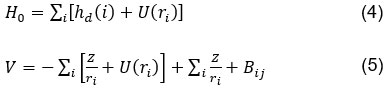
Where U(r) is a model potential including the screening effects of all electrons and which is approximated by a local central potential derived from a Dirac-Fock-Slater self-consistent field calculation. It should be chosen appropriately to make the perturbation potential V as small as possible.
The mean idea of the MBPT approach is to divide the Hilbert space of the full Hamiltonian into two orthogonal spaces mainly: M and N. In such model the M space represents a model space which contains the non-Hermitian effective Hamiltonian while N is a model space with perturbation expansion. The eigenvalues of this effective Hamiltonian yield the energy levels of the full Hamiltonian. Once applied, the multi-configuration interaction effects within the model space are exactly accounted for, but the interaction between the M and N model spaces is calculated by the perturbation method.
Results and Discussions
Computational Details
In this study, we interest on the 1s2, 1s2l, 1s3l, 1s4l and 1s5l configurations of He-like lithium which gives rise to the lowest 49 levels of the He-like-Li. For that purpose, we used the code FAC (Flexible Atomic Code) which is a fully relativistic code created by Ming Feng Gu.16 This code enables user to carry out large-scale computations and allows finding various atomic parameters. We employed the 1.1.4 version of the code, to perform three different calculations by modifying the CI scale: Standard FAC calculation, Relativistic Configuration Interaction (RCI) and Many Body Perturbation Theory (MBPT). The first calculation libeled “Standard FAC” calculation is implemented in FAC code by calling the complex from 1 to n=5 separately and one by one. In this case, the code proceeds to the diagonalization of the Hamiltonian of eq. 1 with not taking account any configuration interaction. For the next two approaches, i.e. “RCI” and “MBPT”, series of calculations have been performed with increasing amount of CI included with up to n = 5, which generate up to 49 lower energy levels of the considered ion.
The second calculation is based on the RCI method. In this frame, the electron correlations among the configurations included in the M model space are taken into account. In our case, the M space contains all complex up to n=21. The diagonalization of the Hamiltonian yields a total of 1627 values of energy levels for even and odd parity states with 0≤J≤5. But, we consider only the first 49 energy values target of this study.
Finally, we performed the MBPT calculations in which the 1s2, 1s2l, 1s3l, 1s4l and 1s5l are contained in the M space. In the other space, the N space contains all configurations generated by single/double excitations of the M space. For both single and double excitations, the configurations with n≤21 and l≤n-1 are included. In addition to the Hamiltonian HDBC, several higher order corrections such as finite nuclear size, Vacuum polarization and Self-energy are also included.
Obtained Energy Levels
In table A of appendix, we summarize our calculated level energies (in cm-1) obtained from standard FAC, RCI and MBPT methods for the lowest 49 levels of the He-like-Li. Within this table, we found theoretical calculations carried out by Aggarwal15 as well as experimental energies compiled by NIST.8 The energy levels performed by Aggarwal et al. were done using also the standard calculation of FAC code but they performed restricted calculations with reduced CI. Also, in figure 1, we plot, for 49 values, energy levels deduced from present Standard FAC, RCI and MBPT as well as values published by Aggarwal et al.,15 (Etheo) as function of experimental data (ENIST) found in the NIST data base.8 In figure 2, we performed a zoom out plot on the energy region 5.5x10⁵ to 6.0x105 cm-1. In order to better analyze our results, we add in figure 2 lines corresponding to equations y=x, y=x±5% and y=x±10%. For good understanding of our reliability and exactitude, we calculated relative differences (in percent) of different sets of energy levels. To do that, for each set of values we calculated the flowing quantity : %= 100 x Abs(ENIST- Etheo)/ ENIST. All percentage differences are calculated relatively to the experimental energies data complied within the NIST data base.8 Once done, we calculated the mean value and the standard deviation over the 49 obtained values: ï³ï€½ï³ave ï¤ï³. In table 1, we report ï³ for the four sets of energy values.
Discussion
According table A, our calculated energies level obtained using the three methods are generally in good agreement between each other’s. The discrepancy between them doesn’t exceed the 1% range. Data obtained with standard FAC procedure are consistently upper than the experimental ones by approximately ~8000 cm-1, but agree within 1.33%. With the same method, Aggarwal et al obtained data with discrepancy of 1.54 %. The use of the RCI method allows improvement of the energy levels determination. The 49 level energies values were decreased by approximately 3000 cm-1. Within this approach, we were able to reach the ~ 0.5% discrepancy range. The adoption of the MBPT approach significantly improves the values of the energy levels. The relative differences with the experimental values of NIST are considerably decreasing. The maximum difference relative to the NIST data becomes ~ 200 cm-1. The MBPT calculations allow us to reach the 0.06 % range expect for the 1s5p 1P1 level for which the percentage difference is 0.65 % (see the last point at the right of figure 2). It is important to highlight that this level is the origin of the large obtained standard deviation of ±0.12%. Even the results obtained by both RCI and MBPT are comparable this last level namely 1s5p 1P1 presents better energy value from RCI method than from the MBPT one.
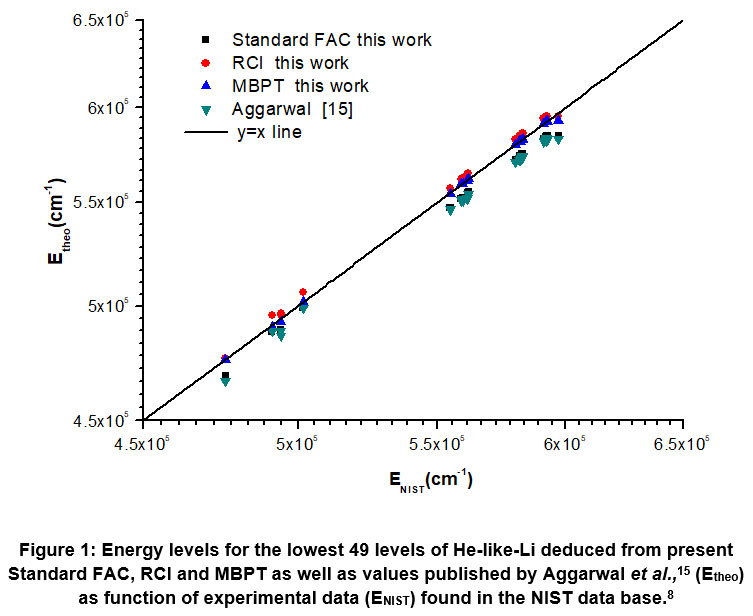 |
Figure 1: Energy levels for the lowest 49 levels of He-like-Li deduced from present Standard FAC, RCI and MBPT as well as values published by Aggarwal et al.,15 (Etheo) as function of experimental data (ENIST) found in the NIST data base.8 Click here to view Figure |
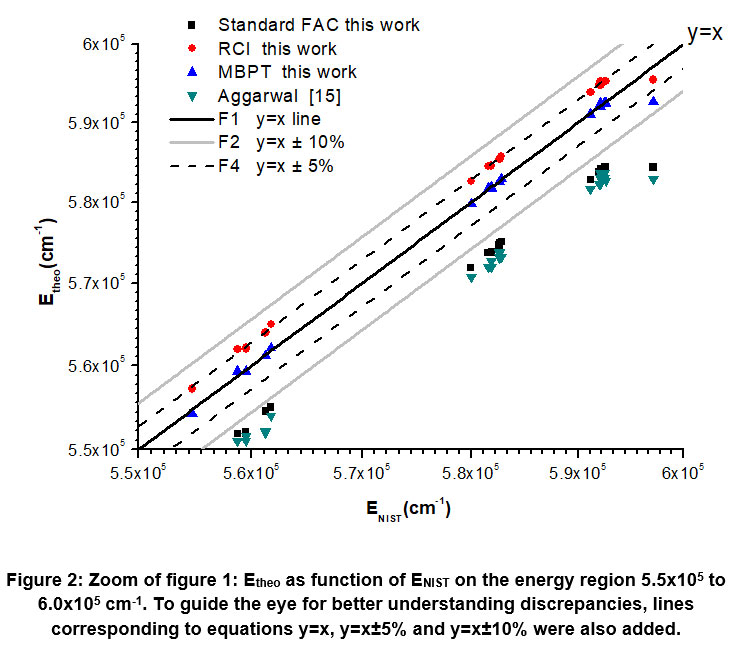 |
Figure 2: Zoom of figure 1: Etheo as function of ENIST on the energy region 5.5x10⁵ to 6.0x105 cm-1. To guide the eye for better understanding discrepancies, lines corresponding to equations y=x, y=x±5% and y=x±10% were also added. Click here to view Figure |
Table 1: Mean and standard deviation of relative differences in percent over 49 values of energy levels of He-like-Li for each method adopted in this work and by Aggarwal et al.,15 Relative differences were calculated according experimental values found in NIST’s database.8
|
Method or reference |
Mean of relative differences (in %) |
Standard deviation of relative differences (in %) |
|
Aggarwal et al.,15 |
1.54 |
±0.28 |
|
FAC our work |
1.33 |
±0.22 |
|
RCI our work |
0.47 |
±0.12 |
|
MBPT our work |
0.06 |
±0.12 |
Conclusion
In this paper, we have presented results for fine structure energy levels among the lowest 49 levels, for He-like-Li ion for the 1s2 and 1snl (n=2-5) configuration. The self-consistent-field approximation and the Breit interaction Hamiltonian as well as QED effects have been included in the calculations to improve the generated wave functions. Based on the experimental published results in NIST database, our energy levels are calculated using three methods, mainly standard FAC, RCI and MBPT are assessed to be accurate to better than 1.33%, 0.47% and 0.06%, respectively. Good agreements between our calculated wavelengths for Li II and the available NIST data reflects the quality of calculation of the wave-functions. Our results are useful for many applications such as controlled thermonuclear fusion, laser and plasma physics as well as astrophysics.
Acknowledgments
This work has been realized with the financial support of the Tunisian Ministry of Higher Education and Scientific Research.
References
- D. E. Salhi and H. Jelassi, Procedings of the 13th arab conference on the peaceful uses of atomic energy, 18-22 December 2016, Hammamet, Tunisia.
- D. E. Salhi and H. Jelassi, Can. J. Phys. 96(3) 343-352 (2018).
- D. E. Salhi and H. Jelassi, Orient. J. Phys. Sciences., 2 (2), (2017).
- D. E. Salhi, Pascal Quinet and H. Jelassi, Atomic Data and Nuclear Data Tables, Volume 126, Pages 70-157, (2018).
- S. Ben Naser, D. E. Salhi, Pascal Quinet and H. Jelassi, Atomic Data and Nuclear Data Tables Atomic Data and Nuclear Data Tables, Volume 129, Pages 101-279, (2019).
- O. Marchuk, G. Bertschinger, W. Biel, E. Delabie, M. G. von Hellermann, R. Jaspers, and D. Reiter, Review of Scientific Instruments 79, 10F532 (2008).
- A.M. Cantu, W.H. Parkinson, G. Tondello and G.P. Tozzi, J. Opt. Soc. Am. 67 1030 (1977)
- Kramida, A., Ralchenko, Yu., Reader, J. and NIST ASD Team (2019). NIST Atomic Spectra Database (version 5.7.1), [Online]. Available: https://physics.nist.gov/asd [Wed Oct 30 2019]. National Institute of Standards and Technology, Gaithersburg, MD. DOI: https://doi.org/10.18434/T4W30F.
- B. Schiff, C.L. Pekeris, Y. Accad, Phys. Rev. A 4, 885 (1971)
- G.W.F. Drake, Phys. Rev. A 5, 614 (1972)
- M.T. Anderson, F. Weinhold, Phys. Rev. A 9, 118 (1974)
- A. Kono, S. Hattori, Phys. Rev. A 30, 2093 (1984)
- C.E. Theodosiou, Phys. Scr. 32, 129 (1985)
- B. Sow and M. Sow and Y. Gning and A. Traore and A.S. Ndao and A. Wague, Radiation Physics and Chemistry, 123 (2016) 25-30.
- K M Aggarwal, T Kato, F P Keenan and I Murakami, Phys. Scr. 83 015302 (2011).
- M.F. Gu, Revue canadienne de physique, 86(5): 675-689 (2008)
Appendix
Table A. Energies (cm-1) for the lowest 49 levels of He-like-Li calculated using three different approaches implemented in FAC code. For comparison, results extracted from the theoretical works of reference15 and experimental data from the NIST database8 are also reported.
|
Configuration |
Level |
Aggarwal |
Standard FAC |
RCI |
MBPT |
NIST |
|
1s2 |
1S0 |
0 |
0 |
0 |
0 |
0 |
|
1s2s |
3S1 |
466762.19 |
468653.14 |
476660.31 |
475809.66 |
476034.74 |
|
1s2s |
1S0 |
488789.77 |
488226.11 |
495893.54 |
490308.45 |
491374.39 |
|
1s2p |
3P2 |
488783.18 |
488227.61 |
495896.08 |
492875.37 |
494260.92 |
|
1s2p |
1P1 |
488780.99 |
488230.97 |
495897.98 |
492877.69 |
494263.20 |
|
1s2p |
3P0 |
486571.97 |
489275.25 |
496474.12 |
492883.62 |
494266.32 |
|
1s2p |
3P1 |
499128.12 |
499233.39 |
506243.90 |
501688.74 |
501808.34 |
|
1s3s |
3S1 |
546550.00 |
547214.25 |
557219.24 |
554216.70 |
554754.17 |
|
1s3s |
1S0 |
551059.11 |
551896.98 |
561999.99 |
559308.59 |
558777.60 |
|
1s3p |
3P1 |
551059.11 |
551897.37 |
562000.82 |
559309.39 |
559500.07 |
|
1s3p |
3P0 |
551060.21 |
551898.11 |
562000.97 |
559311.02 |
559501.14 |
|
1s3p |
3P2 |
551530.98 |
552121.51 |
562184.99 |
559381.10 |
559502.04 |
|
1s3d |
3D3 |
552041.26 |
554429.84 |
563961.07 |
561173.19 |
561242.87 |
|
1s3d |
3D2 |
552041.26 |
554429.86 |
563961.22 |
561173.48 |
561243.49 |
|
1s3d |
3D1 |
552041.26 |
554430.15 |
563961.31 |
561173.75 |
561244.02 |
|
1s3d |
1D2 |
552124.66 |
554524.52 |
564044.93 |
561217.79 |
561273.34 |
|
1s3p |
1P1 |
554025.31 |
555002.55 |
564962.70 |
562132.51 |
561752.54 |
|
1s4s |
3S1 |
570752.57 |
571913.86 |
582634.62 |
579785.22 |
579981.04 |
|
1s4s |
1S0 |
572012.35 |
573760.69 |
584525.71 |
581767.44 |
581596.48 |
|
1s4s |
3P2 |
572012.35 |
573760.84 |
584526.06 |
581767.80 |
581885.29 |
|
1s4p |
3P1 |
572013.45 |
573761.11 |
584526.07 |
581768.47 |
581885.69 |
|
1s4p |
3P0 |
572769.54 |
573828.25 |
584620.84 |
581842.46 |
581886.41 |
|
1s4d |
3D3 |
573736.33 |
574671.79 |
585321.83 |
582532.59 |
582612.73 |
|
1s4d |
3D2 |
573735.23 |
574671.80 |
585321.89 |
582532.71 |
582613.12 |
|
1s4d |
3D1 |
573735.23 |
574671.92 |
585321.93 |
582532.83 |
582613.78 |
|
1s4d |
1D2 |
573145.94 |
574724.06 |
585352.52 |
582555.21 |
582630.66 |
|
1s4f |
3F3 |
573145.94 |
574945.69 |
585352.58 |
582555.26 |
582642.68 |
|
1s4f |
3F4 |
573145.94 |
574945.70 |
585352.59 |
582555.33 |
582642.68 |
|
1s4f |
3F2 |
573147.04 |
574945.76 |
585353.04 |
582556.25 |
582642.68 |
|
1s4f |
1F3 |
573782.42 |
574946.26 |
585368.28 |
582556.72 |
582643.75 |
|
1s4p |
3P1 |
573257.87 |
575049.97 |
585760.65 |
582959.65 |
582829.82 |
|
1s5s |
1S0 |
581642.90 |
582822.12 |
593877.42 |
591058.35 |
591183.97 |
|
1s5s |
3S2 |
582289.25 |
583731.27 |
594812.91 |
592034.50 |
591989.25 |
|
1s5p |
3P1 |
582289.25 |
583731.35 |
594813.07 |
592034.69 |
592133.35 |
|
1s5p |
3P1 |
582289.25 |
583731.47 |
594813.10 |
592035.03 |
592133.73 |
|
1s5p |
3P0 |
583639.02 |
583764.04 |
594871.79 |
592091.01 |
592134.41 |
|
1s5d |
3D3 |
583637.92 |
584151.35 |
595210.88 |
592418.83 |
592133.35 |
|
1s5d |
3D2 |
583637.92 |
584151.35 |
595210.91 |
592418.89 |
592133.73 |
|
1s5d |
3D1 |
582997.06 |
584151.41 |
595210.93 |
592418.95 |
592134.41 |
|
1s5d |
1D2 |
582997.06 |
584180.89 |
595228.23 |
592431.50 |
592503.41 |
|
1s5f |
3F3 |
582997.06 |
584282.61 |
595228.25 |
592431.53 |
592503.80 |
|
1s5f |
4F3 |
583011.32 |
584282.62 |
595228.26 |
592431.56 |
592504.46 |
|
1s5f |
3F2 |
583011.32 |
584282.64 |
595228.50 |
592432.06 |
592514.14 |
|
1s5f |
1F3 |
583011.32 |
584283.06 |
595228.54 |
592432.21 |
592519.81 |
|
1s5g |
3G4 |
583011.32 |
584380.79 |
595228.54 |
592432.22 |
592519.81 |
|
1s5g |
3G5 |
582997.06 |
584380.82 |
595228.57 |
592432.25 |
592519.81 |
|
1s5g |
3G3 |
583664.26 |
584380.83 |
595228.63 |
592432.29 |
592520.81 |
|
1s5g |
1G4 |
582691.99 |
584380.85 |
595237.17 |
592432.70 |
592634.62 |
|
1s5p |
1P1 |
582933.41 |
584388.33 |
595442.65 |
592646.30 |
597121.66 |

This work is licensed under a Creative Commons Attribution 4.0 International License.