
Fossil Fuels, Rising Population, and Global Warming: The Interlinked Phenomena
Mohammad Yusuf*  and Bawadi Abdullah
1Department of Chemical Engineering, Center of Contaminant Control and Utilization (CenCoU), Universiti Teknologi PETRONAS, Bandar Seri Iskandar, Perak, Malaysia .
http://dx.doi.org/10.13005/OJPS05.01-02.07
Copy the following to cite this article:
Yusuf M, Abdullah B. Fossil Fuels, Rising Population, and Global Warming: The Interlinked Phenomena. Oriental Jornal of Physical Sciences 2020; 5(1,2). DOI:http://dx.doi.org/10.13005/OJPS05.01-02.07
Copy the following to cite this URL:
Yusuf M, Abdullah B. Fossil Fuels, Rising Population, and Global Warming: The Interlinked Phenomena. Oriental Jornal of Physical Sciences 2020; 5(1,2). Available From: https://bit.ly/3EChprg
Download article (pdf) Citation Manager Publish History



Short Communication
The swift rise in the global population and its corresponding energy demands leads to the ever-increasing exploitation of fossil fuels 1-3. The world population crossed a whopping figure of 7.9 billion in August 2021 and will cross 8.5 billion by 2030, as per the UN projects world population report. This may further increase the burden on the world's fossil fuel reserves and speed up its exploitation and consumption. In developing countries like Brazil, South Africa, and the South Asian region, 12–24 GJ/cap of energy consumption is required annually to provide a decent standard of living 4. Hence, the energy demand will undoubtedly increase in the future scenario, and still, 84% of the world’s energy is generated from fossil fuels (Figure 1) 5-7. The exploitation of fossil fuels at such a fast pace is never seen before in the earth’s history. The fossil fuels reserve, i.e., coal, oil, and gas, are formed and buried under the earth's crust for millions of years. These fossil fuels are now being exploited at such an abrupt rate that they are estimated to finish within next five decades 8,9. Further, the exploitation of fossil fuels will eventually increase the concentration of greenhouse gases (GHGs) in the earth's atmosphere concisely 10. The concentration of the GHGs (i.e., CO2 and CH4) is rising continuously at very fast rate 11,12. The concentration of CO2 reached 419.13 ppm in June 2021 from 315 ppm in 1959. CH4 is 27 times more potent to the greenhouse effect, and likewise, its concentration also increased from 1650 ppb in 1985 to 1893 ppb in June 2021 13.
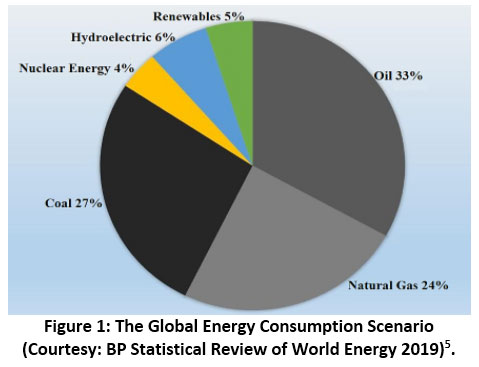 |
Figure 1: The Global Energy Consumption Scenario (Courtesy: BP Statistical Review of World Energy 2019)5. Click here to view Figure |
The rising global temperature is thus interfering with the ecosystems, causing havocs via flooding, draughts and sinking of lands in various regions 14-16. The solution to the problem of global warming endures in the vision of sustainable development. In December 2015, 'The Paris Agreement’ was signed between 196 countries to achieve sustainable growth and control the rising global temperatures. The goals of the Paris Agreement can be achieved if the dependency on fossil fuels is controlled. This poses another challenge for alternative fuel sources that could replace fossil fuels 17. Hydrogen can be a promising alternative to fossil fuels due to its high calorific value and abundance of feedstock availability in nature 18,19. The energy generated by hydrogen is highest compared when to carbonaceous fuels (cf. Table 1). Further, hydrogen produces only water on combustion and hence a non-carbonaceous and clean source of energy 20,21.
Table 1: Energy Content of Different Fuels 18.
|
Fuel |
Energy content (MJ/kg) |
|
Hydrogen |
120 |
|
Liquefied natural gas |
54.4 |
|
Aviation gasoline |
46.8 |
|
Gasoline |
46.4 |
|
Diesel |
45.6 |
|
Ethanol |
29.6 |
|
Coke |
27 |
Several world governments (including developing countries like Brazil and India) came forward and focusing on the vision of ‘Hydrogen Economy’ for sustainable development. The future demand of ever-increasing population can’t be met by the fossil fuels alone, especially in the extremely populated countries like India 22. Hence, there is a great need of an alternative and clean source of energy. However, sustainability can be achieved via reducing the carbon footprints and hence grey hydrogen production cannot actualize the goals. Recently, some researchers also focused on maintaining a carbon balance in the atmosphere. This further suggests creating more carbon sinks (i.e., planting forests and commercializing CO2 capture techniques) to maintain lower GHG concentrations of GHGs 23. Therefore, it can be concluded that the rising world population, its parallel energy demand, and reliance on fossil fuels as the main source of energy are directly associated with one another. This is causing the accumulation of GHGs in the atmosphere rapidly. The remedies for global warming and sustainable development comprise of the all-round approaches, i.e., (a) alternative economic and clean source of fuel to lower the dependency on fossil fuels, (b) enhancements in the sinks for GHGs including the increase in forest areas, and (c) investing in R&D for exploring techno-economic feasibility in renewable energy sources.
Acknowledgement
The authors would like to acknowledge Universiti Teknologi PETRONAS, for providing the resources in conducting this research.
References
- Yusuf, M., Farooqi, A.S., Keong, L.K., Hellgardt, K., and Abdullah, B. (2021) Contemporary trends in composite Ni-based catalysts for CO2 reforming of methane. Chem. Eng. Sci., 229, 116072.
CrossRef - Yusuf, M., Beg, M., Ubaidullah, M., Shaikh, S., Keong, L., Hellgardt, K., and Abdullah, B. (2021) Kinetic studies for DRM over high-performance Ni-W/Al2O3-MgO catalyst. Int. J. Hydrogen Energy, 1–10.
CrossRef - Alam, M.A., Ya, H.H., Yusuf, M., Sivraj, R., Mamat, O.B., Sapuan, M.S., Masood, F., Parveez, B., and Sattar, M. (2021) Modeling , Optimization and Performance Evaluation of Response Surface Methodology. Materials (Basel)., 14 (16), 4703.
CrossRef - Millward-Hopkins, J., Steinberger, J.K., Rao, N.D., and Oswald, Y. (2020) Providing decent living with minimum energy: A global scenario. Glob. Environ. Chang., 65 (September), 102168.
CrossRef - Bernard Looney (2020) Stratistical Review of World Energy. Br. Pet., 69 Edition.
- Yusuf, M., and Athar, M. (2015) Biodiesel Production Using Hexane as Co-Solvent. J. Biofuels, 6 (2), 88.
CrossRef - Yusuf, M. (2016) Natural Gas Hydrates: The Future’s Fuel. J. Environ. Res. Dev., 10 (4), 738–746.
- Burek, S. (2010) When will fossil fuels finally run out and what is the technical potential for renewable energy resources? Int. J. COMADEM, 13 (4), 22–27.
- Khan, S., Yusuf, M., and Sardar, N. (2018) Studies on Rheological Behavior of Xanthan Gum Solutions in Presence of Additives. Pet. Petrochemical Eng. J., 2 (5), 1–7.
CrossRef - Yusuf, M., Salam, A., Alam, M.A., Keong, L.K., Hellgardt, K., and Abdullah, B. (2021) Response surface optimization of syngas production from greenhouse gases via DRM over high performance Ni-W catalyst. Int. J. Hydrogen Energy.
CrossRef - Yusuf, M., Farooqi, A.S., Alam, M.A., Keong, L.K., Hellgardt, K., and Abdullah, B. (2020) Latest trends in Syngas production employing compound catalysts for methane dry reforming. IOP Conf. Ser. Mater. Sci., 991 (1), 12071.
CrossRef - Farooqi, A.S., Yusuf, M., Ishak, M.A.I., Zabidi, N.A.M., Saidur, R., Khan, A., and Abdullah, B. (2021) Combined H2O and CO2 Reforming of CH4 Over Ca Promoted Ni/Al2O3 Catalyst: Enhancement of Ni-CaO Interactions. Adv. Mater. Sci. Eng., 220–229.
- Global, E., Division, M., Greenhouse, G., and Reference, G. (2021) Global Monitoring Division (/ gmd /) Monthly Average Mauna Loa CO2. 2–5.
- Abdullah, B., Abd Ghani, N.A., and Vo, D.V.N. (2017) Recent advances in dry reforming of methane over Ni-based catalysts. J. Clean. Prod., 162, 170–185.
CrossRef - Rosdin, R.D. binti, Yusuf, M., and Abdullah, B. (2021) Dry reforming of methane over Ni-based catalysts: Effect of ZrO2 and MgO addition as support. Mater. Lett. X, 12 (August), 100095.
CrossRef - Yusuf, Mohammad; Farooqi, Ahmad Salaam; Alam, Mohammad Azad; Keong, Lau Kok; Hellgardt, Klaus; Abdullah, B. (2021) Performance of Ni/Al2O3-MgO catalyst for Dry Reforming of Methane: Effect of preparation routes. IOP Conf. Ser. Mater. Sci. Eng., 1092 (012069), 1–9.
CrossRef - Yusuf, M., Farooqi, A.S., Al-Kahtani, A.A., Ubaidullah, M., Alam, M.A., Keong, L.K., Hellgardt, K., and Abdullah, B. (2021) Syngas production from greenhouse gases using Ni–W bimetallic catalyst via dry methane reforming: Effect of W addition. Int. J. Hydrogen Energy, 46 (53), 27044–27061.
CrossRef - Dutta, S. (2014) A review on production, storage of hydrogen and its utilization as an energy resource. J. Ind. Eng. Chem., 20 (4), 1148–1156.
CrossRef - Yusuf, M., Alnarabiji, M.S., and Abdullah, B. (2021) Clean Hydrogen Production Technologies BT - Advances in Sustainable Energy: Policy, Materials and Devices, Springer International Publishing, Cham, pp. 159–170.
CrossRef - Farooqi, A.S., Yusuf, M., Mohd Zabidi, N.A., Saidur, R., Sanaullah, K., Farooqi, A.S., Khan, A., and Abdullah, B. (2021) A comprehensive review on improving the production of rich-hydrogen via combined steam and CO2 reforming of methane over Ni-based catalysts. Int. J. Hydrogen Energy, 46 (60), 31024–31040.
CrossRef - Iqbal, F., Abdullah, B., Oladipo, H., Yusuf, M., Alenazey, F., Nguyen, T.D., and Ayoub, M. (2021) Recent developments in photocatalytic irradiation from CO2 to methanol, in Nanostructured Photocatalysts- From Fundamental to Practical Applications (eds.Nguyen, V.-H., Vo, D.-V.N., and Nanda, S.B.T.-N.P.), Elsevier, pp. 519–540.
CrossRef - Jha, S.K., and Puppala, H. (2017) Prospects of renewable energy sources in India: Prioritization of alternative sources in terms of Energy Index. Energy, 127, 116–127.
CrossRef - Nogia, P., Sidhu, G.K., Mehrotra, R., and Mehrotra, S. (2016) Capturing atmospheric carbon: Biological and nonbiological methods. Int. J. Low-Carbon Technol., 11 (2), 266–274.
CrossRef

This work is licensed under a Creative Commons Attribution 4.0 International License.