
On the Boundary Value Problem of a Finite Isotropic Wedge Under Anti Plane Deformation
Bright Adinchezo Adimoha 1  , Bright Okore Osu 1* , George Ndubueze Emenogu2 and Murphy Emeke Egwe3
1Department of Mathematics, Abia State University, Uturu, Nigeria .
2Department of Mathematics, Michael Okpara University of Agriculture, Umudike, Umuahia, Ngeria .
3Department of Mathematics, University of Ibadan, Nigeria .
osu.bright@abiastateuniversity.edu.ng
http://dx.doi.org/10.13005/OJPS10.01.10
A boundary value problem for a finite isotropic wedge under anti plane deformation has been solved. Depending on the boundary data on the radial edges, two cases are considered. The boundary data are: traction free-fixed displacement and traction-fixed displacement. The solution is accessed using the finite Mellin transform to obtain a full field solution for the stresses and displacements in the configuration through which the order of singularities due to the geometry are obtained for the cases considered.
Copy the following to cite this article:
Adimoha B.A, Osu B. O, Emenogu G. N, Egwe M. E. On the Boundary Value Problem of a Finite Isotropic Wedge Under Anti Plane Deformation. Oriental Jornal of Physical Sciences 2025; 10(1).
DOI:http://dx.doi.org/10.13005/OJPS10.01.10Copy the following to cite this URL:
Adimoha B.A, Osu B. O, Emenogu G. N, Egwe M. E. On the Boundary Value Problem of a Finite Isotropic Wedge Under Anti Plane Deformation. Oriental Jornal of Physical Sciences 2025; 10(1). Available here: https://bit.ly/4ijHaPU
Download article (pdf) Citation Manager Publish History



Introduction
Wedges are important geometry in most technical and engineering works, hence the need to understand their structural behavior. 14William (1952) solved the problem of stress singularities at an apex of an isotropic elastic wedge using the method of Eigen function-expansion and obtained stresses at the wedge apex that is proportional to r-hs ). Wedge apex and the stress singularities under various loading conditions was studied by 4Demsey and Sinclair (1979). 6Kargarnovin, Shahani and Fariborz (1997) analyzed the stress distribution in a wedge with finite radius subjected to anti plane shear deformation. They obtained the singularities at wedge apex under various loading as a dependent of apex angle. 8Ma and Hour (1990) analyzed an anti plane shear deformation problem of composite anisotropic wedge with perfect bond long the interface by adopting Mellin transform in combination of stress functions. The assumed that the the order of singularities is O(r-hs ) )as r - 0 . 10Shahani (2007) extracted an expression for the singularities at the wedge apex by solving an anti plane shear deformation of a finite wedge using the finite Mellin transform. It was found that the necessary condition for singularities depends on the geometry. It was shown that stress fields are bounded for 0 < a < r/2 , but for r/2 < a < 2a where a is the apex angle , the strength of geometry singularity is hs = 1 - r/2. 2Adimoha, Nnadi, Emenogu and Osu (2024) adopted Mellin transform in conjunction with the Wiener-Hopf technique to analyze the displacements everywhere in a finite isotropic cracked wedge under anti plane deformation. 3Chih , Chein and Chien (2009) considered a finite a finite isotropic wedge under anti plane shear with a non zero anti plane shear load in the radial direction. The boundary data on the circular arc of the wedge were either fixed or traction-free. 1Adimoha , Nnadi ,Osu and Nwafor (2024) solved a mixed boundary value problem for a finite isotropic wedge under anti plane shear deformation using the Mellin transform, and obtained a closed form solution for the stresses and displacements. They articulated the stress intensity factor for the configuration which depends on the material constants.
Materials and Methods
In this paper, a parameterized elastic finite isotropic wedge configurations were considered. The geometrical configurations were subjected to an anti plane shear deformation for the two different cases established by different boundary conditions. The schematic cross section of the wedges were shown in figures 1 and 2, respectively.
The parameterization of the geometry were performed on their main parameters: stresses, displacements, apex angles, traction free-fixed displacement and traction-fixed displacement.
The materials were considered in an elastic formulation with their material properties u and the apex angle a.
Two cases were considered, traction free-fixed displacement and traction-fixed displacement, respectively.
The methodology of the paper is owing to the fact that functions in elastic solids satisfies the equilibrium equation, as well as boundary conditions. The task was implemented as a boundary value problem with the mathematical problem supplemented by boundary conditions.
As a result of the nature of the boundary conditions, we adopted the finite Mellin transform of the second kind in conjunction with its inversion formula to obtain the convergence series form of the required fields, through which the fracture responses and the strength of singularities of the wedges were established.
Basic Equations for Cases Considered
A finite isotropic wedge of radius a and apex angle a under anti plane shear deformation is considered. Therefore, the only non-vanishing displacement component is the one in z-direction given by W(r,0), which is a function of the in-plane coordinates r and 0. The non-vanishing components of the stresses are given by
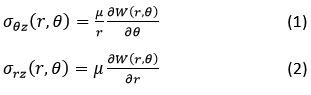
where u is the shear material constant. In the absence of body force, the equilibrium equation yields the Laplace equation in terms of the displacement by

The boundary conditions are:

The finite Mellin transform of the first and second kinds are to be employed in this analysis. The finite Mellin transform of the first kind is defined by

The finite Mellin transform of the second kind is defined by

If W1 (s,0) and W2 (s,0) are found, then W(r,0) is obtained by the use of the Mellin inversion formula defined by

The application of (6) to the Laplace equation (3) and the use made of integration by parts and the Leibnitz rule for differentiating the integral yields
.jpg)
provided that

also,
application of (7) to (3) and use made of integration by parts and the Leibnitz rule for differentiating the integral produces

provided that

The range of values of c in the inversion formula (8), is the strip of regularity of W(s,0). It is derived from the conditions (10) and (12).
The stress and displacement has the following asymptotic behaviors

Referring to (12) in view of (13) and (14) leads to
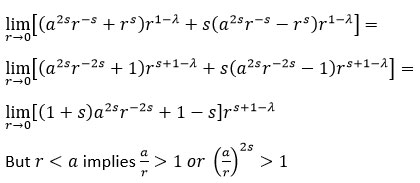
Hence

implies that
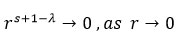
if

or Res > h - 1 , where Re means the real part of. Equations (10) , (13) and (14) lead to the same result if Res = 0.
Problem 1
(Traction Free-Fixed Displacement)
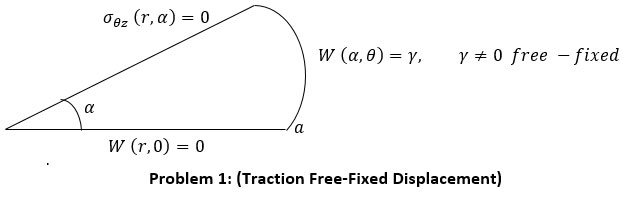 | Problem 1: (Traction Free-Fixed Displacement) |
By the use of (6) and (9) we get
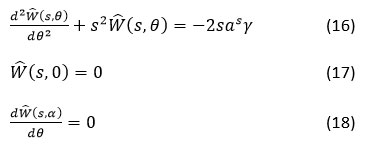
Consider the solution of (16) to be of the form
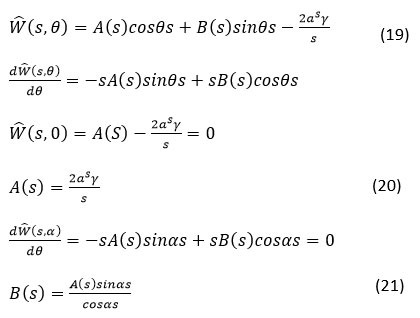
Hence, substituting (20) and (21) into (19) yields
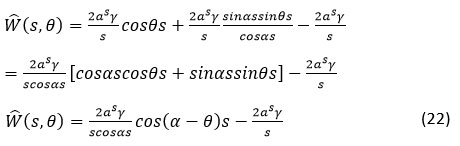
Substituting (22) into (8) yields

The Bromwich integrands in (23) can be evaluated by Cauchy’s residue theorem in accordance with Jordan’s lemma. The second integrand has a pole at s = 0 which leads to constants as r gets to the neighborhood of zero. These constants are ignored because the problem being solved is a Neumann boundary value problem for which constants do not affect solutions. Therefore, we consider the first integrand in (23) with simple poles at s_n = ± (2n-1) r/2a , n = 1,2,3… Because of convergence as r - 0, we give attention to sn = -(2n - 1) r/2a , n = 1,2,3…
Therefore, residue theorem gives
Utilizing (1), (2) and (24) , the corresponding stress components reads

Having obtained (25) and (26), s1 if is the least of the poles with |s_1 |< 1 and hs1 = 1 - s1 , then hs1 is the order or strength of the stress singularity at the apex of the wedge. Whether or not a stress singularity occurs at the wedge apex depends on the fact that the inequality |s1 |< 1 holds. Therefore, 0 < a < 2r implies 0 < a < r/2 and r/2 < a < 2r . Also, 0 < a < r/2 implies r/2a > 1. That is (2n-1) r/2a > 2n - 1 or (2n - 1) r/2a - 1 > 2(2n - 1). Thus, for n = 1, r/2a - 1 > 0 or |s1|> 1. For this case, the fields are bounded.
But, if r/2 < a, then r/2? < 1 implies (2n - 1) r/2a < 2n - 1 and (2n - 1) r/2? - 1 < 2( n - 1). Thus, for n = 1, we have s1 = r/2? < 1. Therefore, singularity occurs for all a > r/2.
Problem 2
(Traction-Fixed Displacement)
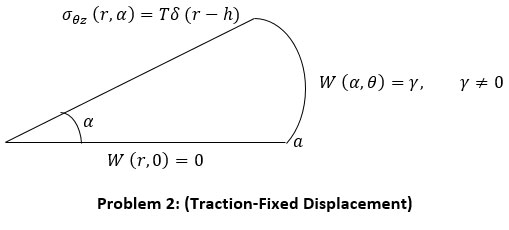 | Problem 2: (Traction-Fixed Displacement)
|
from problem (1)
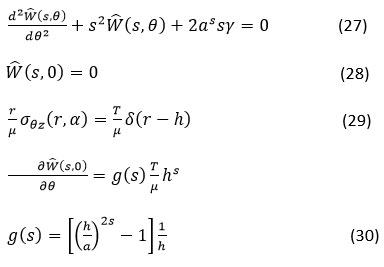
Let the solution of (27) be
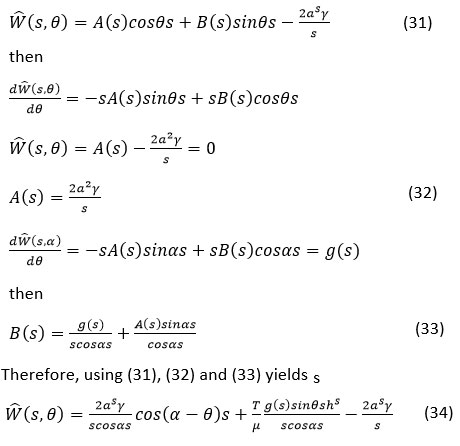
Adopting the inverse Mellin transform defined by (8), we obtain

The Bromwich integral in (35) can be evaluated by the residue method. The simple poles at s = 0 are dropped because they produce constants which do not alter the solution of a Neumann boundary value problem. For the sake of convergence, the residue at simple poles given by sn = -(2n - 1) r/2a , n = 1,2,3… to obtain the required fields. Therefore, sum of residue gives for the first and second integrands respectively yields

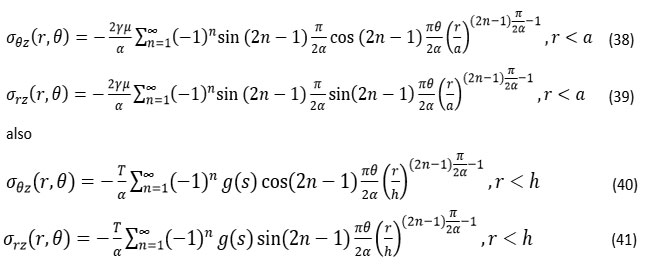
Then , utilizing (36) and (37), their corresponding stresses are obtained as
Results
Considering (38),(39),(40) and (41), if (2n - 1) r/2? > 1 , then (2n - 1) r/2? - 1 > 0, so that the power of (r/a) or (r/h) in o0z (r,0) or orz (r,?) for the fields from both integrals will be positive and therefore bounded. This happens when 0 < a< r/2. as r - 0. If on the other hand, r/2 < a < 2r, then r/2a < 1< 2r/a which implies that r/2? < 1. Then, s1 < 1 will hold, so there exist stress singularity at the wedge apex. Therefore, the stress fields are unbounded as r - 0.
The asymptotic behaviour (13) yields the strength of geometric singularity as

Discusion
From the analysis and (42), it can be seen that when a approaches critical values of 2r/3, 3r/4and r which is a case of circular shaft with a radial crack, then strength of singularity exhibits significant variations, specifically decreasing to 3/4 , 2/3 and 1/2 respectively. This shows the relationship between the wedge geometry and the resultant stress distribution around singularities. Also, the implication of this research extends to the importance of understanding singularities in the design of structures in practical engineering application.
Conclusion
A boundary value problem for a finite isotropic wedge under anti plane shear deformation has been solved in this paper. The finite Mellin transform of the second kind was employed to solve a two-dimensional Neumann boundary value problem in terms of the only non-zero displacement component. Two different cases of traction free-fixed displacement and traction –fixed displacement were examined. Exact solutions for the required fields were obtained for both cases and the effects of geometry on the strength of geometric singularity were also examined.
Acknowledgement
The authors would like to appreciate the Department Of Mathematics, Faculty Of Physical Sciences, Abia State University, Uturu, Nigeria and Michael Okpara University Of Agriculture, Umudike, Nigeria for providing us with some of the helpful materials for this research. Also, we owe our gratitude to the Department Of Mechanical Engineering of both institutions for availing us their workshops to visualize the structural configuration of the finite isotropic wedge and the effects of the variations of the apex angle on the wedge configuration.
Funding Sources
The authors received no fund from any external source.
Conflict of Interest
The authors declared no any form of conflict of interest.
Data Availability Statement
Data Availability Statement
Ethics Statement
This research did not involve human participants, animal subjects, or any material that requires ethical approval.
Informed Consent Statement
This study did not involve human participants, and therefore, informed consent was not required.
Authors Contributions
Bright Okore Osu And Bright Adinchezo Adimoha - Conceptualization, Formulation, Analysis and Supervision
Bright Adinchezo Adimoha, Bright Adinchezo Adimoha, Bright Adinchezo Adimoha and Murphy Emeke Egwe - Validation and Visualization
Murphy Emeke Egwe and Murphy Emeke Egwe - Writing the original draft, Review and Editing.
Bright Adinchezo Adimoha, Bright Adinchezo Adimoha, George Ndubueze Emenogu and George Ndubueze Emenogu - Funding
References
- Adimoha,B.A.,Nnadi, J.N.,Osu, B.O.,Nwafor, F.A. A Mixed Boundary Value Problem For A Finite Isotropic Wedge Under Anti Plane Deformation. Jour Of Comm In Phy Sci.2024;11(4):928-935.
- Adimoha,B.A, Nnadi, J.N, Emenogu,G.N, Osu,B.O. On The Analysis Of The Displacements In A Finite Isotropic Cracked Wedge Under Anti plane shear Deformation. Int’l Jour Of Comp Sci And Maths Theory.2024;10(6):59-72.
- Chih,H.C., Chein,L.W. and Chien,C.K. Analysis of composite finite wedges under antiplane shear. Int’l Jour Of Mech Sci. 2009;51, 583-597.(2009)
CrossRef - Dempsey,J.P. and Sinclair,G.B. On The Stress Singularities In The Plane Elasticity Of A Composite Wedge. Jour Of Elasticity.1979;9 (4): 373-391.
CrossRef - Gradshyten,I.S. and Ryzhik, M.I. Tables Of Integrals , Series And Products. Academic Press, New York;1965.
- Kargarnovin,M.H.,Shahani,A.R. and Fariborz,S.J. Analysis Of An Isotropic Finite Wedge Under Anti Plane Deformation. Int’l Jour Of Solid Structures.1997;34, 113-128.
CrossRef - Korn, G.A and Korn,T.M. Mathematical Handbook For Scientists And Engineers, Dover Publications,Inc. Mineola , New York;1968.
- Ma,C.C and Hour,B. Analysis Of Dissimilar Anisotropic Wedges Subjected To Anti Plane Deformation. Int’l Jour Of Solid Structures.1990;25 (11): 1295-1309.
CrossRef - Riley,K.F., Hobson,M.P. and Bence , S.J. Mathematical Methods For Physics And Engineering, Third Edition, Cambridge University Press, 2002.
CrossRef - Shahani, A.R. On The Anti Plane Shear Deformation Of Finite Wedges. Appl Mathe Model.2007; 31, 141-151.
CrossRef - Singh,S.Theory Of Elasticity, Khana Publishers Darya Gary, New Delhi,2010.
- Timoshenko,S. and Goodier,J.N. Theory Of Elasticity. McGraw-Hill Book Company, London, 1951
- Tranter,C.J. Integral Transforms In Mathematical Physics,Willey, New York,1956.
- William, M.L. Stress Singularities Resulting From Various Boundary Conditions In Angular Corners of Plate In Extension. Jour Of Appl Mech.1952;1, 526-528.
CrossRef

This work is licensed under a Creative Commons Attribution 4.0 International License.