
Photoluminescence Properties of Eu3+ and Ce3+ Activated Calcium Chlorophosphate Via Combustion Synthesis Method
Nahida Baig 1 *  , N. S. Dhoble 1 , N. S. Kokode and S. J. Dhoble
1Department of Physics, Janata Mahavidhyalaya, Chandrapur, Janata Mahavidhyalaya, Chandrapur, 442401 India .
2Sevadal Mahila Mahavidyalaya, Sakkardara Square, 1Sevadal Mahila Mahavidyalaya, Gadchiroliri, 440009 Nagpur India .
3Principal, N. H. College, Bramhapuri, Gondwana University, Gadchiroli, 442605 India .
4Department of Physics, R.T.M. Nagpur University, Nagpur, R.T.M. Nagpur University, Nagpur, 440033 India .
http://dx.doi.org/10.13005/OJPS01.0102.03
Calcium chlorophosphate (Ca2PO4Cl) phosphors, activated by rare earth ions Eu3+ and Ce3+ were prepared by urea assisted combustion synthesis technique and their characterization and luminescent properties were studied. The synthesized phosphors were investigated by powdered XRD, SEM and Photoluminescence characterization (PL) methods. PL excitation spectra of Ca2PO4Cl:Eu3+/Ce3+ phosphor exhibit narrow bands in the near ultra violet (n-UV) range, and the PL emission spectra of Ca2PO4Cl: Eu3+/Ce3+ phosphor shows sharp narrow bands typical of rare earth ions. The bands observed in the PL emission and excitation spectra of Ca2PO4Cl: Eu3+/Ce3+ phosphors can be ascribed to the electronic transitions within 4f configurations of rare earth ions. The excitation peaks for Ca2PO4Cl: Eu3+ is in n-UV range. The obtained results suggest that these phosphors may be favorable for lamp industry.
Copy the following to cite this article:
Baig N, Dhoble N. S, Kokode N. S, Dhoble S. J. Photoluminescence Properties of Eu3+ and Ce3+ Activated Calcium Chlorophosphate Via Combustion Synthesis Method. Orient J Phys Sciences 2016;1(1-2).
DOI:http://dx.doi.org/10.13005/OJPS01.0102.03Copy the following to cite this URL:
Baig N, Dhoble N. S, Kokode N. S, Dhoble S. J. Photoluminescence Properties of Eu3+ and Ce3+ Activated Calcium Chlorophosphate Via Combustion Synthesis Method. Orient J Phys Sciences 2016;1(1-2). Available from: https://bit.ly/3hMP2vs
Download article (pdf) Citation Manager Publish History
Introduction
Phosphor converted white light emitting diodes (Pc-wLEDs) has attained more significance in current times for their various applications such as flashlights, indicator lights, display backlighting and architectural lighting [1,2]. It is believed that nUV-LED+RGB luminescent materials can be considered as one of the best methods to produce highly efficient white light [3,4].
Ca2PO4Cl, known as Calcium Chloro phosphate was first investigated by Martha Greenblatt [5] et-al. for its crystal structure. A. Meijerink and G. Blasse have reported the photoluminescence and thermoluminescence properties of Ca2PO4Cl:Eu2+ [6]. Yi-Chen Chiu[7] has reported the application of Ca2PO4Cl:Eu2+ as a guaranteed blue phosphor for white light emission diodes by exciting with near ultra violet light and prepared by solid state reaction. Panlai Li et al., reported Ca2PO4Cl:Eu2+, Mn2+ as a novel, warm light emitting phosphor for white LEDs [8].
The photoluminescence of Ca2PO4Cl:Yb2+ has been investigated and compared with that of Ca2PO4Cl l:Eu2+, and the application of Ca2PO4Cl:Yb2+ for white LED has been evaluated by Di-Yin Wang et al[9]. A series of Ce3+, Eu2+ and Ce3+/Eu2+ doped Ca2PO4Cl phosphors, prepared by a high temperature solid-state method were investigated by Panlai Li et al., and found an increase in the emission intensity of Ca2PO4Cl:Eu2+ without affecting the spectral profile [10].
Hence we are motivated to study Ca2PO4Cl:Eu phosphor, but via a different synthesis route. Combustion synthesis (CS) is another wet chemical method for synthesizing powdered materials [11]. Combustion synthesis processes have typical characteristics like high-temperatures, fast heating rates and small reaction times. These characteristics make this a striking method for the creation of technologically functional materials at cheap rates compared to other usual processes.
Therefore we are reporting the luminescence properties of Ca2PO4Cl: Eu and Ce phosphors, prepared by urea assisted combustion synthesis method.
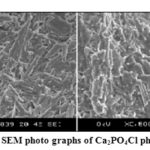 |
Figure 1: SEM photo graphs of Ca2PO4Cl phosphor |
Experimental
The chloride based Eu3+ and Ce3+ activated Ca2PO4Cl halophosphor material were prepared by combustion synthesis method. Chemically homogenous, well and untainted powders are prepared by this method. The ingredients used to synthesize this halosulphate phosphor were of AR grade Calcium nitrate (Ca(NO3)2), Ammonium Chloride (NH4Cl), Ammonium di- hydrogen phosphate (NH4H2PO4), ammonium Cerium nitrate [(NH4)2Ce(NO3)6], Europium oxide (Eu2O3) and Urea[NH2-CO-NH2]. The initial materials in the stoichoimetric proportion were combined together along with Urea in agate mortar by grinding. The solution of dopant in the nitrate form was then added to homogenous mixture to form a semiliquid paste. The stoichoimetric composition of all the components were calculated using the total oxidizing and reducing valencies of the chemicals which serve as the numerical coefficients so that the equivalence ratio is unity. The paste formed is moved to silica crucible and kept inside a muffle furnace operating at 550°C. Combustion synthesis is a reaction which takes place with the evolution of heat and light. This high temperature plays a vital role in the formation and crystallization of required phosphor material. The mixture when heated rapidly at 550°C started boiling and generating combustible gases. The thin chips of white colored powder in the crucible were then mashed to powdered form. The synthesized host material was characterized for their phase purity and crystalline nature by XRD using PAN-analytical diffractometer. The PL measurement of excitation and emission were recorded on Shimadzu RF-5301PC Spectrofluorophotometer.
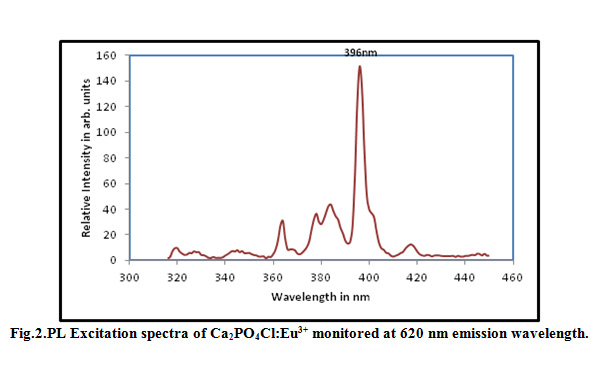 |
Figure 2: PL Excitation spectra of Ca2PO4Cl:Eu3+ monitored at 620 nm emission wavelength. |
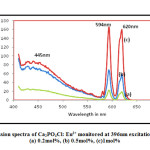 |
Figure 3: PL emission spectra of Ca2PO4Cl: Eu3+ monitored at 396nm excitation wavelength. (a) 0.2mol%, (b) 0.5mol%, (c)1mol% |
Characterization
Structure of compound was established by taking the XRD pattern. The Photoluminescence excitation and emission spectra of the samples were recorded using fluorescence spectrometer RF-5301PC, using a spectral slit width of 1.5nm. The surface morphology was studied by taking scanning electron microscopy photographs.
The XRD pattern of Ca2PO4Cl is in agreement with that of JCPDS file No. 72-0010. Calcium chlorophosphate, as reported by Greenblatt[5] et al. ,crystallizes in the orthorhombic system with a space group of Pbcm [7], with four molecules per unit cell. The dimensions of the unit cell are a = 6.1850 Å, b = 6.983 Å, and c = 10.816 Å [7]. The ionic radii of Ca2+ and Eu3+/ Ce3+ are approximately same. Therefore Eu3+/ Ce3+ ions may prefer to occupy Ca2+ sites in Ca2PO4Cl host lattice.
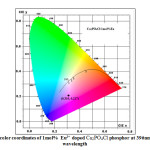 |
Figure 4: CIE color coordinates of 1mol% Eu3+ doped Ca2PO4Cl phosphor at 396nm excitation wavelength |
SEM characterization
The Fig.2 shows SEM images of Ca2PO4Cl phosphor. It is clear that the surface morphology is inhomogeneous. The particles are rod like of irregular sizes. The particle size varies from 5µm to 10 µm.
Result and Discussion
Ca2PO4Cl: Eu3+
Rare earth ions are identified to be present in a variety of valence states although the trivalent state is the most common [7, 12]. Among rare earth ions, Eu, particularly is known to be steady in both trivalent and divalent states. The excitation spectra for Ca2PO4Cl: Eu3+ is shown in Fig. 2. The excitation spectra, watched at 620 nm emission wavelength illustrates a maximum at 396nm which is ascribed to 7F0→5L6 transition of Eu3+. The sharp excitation bands in the 315 - 450nm region belongs to the intraconfigurational 4f-4f transitions of Eu3+. Two low intensity broad bands peaking at 328nm and 345nm are also seen, which may be due to 4f7 - 4f65d transitions of the Eu2+ ions [13]. The 7F0→5L6 at 396nm is the strongest absorption. Thus we find that Eu ions dwell in two different sites in the host Ca2PO4Cl network.
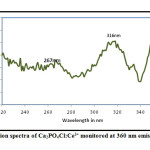 |
Figure 5: PL Excitation spectra of Ca2PO4Cl:Ce3+ monitored at 360 nm emission wavelength. |
Upon excitation with 396nm radiation, the emission spectra (Fig.3) consists of two types of transitions one is the broad emission at 440 nm lying in the blue region of visible spectrum, which can be ascribed to the transition from 4f65d excited state to the 4f7 ground state of a Eu2+ ion. And the second is the sharp intense emissions at 594nm and 620nm which are due to 5D0→5FJ (J=1-4) of the 4f6 configuration of Eu3+. The bands obtained can be represented as: 5D0→7F1 (593nm) and 5D0→7F2 (620 nm). Thus along with Eu3+ emission, a broad emission at around 440 nm attributable to Eu2+ emission could be seen in the emission spectra, pointing that the reduction of Eu3+ to Eu2+ ions is possible to be achieved in this host Ca2PO4Cl material. The rare earth ion Eu2+ emission is a consequence of two forms of transitions. Commonly the transition is due to 4f6 5d1→4f7 (8S7/2). As the position of the band corresponding to 4f65d configuration is strongly affected by the host, the emission can stretch out anywhere between 365 nm to 650 nm [14].
The intensity of emission line 594nm assigned to the magnetic dipole 5D0→7F1 (MD) transition of the Eu3+ ions is slightly greater than the intensity of emission peak at 620 nm corresponding to the forced (ED) electric dipole 5D0→7F2 transition of Eu3+. The electric dipole transition 5D0→7F2 with ∆J=2 is hypersensitive, and the intensity can vary by the order of magnitude, depending on the neighboring environment [15]. It is recognized that when the Eu3+ ions are embedded in a site with inversion symmetry, 5D0→7F1 MD transition of Eu3+ is directed, whereas without inversion symmetry the 5D0→7F2, ED transition is the strongest among the 5D0→7FJ (J=1,2,3,4) transitions[16].
The result of Eu3+ ions concentration on the emission intensity of Ca2PO4Cl is studied. The variation of emission intensities of Ca2PO4Cl: Eu3+ with different doping concentration of Eu ions can be seen from Fig. 3. The form of the emission curve was same for all the concentrations, but the emission intensity was found to increase with the increase in the Eu doping content. The maximum intensity was for 1mol% concentration of the activator Eu3+ ions. No concentration quenching was observed for europium activator ions up to 1mol%.
As the phosphor Ca2PO4Cl: Eu, shows three distinct colors due to Eu2+ and Eu3+ emissions, at 445nm(blue), 544nm(yellow) and 620nm(red), we have calculated the CIE color coordinates to find out the resultant emission color from the spectral distribution of intensity. The CIE color coordinates are found to be (0.310, 0.217) which lies in the white region of the visible spectrum as shown in Fig.4.
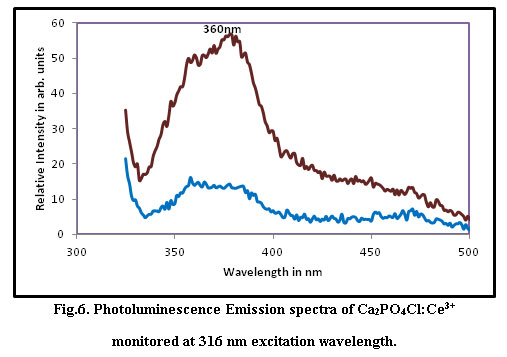 |
Figure .6: Photoluminescence Emission spectra of Ca2PO4Cl:Ce3+ monitored at 316 nm excitation wavelength
|
Ca2PO4Cl: Ce3+
Fig. 5 illustrates the photoluminescence excitation (PLE) of Ce3+ doped Ca2PO4Cl phosphor. As shown in the figure, the excitation spectrum monitored at 360 nm emission wavelength, shows two broad band centered at 267nm and 316nm, which can be attributed to the crystal field splitting of 5d states of Ce3+ [17].
The excitation at 316nm of Ca2PO4Cl: 1% Ce3+ agrees well with the emission of nUV chips. Fig. 6 shows the emission spectrum at 316 nm excitation wavelength. The emission spectrum shows a broad band which extends between 335 to 400 nm peaking at 360 nm, which can be attributed to characteristic 5d -4f emission of Ce3+. This emission could be utilized in scintillators and photo-therapy. Also it could act as a good sensitizer in energy transfer process for phosphors. From the emission spectrum we find that the intensity of emission at 360 nm increases with increase in dopant concentration.
Conclusion
Phosphor Ca2PO4Cl activated by rare earth ions Eu3+ and Ce3+ were synthesized by Urea assisted combustion synthesis procedure. The powdered phosphors were described by XRD and SEM procedures. Phase purity of phosphors was confirmed by XRD. The prepared micro phosphors display good luminescence properties. The Ca2PO4Cl:Eu3+ phosphor exhibit emission in the white region of the visible spectrum due to three prominent emissions peaking at 445nm, 594nm and 620nm, upon excitation at 396nm wavelength. The CIE color coordinates of Ca2PO4Cl:1mol%Eu was calculated to be (0.310, 0.217). By changing the dopant concentration, the phosphor Ca2PO4Cl: Eu can be further investigated for its potential application as a white light emitting phosphor for Lamp industry.
References
- Zukauskas A. Kauskas V. Appl. Phys. Let. 2008, 93: 051115
- Allen S.C, et al. Appl. Phys. Lett 2008; 92:143309
- Thornton W.A. J.opt.soc.Am.61(1971)1155
- Koedam M., Opstelten J. J., Lighting Res. Technology .3(1971)205
- Greenblatt M., Banks E., Post B., Acta Cryst. (1967)23,166.
- Meijerink A. and Blasse G., J. Phys.Condens matter 1990 , 2,3169.
- Chiu Y.C., Liu W., Chang C.K, Liao C.C., Yeh Y.T., Janga S.M., Chen T-M, Journal of material chemistry, 20(2010) 1755
- Panlai Li, Wang Z. , Yang Z., and Qinglin G., J. Mater. Chem. C, 2014,2, 7823
- Wang D.Y., Chiu Y.C., Huang C. H. , Wu Y. C., Chen T. M., J. Luminescence (04) 2014; 148
- Panlai Li, Wang Z. , Yang Z., and Qinglin G.RSC Adv., 2014,4, 27708
- Patil K.C., Aruna S.T., Mimani T., Current Opinion in Solid State and Materials Science 6 (2002) 507
- Singh V, Haque MD. M., Kim D.K., Bull. Korean chem. Soc. 28(12)( 2007)2477
- Nguyen H.D., Yeo T.H., Mho S.I., ECS Trans, 28(2010) 167
- Singh R., Dhoble S.J. Bull. Mater. Sci. Vol. 34.No.3(2011) 557
- S. Shionaya, Phosphor Handbook, CRC Press, Boca 303(1999)110.
- Blasse G. Grab Maier B.C. Luminescent materials. Berlin:Springer-Verlay 1994
- Kodama N, Sasaki N, Yamaga M, Masui Y, J.Lumin, 94 (2001) 19

This work is licensed under a Creative Commons Attribution 4.0 International License.