
Cosmic Baby and Crystallography — Decoding the Invisible Inside the Secret of the Universe
Ramen Kumar Parui* 
1ARC, Room No – F101, Block – F, Mall Enclave, K. B. Sarani, Kolkata, West Bengal India .
http://dx.doi.org/10.13005/OJPS09.02.06
Discovery of Bragg’s X-ray diffraction opened a new field “ X-ray Crystallography” and offered us a method of decoding to see the invisible inside of a crystal. Initially it was confined to crystal structure but pioneering works of Dorothy Hodgkin on the structure of Penicillin, Insulin and Vitamin B12 extended this X-ray crystallography applicable to other branches of science such as chemistry, biology, astrophysics ( i.e. neutron star, magnetar ), cosmology i.e. cosmic crystallography, etc. Discovery of cosmic baby allows the astronomers as probe of investigating the possible crystallography in the interior of neutron star, magnetar, pulars as well as cosmic crystallography. In the cosmic crystallography, new idea spacetime as fluid in which magnetic reconnection process produces a “stir “ or “mix” resulting which vortices, a kind of “gravitational whirlpool” appear. Energy release due to this vortices could create black hole, even creation of the universe itself. Cosmic baby offers the astronomers as probes of studying why the crystal formation in space i.e. terrestrial crystal formation ( based on the protein formation experiment in the ISS lab) is more effective in shape and size of the crystal than that of produced in the laboratory located on our earth.
Copy the following to cite this article:
Parui R. K. Cosmic Baby and Crystallography — Decoding the Invisible Inside the Secret of the Universe. Oriental Jornal of Physical Sciences 2024; 9(2).
DOI:http://dx.doi.org/10.13005/OJPS09.02.06Copy the following to cite this URL:
Parui R. K. Cosmic Baby and Crystallography — Decoding the Invisible Inside the Secret of the Universe. Oriental Jornal of Physical Sciences 2024; 9(2). Available here: https://bit.ly/4f3eXey
Download article (pdf) Citation Manager Publish History



Introduction
The Dawn
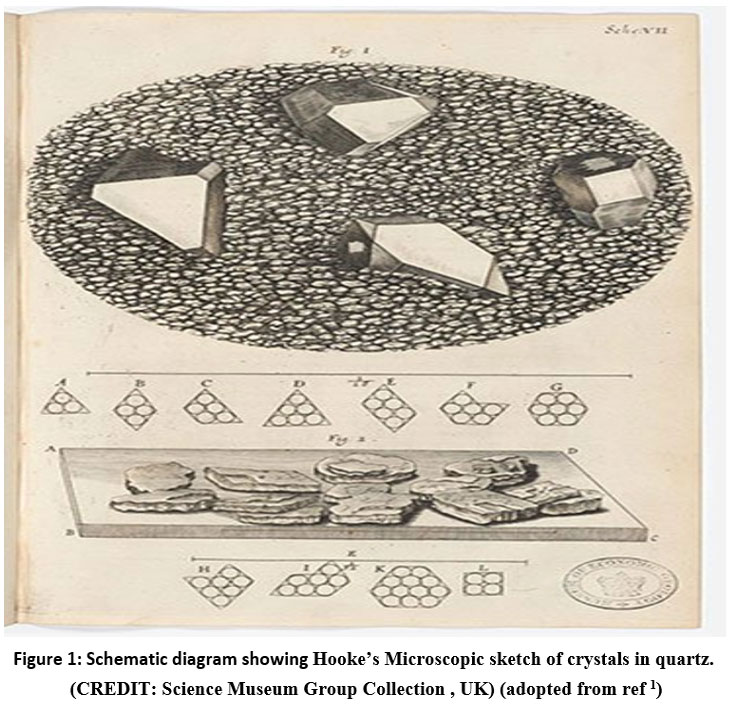
Before the discovery of X-ray in 1985 scientists were limited to know about crystallography (i.e. internal structure of a solid) through outer surface structure of a crystal (see fig.1). Gleaming with light and using Hooke’s microscope astronomers Johannes Kepler and French scientist Rene Just Haüy studied the crystalline minerals based on it’s outward structure and attempted to model. Later British chemist William Hyde Wollaston studied crystals using precision special instrument.
In 1901 the announcement of the first physics Nobel prize awarded to Professor Wilhelm Rontgen for his invaluable discovery of X-ray . Since then X-ray became popular only on its application to human health. Scientists were thinking other modes of application of X-rays rather than health. But physicists were not aware of the actual nature of X-rays except the possible characteristic of electro-magnetic radiation. Note that physicist Arnold Sommerfeld suggested
 |
that x-rays have dual behavior i.e. as a wave of wave length of about 1 Angström as well as particle properties. Utilizing the wave properties Max von Laue first showed that crystals can be used for exhibiting of diffraction grating of X-rays (fig.2) as because x-ray might have a wavelength that is comparable to the unit cell spacing in crystals. Finally, von Laue able to develop his law (known as von Laue diffraction law ) connecting the scattering angle, the size and orientation of the unit cell-spacing associated in the crystal.
 | Figure 2: (A) Photo of x-ray diffraction pattern obtained by Max von Laue during his experiment on crystal ZnS which revealed spots of variation in shape and intensity ( adopted from Friedrich et al 1912 2 ) with (B) the mathematical explanation of how diffraction is produced (E, F) after the incident x-rays (A, B) hit on the atoms of the crystal |
Based on the von Laue’s pioneering work William Henry Bragg 3 and jointly with his son William Lawrence Bragg developed a law ( known as Bragg’s law) that expresses a relation of the scattering angle (?), i.e. scattering from the evenly spaced planes hidden inside the crystal (fig.3) :
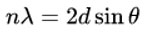
where ? = wave length of the incident x-rays,
d = spacing of the planes where atoms are arranged,
n = number of planes considered.
What happens in this Bragg diffraction is that two x-ray beam lines ( with identical wavelength and phase) fall on a crystalline surface, scattered off two different atoms located within it. In fact, the lower beam travels an extra path length of “ 2d sin ? “ in comparison to the upper beam line. This means a constructive interference will appear when this path length is equal to an integer ( n ) multiple of the wavelength of incident radiation.
As a result, a new branch of physics called “ X-ray Crystallography” was born. With this X-ray crystallographic method it is possible to determine the arrangement of atoms of inside a crystalline solid in three dimensional space.
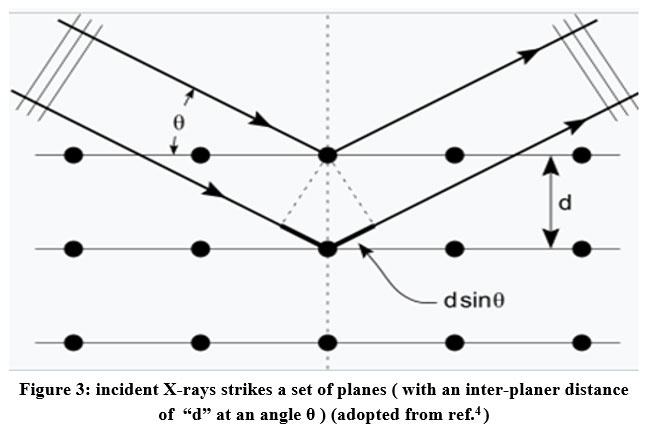 | Figure 3: incident X-rays strikes a set of planes ( with an inter-planer distance of “d” at an angle ? ) (adopted from ref.4 ) |
Contributions of Physics to X-ray Crystallography
The initial discovery of Max Laue showed that crystal will diffract X-rays. Lawrence Bragg’s theory 3 expresses the macroscopic properties of crystals ( i.e. size, shape , symmetric planes etc ) through the diffracted angle (?) of the incident x-ray from the inside planes where atoms are arranged i.e. the whole crystal is nothing but a composed of stacked smaller crystals of specific form with repeating blocks. Based on the external crystal morphology Johann Hessel made 32 type possible crystal classes. (note that, later 32 crystallographic point group of lattice symmetry has been identified) 5 – 7 . However, mineralogist William Miller 8 introduced the concept of ( h, k, l ) Miller indices to describe the crystal faces. In fact, Bragg’s reflection influenced remarkably in the development of crystallography applicable not only to physics but in other branches such as chemistry, molecular biology, Astrophysical Compact Objects ( interior structure of White Dwarf, Neutron Star, Magnetars, pulsars. ) as well as in the structure of the Universe i.e. crystal cosmology.
Perceptions of Crystallography in other Branches of Science
Biological macromolecule crystallography
Bragg’s work (i.e. father William Henry Bragg and his son William Lawrence Bragg) was in physics. Among William Bragg’s 18 brilliant research students Kathleen Lonsdale was in a
leading role among 11 women research students. But one of her brilliant scholars Dorothy Crowfoot Hodgkin became the most important crystallographer in the 20th century in the branch of medicine. Her research work as associated with the structures of medically important molecules such as Penicillin, Vitamin B12 and Insulin.
X-ray crystallography in biological molecules took a great height when Dorothy Crowfoot Hodgkin first solved the structures of cholesterol ( in the year 1937), penicillin ( in 1946, see fig.4) and vitamin B12 (in 1956) 9 – 11 . [* for these discoveries Dorothy was awarded Nobel Prize in Chemistry in 1964].
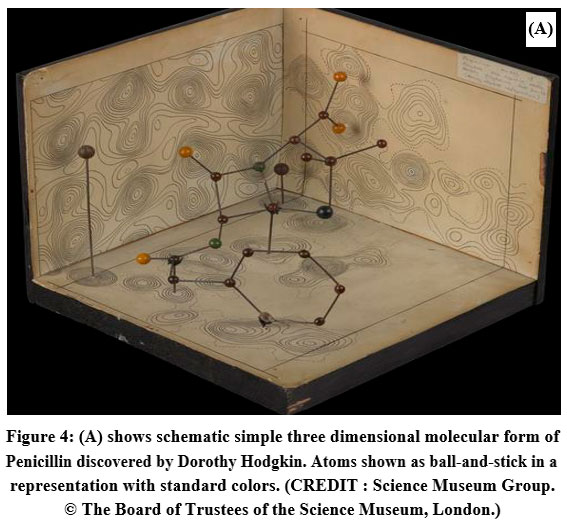 | Figure 4: (A) shows schematic simple three dimensional molecular form of Penicillin discovered by Dorothy Hodgkin. Atoms shown as ball-and-stick in a representation with standard colors. (CREDIT : Science Museum Group. © The Board of Trustees of the Science Museum, London.) |
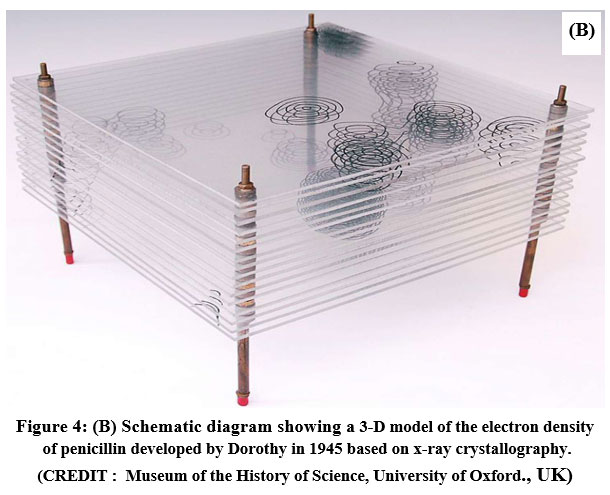 | Figure 4: (B) Schematic diagram showing a 3-D model of the electron density of penicillin developed by Dorothy in 1945 based on x-ray crystallography. (CREDIT : Museum of the History of Science, University of Oxford., UK) |
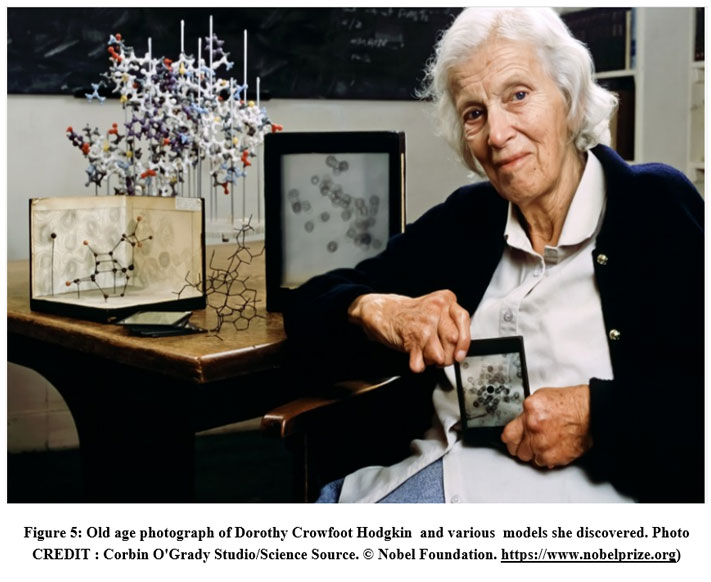 | Figure 5: Old age photograph of Dorothy Crowfoot Hodgkin and various models she discovered . Photo CREDIT : Corbin O'Grady Studio/Science Source. © Nobel Foundation. https://www.nobelprize.org) |
Inspirational Note: Dorothy Hodgkin suffered greatly from rheumatoid arthritis when she was 24 years only and it continued till her death in 1994 (see her hands in the above figure 5). Due to this she suffered great pain through out her life. In spite of this she never dropped a moment in her research concentration, even she supplemented her teaching and research duties with international collaborations to develop research in crystallography around the world.
Crystallography in Astrophysical compact objects
Discovery of Cosmic Baby
The Swift Burst Alert Telescope (BAT) 12, 13 detected typical characteristics of a short burst from a magnetar on 12th March 2020 at 21:16:49 UT 14. Swift E-ray telescope (XRT) finally detected this new but un-catalogued X-ray source as Swift J1818.0 – 1607 which is presently known as Cosmic Baby (see fig.6). The significant parameters of cosmic baby are :
Characteristic age ~ 240 years 15
Surface magnetic field strength ~ 2.7 x 10¹⁴ G
Dipole magnetic field strength ~ 7 x 10 14 G
Spin period = 0.7333920s
Coherent periodicity of X-ray signal = 1.36 s
Period derivative ~ 9 x 10 – 11 s. s-116
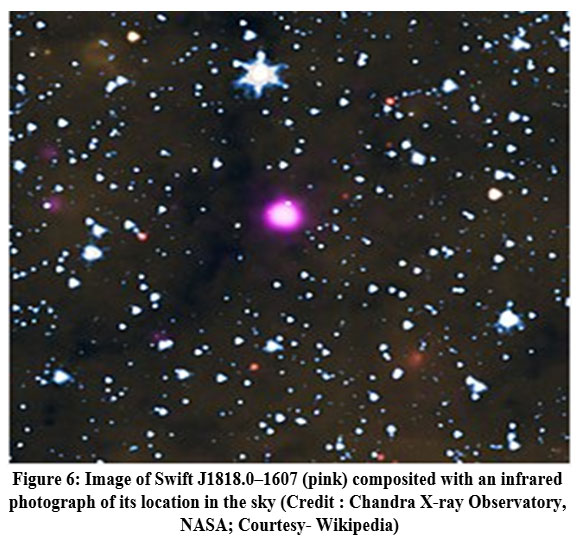 | Figure 6: Image of Swift J1818.0–1607 (pink) composited with an infrared photograph of its location in the sky (Credit : Chandra X-ray Observatory, NASA; Courtesy- Wikipedia) |
Based on the initial observed data Parui 17 – 19 estimated internal core magnetic field strength and elliptiicity of this cosmic baby and found 8.9424 x 10¹⁷ G and 9 x 10 – 3 , respectively. It is seen that deformation due super-strong magnetic field turns it into a “triaxial star”. As its age is ~ 240 years this cosmic baby will exhibit its triaxiallity for next 760 years. The importance of cosmic baby is that it shows the first evidence of the existence of a triaxial star that was predicted by S. Chandrasekhar in 1969 i.e. more than 50 years ago 20 This means that physical existence of a triaxial star is possible.
Crystal structure inside the Neutron Star (i.e. Magnetar)
Compact objects such as white dwarfs, neutron stars and blackholes are the endpoint products of stellar evolution. Our present understanding is that when a massive star ( mass M > 8 Mo, Mo being the mass of the sun
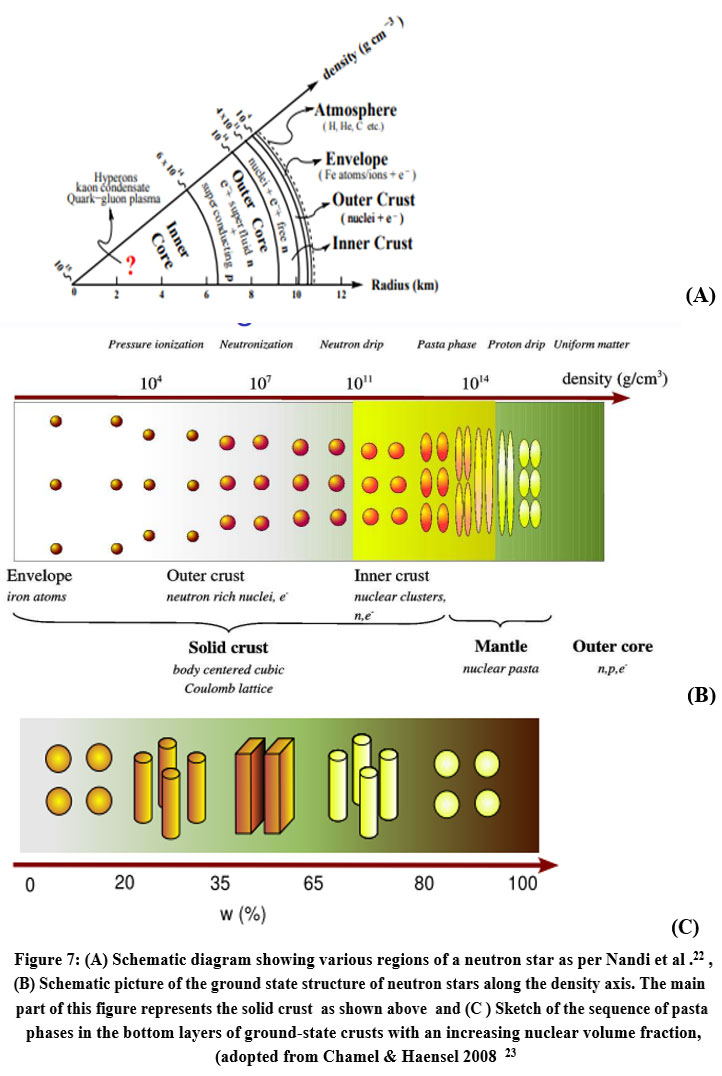 | Figure 7: (A) Schematic diagram showing various regions of a neutron star as per Nandi et al .22 , (B) Schematic picture of the ground state structure of neutron stars along the density axis. |
At densities >~ 4 x 10¹¹ g.cm – 3 , not all but a fraction the neutrons become unbound and form a gas around the nuclei 26,27. With further increase in density i.e. at density >~ 1014 g.cm – 3 some 90% the nucleons are neutrons, while nuclei are proton clusters with a small neutron fraction 26. But at density above 1014 g.cm-3 nuclei can no longer exist, turn into a uniform plasma of almost pure neutron matter with a few % admixture of protons and electrons under strong magnetic field ~ 1015G at the bottom of the inner crust. Therefore, constituents of inner core of neutron star , under high pressure and strong magnetic field, will have undergo superfluidity, superconductivity, liquid crystal phases 28. This means that inner crust of a neutron star ( also magnetar ) an ideal location of existing free neutrons, proton cluster, electrons under extreme physical conditions. Due to this extreme pressure and strong magnetic field deformation of the nuclei , in particular neutrons, protons as well as the structure or shape of the neutron star (i.e. from ellipsoid to triaxial ), will arise 20. In this context, the free neutrons in the interior of neutron star may play an important role towards understanding the nuclear and magnetic structure under extreme temperature, pressure, and high magnetic field associated with the nano science 29.
Mangetars are slowly rotating neutron stars having surface magnetic fields ~ 1014 – 15 G.Cosmic baby possesses internal magnetic fields ~ 1017 G and its age is ~ 240 years. As a result, continuous observation of the evolution of cosmic baby provides the astronomers / scientists the information (i) the evolution of interior magnetic fields as well as (ii) the structure formation in the crust region associated with this strong magnetic fields. As the magnetic field strength in the interior of a magnetar is few order more than that of the neutron star, cosmic baby could be a probe to understand the formation of crystallographic structure at terrestrial level w.r.t. that of on our Earth. In an experiment, done inside the International Space Station (ISS), it has been observed that protein crystals are formed many times more in shape and size in the ISS laboratory than that formed in our earth based laboratory (see fig.8). This also raises a question—whether this will be valid in compact objects also ? i.e. crystal formed inside the crust of a magnetar or neutron star would be different than that of formed , if possible to produce the same on the earth based laboratory, on our Earth (!).
 | Figure 8: Schematic diagram showing experimental result of protein growth as obtained in the laboratory in ISS (left) and in the earthed base laboratory (right) . |
Cosmic Crystallography
Spacetime Crystallography
In general, an ordinary crystallography deals with the regular discrete and static arrangement of atoms in space. For dynamic consideration the additional dimension of “time” is introduced to study the origin of crystals and their physical properties like conductivity and compressibility. To understand the dynamics of space and time in which the crystal is embedded , Toffoli 30 found the spacetime structure underlying a discrete but regular dynamics. To understand this discrete spacetime histories one has to know how the possible states of this crystal transform itself under different crystal transformation. It will provide us the basic of spacetime crystallography so that the novel features of this (i.e. spacetime crystallography) can be compared by analogy and by contrast with the conventional crystallography.
Considering the space-time as a “fluid” and “magnetic reconnection” such that spacetime fluid is “stirred” or “mixed” by this magnetic reconnection process and resulting which a vast amount of energy releases. This released energy could have a relation towards the formation of blackholes, the acceleration of particles in high energy astrophysical environment or origin of the Universe itself. According to Husk 31 — two regions of spacetime means different magnetic field orientations are brought together the similar one of two fluids with different velocities. When they interact i.e. their interaction implying the magnetic fields would “reconnect” with a release of a burst of energy that could have profound implication for the surrounding spacetime. This means that there is a possibility of formation of “ vortices” and
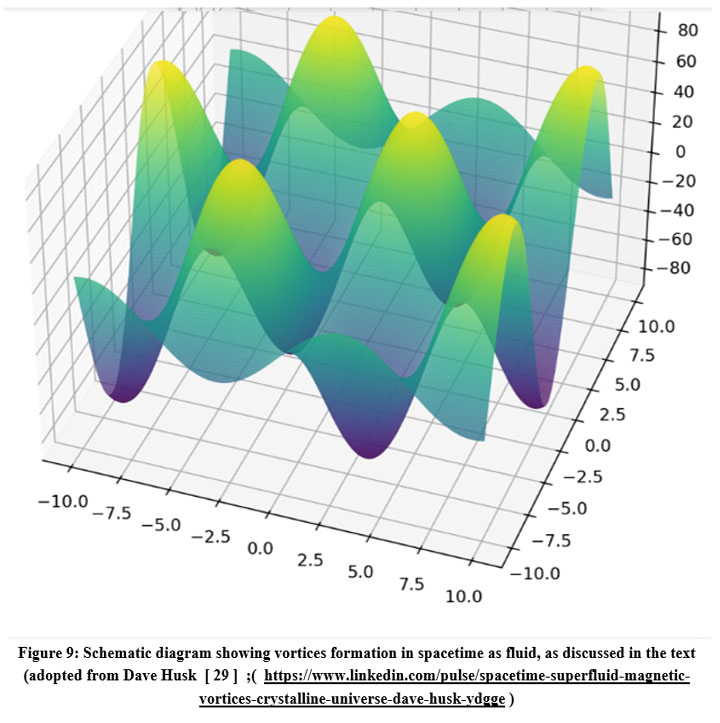 | Figure 9: Schematic diagram showing vortices formation in spacetime as fluid, as discussed in the text (adopted from Dave Husk [ 29 ] |
“wormholes”. Vortices are those regions, in fluid dynamics, when the fluid rotates around a central axis through the creation of “Whirlpool” effect. Thus, in the spacetime context, vortex produced regions indicate the fabrication of severely curved spacetime i.e. generation of “gravitational whirlpool” type effect due to warps the motion of the objects associated on that spacetime.
Regarding workholes, it could be viewed as “tunnels” or “channels” passing through the spacetime, connecting two distant regions of spacetime. The significance of these tunnels is that their stability could be possible by the magnetic fields and currents within the spacetime fluid that allow for faster than light travel and communication.
This concept of spacetime as fluid is supported by the recent detection of gravitational waves through LIGO and VIRGO in 2015 which provide a strong evidence of the existence of ripples
in spacetime. These ripples can be considered as waves propagating through spacetime fluid which is similar like water waves on the surface of a lake. Not only that, the frequency and amplitude of these waves could be related to the properties of the spacetime such as its density and magnetic field strength.
This new idea of spacetime as a fluid offer us to rethink of our understanding the behavior of gravitational waves and their key role in shaping the universe i.e. if the spacetime is a dynamic, flowing medium then how the structure formation and the emergence of complexity is possible under more turbulent and chaotic situation of the spacetime fluid in the early universe ?
In fact, our present understanding is that as the universe expanded, due cooling space time fluid could have become less turbulent, leading to the formation of the large scale structures what we see today.
Therefore, more investigation are required in searching the correlation between magnetic reconnection, spacetime vortices and wormholes treating space time as fluid.
Conclusion
Discovery of x-ray offered the scientist to see the bone structure of a human body. Max von Laue explained another important property of x-ray i.e. diffraction from a solid or crystal body. Bragg’s discovery of reflection of x-rays from the atoms and their associated planes provide us the internal arrangement of atoms situated in the respective planes. Thus, with the help of measuring the x-ray reflection parameters scientists were able to see the internal structure of a crystal i.e. arrangement of atoms inside the crystal. This implies that a new branch of science — the Crystallography was born. Pioneering works of Dorothy Hodgkin on penicillin, insulin and vitamin B12 open a new view of biological macrostructure of medicine that was helpful for treatment of the related diseases. Application of this new probe i.e. the x-ray crystallography was extended in different branches of science such as chemistry ( to see the possible atomic and molecular structures of elements in periodic table ), physiology and microbiology ( helpful for knowing the structure of DNA, RNA) , astrophysical compact objects ( such as neutron stars, magnetars and their crustal structures under strong magnetic field), cosmic crystallography. In cosmic crystallography a new idea of spacetime as a fluid that could be stirred or mixed by the magnetic reconnection and resulting which “vortices” and “wormholes” are generated with the release of vast amount of energy.
This burst of energy could create black holes, and even responsible for creation of the universe itself. This raises a question regarding structure formation at the early phase of the universe where chaotic situation were existed. Another important question arises regarding the crystal formation in space i.e. terrestrial space. Experiment on Protein structure formation in the laboratory on boarded in International Space Station (ISS) showed that protein crystals are formed are larger both in shape and size in comparison to that of in the laboratory on the earth. This experimental results hint that crystal structure could be found in the interior of terrestrial compact objects i.e. neutron stars, pulsars, magnetars which are far more effective than that could be produced , if possible , on the earth based laboratory.
Acknowledgement
The author is greatly indebted to Dr Muskan Khan for her kind invitation and encouragement. He also wishes to thank Prof. H. N. K. Sarma, Dept. of Physics, Manipur University; Mr B. K. Ganguly, Airports Authority of India, Kolkata; Mrs. Tapati Parui and Sri Rajarshi Parui for their kind encouragement and help.
Funding Sources
The author(s) received no financial support for the research, authorship, and/or publication of this article.
Conflict of Interest
The author(s) do not have any conflict of interest.
Data Availability Statement
This statement does not apply to this article.
Ethics Statement
This research did not involve human participants, animal subjects, or any material that requires ethical approval.
Reference
- Encyclopedia Britannica : Robert Hooke ; http://britannica.com/biography
- Friedrich W., Knipping P., Laue M. : In Sitzungsberichte der Math. Phys. Klasse (Kgl.) Bayerische Akademie der Wissenschaften 303–322 (1912).
- Bragg, W. L. : The structure of some crystals as indicated by their diffraction of x-rays. Proc. Royal. Socy. London. A 89, 248 (1913)
CrossRef - Bragg Law : Wikipedia Common.
- Kim H. : Crystallography 1782 – 1912 in Wikipedia
- Names and symbols of the 32 crystal classes. Int. Tables of Crystallography. Vol- A Chapter -10,11, pages 794 – 820 (2006)
- Ewald P. P. : 50 years of X-ray Diffraction. In Chapter 3. Crystallography. Int. U. Crystallography Publ. (1962)
CrossRef - Ashcroft N. W., Mermin N. D. : Solid State Physics. Rinehart and Winstro Publ. NY. USA (1976) . ISBN – 0030839393
- Crowfoot D. : X-ray single crystal photo proof of Insulin. Nature 135, 591 (1935)
CrossRef - Crowfoot D. and Bernal J. D. : Crystal structure of Vitamin B1 and of adenine hydrochloride. J. Chem. Socy. Annual Report. P. 716 (1933)
- Collective works of Dorothy Hodgkin. Eds: G G Dodson et al, Indian Institute of Science, Bangalore.
- Gehrels N. et al . : The Swift Gamma Ray Bursts Mission. Astrophys. J. 611 , 1005 (2004)
CrossRef - Gehrels N., Razzaque S. : Gamma Ray Bursts in the Swift Fermi Era. Frontiers Phys. 8 , 661 (2013)
CrossRef - Evans P.A., Gropp J. D., Kennea J. A., et al. : Swift-BAT trigger 960986: Swift detection of a new SGR Swift J1818.0 – 1607 . GCN Circular # 27373 (2020)
- Esposito P., Rea N., Borghese A. et al. : A very young radio-loud Magnetar. Astrophys. J. Lett. 896 , L30 (2020)
CrossRef - Champion D., Desvignes G., Jankowski F. : Spin evolution of the new magnetar J1818.0 – 1607. Astron. Telegram # 13559 (2020)
- Parui R. K. : A Remark on “Do triaxial star supermassive compact star exist ? Int. Astron. Astrophys. Res. J. 5 , 33 (2023)
- Parui R. K. : A New Compact Star—the "Triaxial Star"—and the Detection of a Cosmic Baby: A Possibility. Int. Astron. Astrophys. Res. J. 5 , 38 (2023)
- Parui R. K. : Cosmic Baby and detection of a new compact star — the Triaxial Star : A possibility. Astrophys. Space Sci. 368 , 46 (2023) . Revised to be submitted (2024)
CrossRef - Chandrasekhar S. : Ellipsoidal Figures of Equilibrium. Yale University Press, New Haven, USA. (1969)
- Soderberg A. M., Berger E., Page K. L. et al. : An Extremely luminous X-ray out burst at the birth of a supernova. Nature 453 , 469 (2008)
CrossRef - Nandi R, Bandyopadhyay D. : Magnetized neutron star crusts and Torsional shear : Modes of Magnetosphere. J. Phys. Conf. Series 420, 012144 (2012)
CrossRef - Chamel N. , P. Haensel, Physics of neutrton star crusts, Living Rev. Relativity 11, 10 (2008)
CrossRef - Oyamatsu, K., Hashimoto, M., and Yamada, M., “Further Study of the Nuclear Shape in High-Density Matter”, Prog. Theor. Phys., 72, 373–375, (1984).
CrossRef - Shapiro S L, Teukolsky S A. : Black holes, white dwarfs and neutron stars. The physics of compact objects. Wiley-Interscience Publication, New York: Wiley, 1983.
CrossRef - Örtel M, Hampel T, Klahn S. : Equation of States for supernova and compact stars. Rev. Mod. Phys. 89 , 015007 (2017)
CrossRef - Potekhi A Y, Chabrier G. : Crust Structure and Thermal evolution of Neutron Star in soft x-ray transients. Astron. Astrophys. 645 , A102 (2021)
CrossRef - Ravenhall D G, Pethick C J, Wilson J R. : Structure of matter below nuclear saturation density. Phys. Rev. Lett. 50 , 2066 (1983)
CrossRef - Anderson I S, et al : X-rays and Nano Technology workshop. National science Foundation, USA. (2005)
- Toffoli T. : A pedestrian’s introduction to space time crystallography. IBM J. Res. & Dev. 48, 13 (2004)
CrossRef - Husk D. : Space time as superfluid magnetic vortices and the crystalline Universe. http://www.linkedin.com / pulse/spacetime-superfluid-magnetic-vortices-crystalline-universe-dave

This work is licensed under a Creative Commons Attribution 4.0 International License.