
Analysis of Bharadwaj Spectral Rings
Rakesh Kumar Pandey* 
1Synod Higher Secondary School, Mission Vengthlang, Aizawl, Mizoram India .
http://dx.doi.org/10.13005/OJPS10.01.12
Originally written in Sanskrit by Maharshi Bharadwaj in Vedic period, the Amshubodhini mentions a novel spectrometer that measures the three components viz. ultraviolet, visible and infrared regions of solar radiation simultaneously using a conical prism that forms unique circular spectrum unlike linear spectrum formed by a conventional triangular prism. The present article discusses in detail about the Dhvanta Pramapaka Yantra and its working as well as the complexity of the spectral rings formed by a conical prism in terms of assimilation of Snell’s laws of refraction and Cauchy’s dispersion relation. It is found the assimilated formulae reproduces the observed spectral data and the dark lines in solar spectrum vis-à-vis Fraunhofer lines in modern spectroscopy and obtained by the Maharshi. Wavenumber is proportional to square root of change in radii of spectral rings associated to its limiting value
Copy the following to cite this article:
Pandey R. K. Analysis of Bharadwaj Spectral Rings. Oriental Jornal of Physical Sciences 2025; 10(1).
DOI:http://dx.doi.org/10.13005/OJPS10.01.12Copy the following to cite this URL:
Pandey R. K. Analysis of Bharadwaj Spectral Rings. Oriental Jornal of Physical Sciences 2025; 10(1).Available here:https://bit.ly/4aRTbte
Download article (pdf) Citation Manager Publish History



Introduction
An ordinary sunlight contains seven colors VIBGYOR, which become visible in a rainbow or when light passes through a prism. If a star is big enough, in its sparkle, the seven colors appear same as the emission of color from a diamond. Many Vedic verses state the presence of seven visible colors in sunrays long before establishment of optics. Some verses that state light dispersion are as follow:
Radiant seven rays, which are yours hairs Sun, carry illumination (chariot).
Rig Veda 1.50.8
A single ray (single wheeled chariot) comprising of seven colors carries sunlight.
Rig Veda 22.164.2 and Atharvaveda I 9.14.2
He, who is seven rayed, the bull, the mighty, set free the seven oceans to flow at pleasures.
Rig Veda 2.12.12
Purifier sunlight contains seven colorful rays by which light reaches everywhere.
Yajurveda 6.5.13
Sun observes whole world with seven colorful rays.
Samaveda 4.36.7
There are seven types of sunrays.
Atharva Veda 7.107.1
A single white ray alone is known by seven names.
Taittareeya Aaranyaka 3.11.9
There are thousands of self-divisible rays, which form seven distinct groups of rays that combine to a single ray of a Sun.
Brahmand Puran, Kalpaprasandhi Varnanam 45
It is very interesting that sunrays have seven distinct regions and each region has thousands of self-divisible discrete rays. Surprisingly, electromagnetic EM waves have seven distinct regions viz. gamma rays, X-rays, ultraviolet UV, visible, infrared IR, microwave, and radio wave. Visible region lies between UV and IR regions of electromagnetic EM spectrum. UV region is at smallest wavelength and IR region is at longest wavelength ends of visible region. Maharshi Bharadwaj named UV, visible region, and IR regions to andhatama (dark), gurhatama, and tama (heat), respectively. He had studied about the three components viz.; UV, visible and IR of solar radiation in detail using his own devised spectrometer, the Dhvanta Pramapaka Yantra (radiation measuring device), and a conical prism and compiled the findings in his book Amshubodhini in Vedic period.1 Unlike the linear spectrum formed by a conventional triangular prism, he succeeded to form a unique circular spectrum, using a conical prism- a three-dimensional array of infinite triangular prisms. He has also studied in detail the dark lines in sunlight so called as Fraunhofer’s lines in modern spectroscopy and different solar spectral series using his spectrometer.2-6 The availability of explanations of spectral rings formed by a conical prism used in the Dhvanta Pramapaka Yantra is very scanty due to its complex structure.
From the concerned literature survey, it is found that Vedic hymns state presence of seven colors in sunrays but, measurements and analyses of UV, visible and IR components of solar radiation using conical prism are only available in the Amshubodhini. Thus, it becomes quite imperative to bring ancient spectrometer and its outcomes reported by Bharadwaj in notice of researchers to promote this unique discovery. The present article discusses in detail about the spectrometer Dhvanta Pramapaka Yantra mentioned in Amshubodhini. The working of this spectrometer and theories behind complexity of circular spectral rings formed by a conical prim in terms of the assimilation of Snell’s law of refraction, basic dispersion laws through a triangular prism and Cauchy’s dispersion relation are explained. It is found the assimilated formula reproduces vis-à-vis spectral data observed using modern systems and obtained by the Maharshi. It is also reported that wavenumber
Materials and Methods
The Analyses of Bharadwaj spectral rings include experimental set-up, formation of the Bharadwaj spectral rings, theory of its formation, evaluation of kakshya, and measurements.
Experimental Set-up
In accordance with the Amshubodhini Aphorisms 9-10, high speed electrons and positrons annihilate to produce radiation that further split into many parts and three of them are measurable radiation viz. ultraviolet UV, visible, and infrared IR simultaneously by Dhvanta Pramapaka Yantra. Unlike linear spectrum formed by conventional triangular prism, Dhvanta Pramapaka Yantra splits light rays into its components by passing through a conical prism that forms unique circular spectrum in the universal deviation setting and facilitates readings of spectral rings on a dial and thus, seems to be a new concept of today. In his book Dhvanta Vijyan Bhashkara, Sharikanath (760AD-840AD) has explained that the cause of various kinds of radiations is vibrations and movements of electrons and positrons and their annihilation produces pure energy in radiation form 7. Fig.1 shows a schematic diagram of Dhvanta Pramapaka Yantra mentioned in Amshubodhini verses. Sharikanath has cited that Dhvanta Pramapaka Yantra has 32 ancillaries to elucidate spectrum in detail is 109th instrument stated in the book Yantra Sarvasya of Maharshi Bharadwaj. However, only 13 ancillaries are sufficient to explain spectrum. According to the ancillaries, first of all, fix a light weight UV transparent circular shining plate made of 106th class glass of diameter 10 Vitas over a firm glass made base of size 10 vitas×10 vitas (marked 1) where 1Vitas=12 Angulas and 4 Angulas = 10cm. After that, stony glass made rod so called principal pillar marked 2 of circumference 4 Angulas and height 6 Vitas, which has three holes one below other at one Vita apart from top along with electrical wirings that connect the other parts, is fixed firmly in the center of mirror at base. Fix three glass rods of lengths 60,50,and 40 Angulas, respectively horizontally through these holes in downwards.
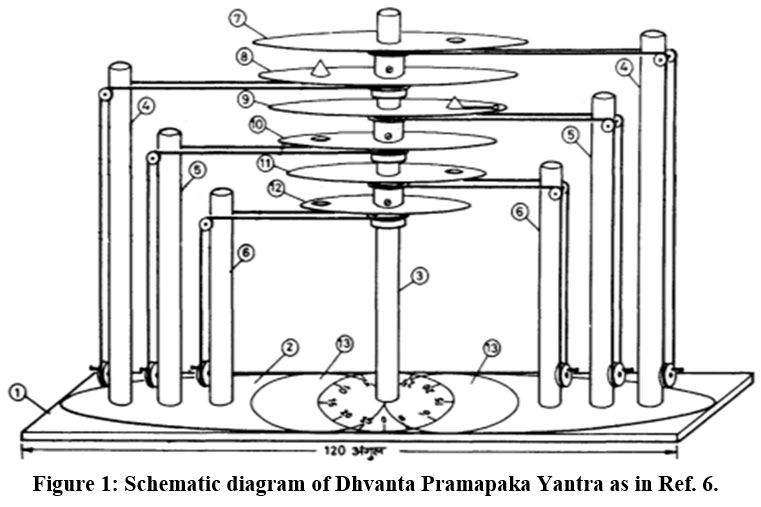 | Figure 1: Schematic diagram of Dhvanta Pramapaka Yantra as in Ref. 6.
|
Later, a plane mirror graduated equally in 30-30 divisions in anticlockwise in right semicircle and clockwise in left semicircle is placed such that it holds central pillar in its center. Each division is a Ghatica (1 Ghatica=24 minutesor 6^°) marked with dots in digits in day (right semicircle) and in night (left semi-circle) making sections like a 24-hour clock dial. Divide each of these angles into sixty equal parts and each of these sub-divisions represents a Vighatica 1 Vighatica=24 seconds.
On both sides of third hole, stony glass made two poles of height 60 Angula (marked 4), two poles of height 50 Angula (marked 5), and another two poles (marked 6) of height 40 Angulaare fixed at 10-10, 8-8, and 6-6 Angulas from principal pillar, respectively. Although heights of pairs of poles on both sides are equal yet in general, the position of poles on right sides are kept slightly higher than the corresponding hole while that on left sides are kept slightly lower than the same hole. On both sides of central pillar, 3-pulleys-rope-axle mechanisms connecting central pillar running from top of all poles are fixed on the base.
After that, holding collimating lens (prabhakaramani) of glass 88th class, prabhakaradarsha disc of glass 106th class (marked 7) of radius 50 Angula and graduated with 30-30 lines in its two halves in anticlockwise and clockwise will be placed horizontally above the third hole in such a manner that it can be turned via rope over 3-pulleys-rope-axle system fixed on the right. Then, graduated like divakardarsh, a 216th class glass nishakaradarsha disc (marked 8) of radius 45 Angula washed with CaOH2 and H3PO4 embedded with 157th class glass conical prism as dispersing element that look like moon halo will be placed below third hole on principal pillar in a manner that rope over pulley on left side can rotate it. Then after, inscribed with points, indicator lines having two cavities, bhanuphalak (marked 9), is of radius 6 Angula less than that of nishakaradarsh disc is placed above second hole on central pillar so as it would be rotated freely with help of 3-pulleys-rope-axle mechanism on the right. In the first cavity, an infrared absorbing sensitive graduated gharmapaharakamani made of 164th class glass is submerged into mercury. The extra amount of mercury that spills out due to rise in temperature is collected into lower second cavity before it gets amalgamated.
Bhanuphalaka resembles to a honeycomb in appearance is made from alloy of 8 parts of extracts of green doorva grass, lotus flower, etc. i.e. potassium iodide KI, 16 parts of copper Cu of 16th grade, 8 parts of gold Au of 12th grade, 6 parts of arsenic sulphide AsS2 & AsS3), 5 parts of mercury Hg, and 6 parts of quartz SiO2 (suryakantmani) placed in a crucible and fused in a furnace at temperature 432 degree of ancient scale and poured into a die to cast. This iron casted material of empirical formula 8KI16Cu8Au6AsS25Hg6SiO2 is the ushnapakarshaka is transparent to heat. Suryakantmani is dual in nature as it appears watery under solar radiations otherwise fiery. After that, inscribed with points and lines the smoky circular dhoom-chhaya- mukha-darsa glass plate marked 10, on which is placed 214th class glass made convex lens (tamograhaka mani) suitable to ultraviolet radiation (tamachhaya). The combination is placed below second hole such that 3-pulleys-rope-axle mechanism on left could rotate it. When exposed to sunlight, this transmits ultraviolet radiation, which is measured on graduations on it. A calibrated glass bhanugarbhadarsha circular disc joined with a convex lens marked 11 is placed over the first hole such that it could be easily turned by 3-pulleys-rope-axle mechanism provided on right side. The convex lens absorbs some part of incident light, which is measurable from graduations on Bhanugarbhadarsha, received from bhanuphalak.
Made by above mentioned method and glass prakashastambhanabhidlauha, a special Prakash stambhan disc marked 12 with graduations and on which another convex lens (vallabhamani) is seated. Place this arrangement below the first hole and connect firmly to corresponding 3-pulleys-rope-axle mechanism provided on left of principal pillar so that the reflectivity of the special bhagarbha mirror will cause the light rays to be mapped.
A mixture, heat absorbing material, of empirical formula 8SiO25CaO4Fe3O46Ca3P2O8 is made from mixture of 8 parts of silica SiO2, 5 parts of CaO, 4 parts of magnetite Fe3O4, and 6 parts of tricalcium phosphate Ca3P2O8 or H3PO4 i.e. ruruka (deer bone ash) fused in a rotating crucible (brahmanikamusa) at temperature 265 degree of ancient scale and poured rapidly into a yantramukh die to cast.
After that, the ultraviolet-visible differentiating chhayaprabhavibhajaka plate marked 13, which is made by joining two round plates side by side on base, be placed to collect vertical projections and display horizontally into round plates on both sides of principal pillar. Differentiating plate of empirical formula 10C 12NH4 Cl 16SbS 24H3 PO4 10Na 8SiO2 14Hg 9Fe2 O3 5Ca CO3 is made from mixture of 10 parts graphite-C, 12 parts of NH_4 Cl, 16 parts SbS, 24 parts of H3 PO4,10 parts of halides of Na and K, 8 parts of sand SiO2), 14 parts of Hg, 9 parts of Fe2 O3, and 5 parts of CaCO3 are placed in a crucible and fused in a furnace at temperature 526 degree of ancient scale and poured into a die to cast the plate. Further, right side plate should be coated seven times of paste made of Al2 O3, ferric ferrocyanides and copper salt. Then after, paste of alkali salts is coated on the plate and then fine dark sand is spread over the coatings. Afterwards, a colorful, charming and beautiful sunrays sensor is rapidly fixed.
Similarly, the left circular plate is coated seven times of a paste, which is prepared from mixture of alkali extract of either mimosa, acids of metal ashes of MnO2 and arsenic compounds. The mixture is spread over the plate with the blue powder in the last. Next 37-grade UV radiation sensor is placed at the center.
Formation of Bharadwaj Spectral Rings
Fig.2 shows a schematic diagram of working of Dhvanta Pramapaka Yantra and formation of Bharadwaj spectral rings. Light rays enter through top hole on collimating lens then, the rays it renders pass through the conical prism on the wheel underneath and continue cascading downwards to marked 2, which leaves a projection of a spectral ring that can be measured on dials on the base.
By properly adjusting the six discs, which are ratable about central pillar as sown in Fig.1, the emergent sunrays from top right-side lens get dispersed from conical prism is focused on right plate. Similarly, with help of left side tamogarbhamani lens, which allows the UV radiation present in sunrays, focus the light on left side of the circular plate. Thus, with such arrangement, visible radiations on right side and UV on left side could be measured simultaneously
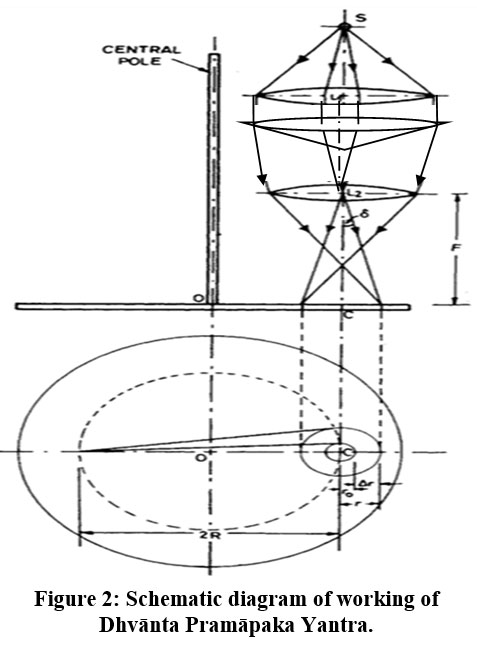 | Figure 2: Schematic diagram of working of Dhvanta Pramapaka Yantra.
|
Theory of Formation of Bharadwaj Spectral Rings
In Fig.3, a light ray incident normally on base of conical prism of base angle a. The ray deviates at angle s. Using Snell’s law, the refractive index of prism material is 8:
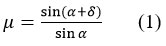
If there is a small deviation A from central deviation s0 i.e., s = s0 + A, then,
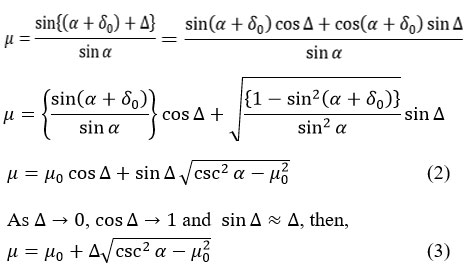
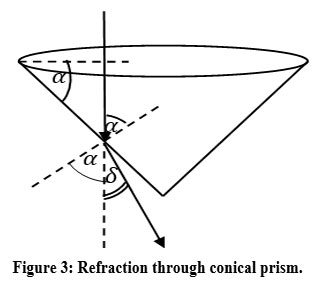 | Figure 3: Refraction through conical prism.
|
If i and e are the angles of incident and emergent and corresponding refraction angels are r1 and r2 for any prism of base angle a, then, from Snell’s law of refraction, the refractive index of prism material is:
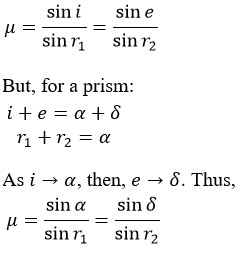

Elimination of sin r1 and cos r1 in above relation results to:
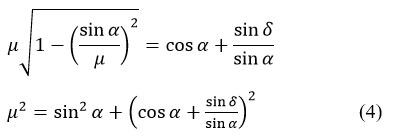
In accordance with Augustine Louis Cauchy, the wavelength

Where

with constant a' and each term of sum representing an absorption resonance of strength bi at a wavelength (hi ). Fig.4 shows variation of refractive index with wavelength. Both, the Cauchy’s relation and Sellmeier relation exactly reproduce experimental data in range 3900A-7800A without deviation. Being small b2 / h4 , bc/ h4 , bc/ h6 , c/h4 , and c2/ h8 are neglected in assimilation of Eqns. (4) and (5), whose final form is as below:
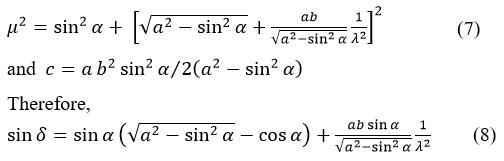
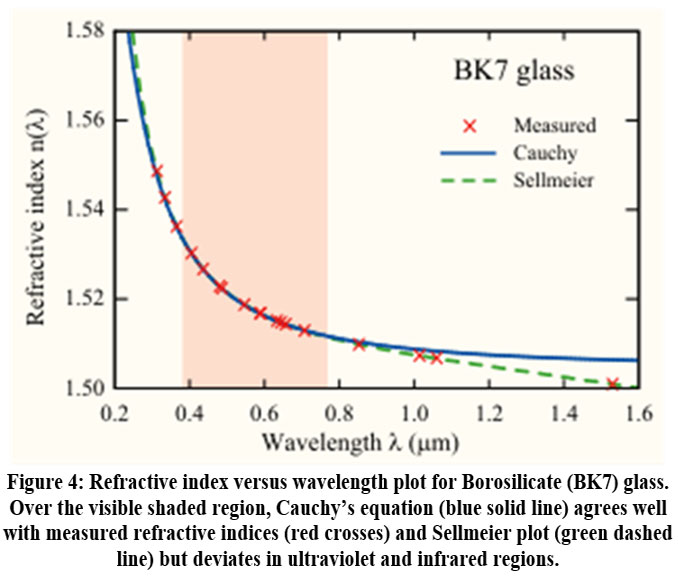 | Figure 4: Refractive index versus wavelength plot for Borosilicate (BK7) glass. Over the visible shaded region, Cauchy’s equation (blue solid line) agrees well with measured refractive indices (red crosses) and Sellmeier plot (green dashed line) but deviates in ultraviolet and infrared regions. |
Angular path difference s at central axis of conical prism would be zero i.e., s0 = 0 and thus, this line would be bright due to constructive interferences. The spectral rings would be formed due to dispersion around this line (Fig.5). If s = s0 for h = 0o i.e., wavenumber v = 1/ h = 0, then, Eqn. (8) becomes:

Combination of Eqns. (8) and (9) results to:

Let r0 and r be the radii of spectral rings corresponding to wavelengths h = 0o and h, respectively. For both s0 - 0 and s = 0, sin s0 = tan s0 = r0 / F0 and sin s = tan s = r/F0 , respectively with focal length F0 of focusing lens. Therefore, above relation reduces to:
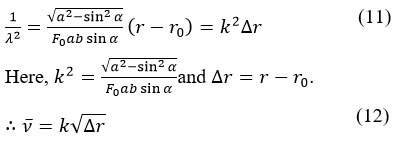
Thus, wavenumber is proportional to square root of change in radii of spectral rings concerned with that for the limiting value of v = 0. Solar/stellar radiation are made to fall on focus of collimating lens through pin hole to render a beam of parallel rays that fall normally on the base of conical prism. After refraction through the prism, radiation of different wavelength imaged as rings of varying radii in the focal plane of focusing lens, which finally projects on the base plates as in Fig. 5.
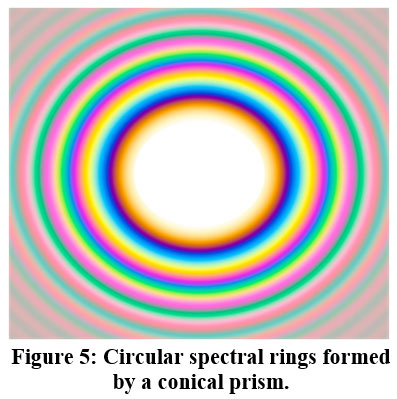 | Figure 5: Circular spectral rings formed by a conical prism.
|
Comparison of Eqns. (3) and (5) gives:

Table 1: Refractive index (for red, yellow, blue colors) and spectroscopic data for flint glass.
Refractive Index | Wavelength (A | Spectral Line | Color |
1.622 | 6563 | C | Red |
1.627 | 5890 | D | Yellow |
1.639 | 4862 | F | Blue |
Evidently, deviation is inversely proportional to square of wavelength. Hence, varying in wavelengths, all colors deviated differently and form spectra. The spectroscopic data obtained in ancient time can be reproduced using Eqn. (13). The constants a and b can be estimated by placing the values of wavelength and corresponding standard refractive index as given in Table 1 for flint glass 9. For a flint glass made conical prism of base angle a = 30°, a = 1.6013215 and b=0.0089068291 u m2, then:
.jpg)
Using Eqn. (15), spectral series number and its angle of deviation is obtained in kakshya unit. The longest wavelength end of visible radiation and the smallest wavelength of Infrared is 7700A. Thus, A value for this point is:
Evaluation of Kakshya
Spectral data is expressed in terms of ancient Vedic unit of angle Kakshya whose value is obtainable from the r value obtained by Aryabhata (476-540 AD) in around 500 AD that states that add four to one hundred, multiply by eight and then add sixty-two thousand; the result is approximately the circumference of a circle of diameter of twenty thousand values (approx.) i.e., [((100+4) × 8 + 62,000)/20000]=3,1416, which is correct up to five places for the value of r = 22/7 10. However, in accordance with Lilavati verse written by Bhaskaracharya-II (1114–1185 AD) in around 1150 AD, the value of r is diameter multiplied by 3927 and divided by 1250 is circumference of a circle. Thus, r value is 11:
Clearly, a circle of 10000-unit length has circumference of 31416 units. This is nearly equal to diameter multiplied by r. Thus, the Kakshya is the angle subtended by an arc of unit length at center of the circle i.e., 10000 kaksha=1 radian.
Measurement of Bharadwaj Spectral Rings
Amshubodhini provides the spectroscopic data in the unit of kaksha, which is the angular position of spectral rings, obtained from graduated circular scale. The enumeration of symbolic names of radiation measuring numbers are Alika, Kaulika, Randhra, Mand, Bimboka, Vichaka, Tamasa, Raunika, Kuta, Stambha, Sambara, Manchura, Gucchaka, Kudupa, Gulika, Chhetika, Padma, Mandala, Kanchuka, etc. are given in Table 2 with their corresponding values and spectral classes. Similarly, kakshya value of Fraunhofer lines lying in visible region of solar spectrum can be obtained. Although many Fraunhofer lines have been observed in solar spectrum yet few of them have been classified as A, B, C, D, F, etc. 9 Evaluation of kakshya value of these Fraunhofer lines indicates Alika as A, Bimboka as B, Vichaka as C, Stumbh as D, Gucchakaas E2, Kudupa as B4, Gulika as F, Mandala as G, Kanchuka as h and Hg as calculated values are very cose to those given for the respective symbolic names given in the text are given in the Table 3 from column 2-6. Conversely, from kakshya values of the respective symbolic names Kaulika, Randhra, Mand, Tamasa, Raunika, Kuta, Shambhara, Manchura, Chhotika and Padma, the corresponding wavelengths may also be calculated and those are asterisk marked in third column of Table 3. These wavelengths may be accounted by those Fraunhofer lines, which are present in solar spectrum but no spectral symbol attributed to them in Astrophysics. In order to complete the list for visible range, two more H and K Fraunhoffer lines along with the value of limiting wavelength 3900 A as a conjuction of violet to ultraviolet radiation, which may be termed as andhatamobindu have been included in last three rows of the Table 3. The inclusion of these may also be considered as justified since the list of the symbolic names given in the text abruptly stops with etc. Thus, it is obvious that ancient list is not exhausted. Interestingly, symbolic names commencing from Kaulika to Mandala just match with the symbols of types of stars as enumerated in spectral classifications done in modern astrophysics shown in columns 7 and 8 of the Table 3 as type of star and visual appearance, respectively.
Table 2 Spectral (kakshya) number and spectral classes.
Spectral kakshya | Spectral class |
125 | Tamobindu |
130 | Alika |
133 | Kaulika |
138 | Randhra |
146 | Mand |
156 | Bimboka |
176 | Vichaka |
186 | Tamasa |
194 | Raunika |
206 | Kuta |
216 | Stambha |
231 | Sambara |
249 | Manchura |
267 | Gucchaka |
287 | Kudupa |
315 | Gulika |
345 | Chhotika |
368 | Padma |
400 | Mandala |
428 | Kanchuka |
- | etc. |
Table 3 Fraunhofer lines, spectral series, kakshya value and spectral colors.
S No | Fraunhofer lines | Wavelength ( | Kakshya value | Spectral kakshya | Spectral class | Spectral line | Spectral color |
1 | - | 0 | 0 | - | - | - | |
2 | - | 7700 | 125.4 | 125 | Tamobindu | - | - |
3 | A | 7594 | 128.9 | 130 | Alika | - | - |
4 | - | 7476* | - | 133 | Kaulika | RN | Dark Red |
5 | - | 7339* | - | 138 | Randhra | - | - |
6 | - | 7135* Red | - | 146 | Mand | S | Dark Red |
7 | B | 6870 | 157.6 | 156 | Bimboka | - | - |
8 | C | 6562 | 172.6 | 176 | Vichaka | M | Red |
9 | - | 6322* | - | 186 | Tamasa | - | - |
10 | - | 6190* | - | 194 | Raunika | K | Reddish Yellow |
11 | - | 6007* Orange | - | 206 | Kuta | - | - |
12 | D | 5890 Yellow | 214.3 | 216 | Stambha | G | Yellow |
13 | - | 5673* | - | 231 | Sambara | - | - |
14 | - | 5464 | - | 249 | Manchura | F | Yellowish White |
15 | 5270 Green | 267.6 | 267 | Gucchaka | - | - | |
16 | 5168 | 278.3 | 287 | Kudupa | A | White | |
17 | F | 4861 | 314.6 | 315 | Gulik? | - | - |
18 | - | 4642* Blue | - | 345 | Chhotik? | B | Blueish White |
19 | - | 4495* | - | 368 | Padma | - | - |
20 | G | 4308 | 400.5 | 400 | Mandala | O | Blueish White |
21 | h, Hg | 4164 Violet | 428.7 | 428 | Kanchuka | - | - |
22 | H | 3968.5 | 472 | - | - | - | - |
23 | K | 3933.7 | 480 | - | - | - | - |
24 | - | 3900 | 489 | - | Andhatama | - | - |
It is found from the spectrogram that transmittance of material non-hygroscopic prakasha-stambha-nadi is 0.5% for v > 5000 cm-1, which increases linearly up to maximum 9.27% for v = 2200 cm-1, h= 455 ucm, then, it decreases to zero for v = 1400 cm-1. The material of v = 5000 - 1400 cm-1) and kakshya 2-19 is suitable for the construction of lenses and windows, is transparent to infrared radiation 12.
Results and Discussion
Unlike linear spectrum formed by a triangular prism, a conical prism forms circular spectral rings due to its complex structure of three-dimensional array of infinite triangular prisms.
The spectrometer Dhwant Pramapaka Yantra facilitates to measure three regions viz. ultraviolet, visible and infrared regions of EM radiation simultaneously. Fig.6 shows a schematic diagram of circular ring formed by Dhvanta Pramapaka Yantra. for the measurement of visible radiation. The solar/stellar radiation is made to incident on collimating Prabhakarmani lens of divakardarsh disc (ancillary 7) that dispersed through conical prism, kirangrahakmani, of nishakardarsh disc (ancillary 8) and finally, focusing lens prabhamani of prabhamukhdarsha disc (ancillary 11) focuses the dispersed rays in spectral rings with centers over graduated circular scale chhaya- pakarsanadarsha (ancillary 2).
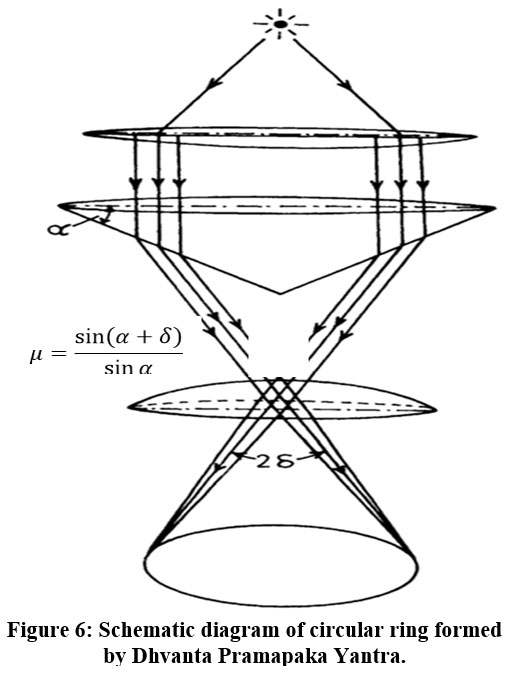 | Figure 6: Schematic diagram of circular ring formed by Dhvanta Pramapaka Yantra. |
Conclusions
Vedic hymns reveal light dispersion is not a new concept perceived by humans instead it is an old concept perceived long ago. Dhvanta Pramapaka Yantra like sophisticated spectrometer, which is quite novel, was made in use in Vedic periods in ancient India to measure dispersion for the spectral classification of solar/stellar radiations as is done now in Astrophysics today. Unlike linear spectrum formed by conventional triangular prisms, Maharshi Bharadwaj succeeded to form circular spectrums for the UV, visible and IR regions of the incident EM radiation using a conical prism, which is an array of three-dimensional infinite triangular prisms. The nature and properties of the ultraviolet, visible and infrared radiations were well known in ancient India. Many spectral lines known in ancient times are yet to be discovered. Not only the properties and methods of preparation of materials useful in construction of lens, prism and windows used in radiation studies were known to them but also, they have discovered a very special nonhygroscopic material prakasha-stambha-nadi for
Acknowledgement
Author is grateful to all colleagues and family members for their fruitful discussions, inspirations and supports during preparation of the manuscript.
Funding Sources
The author received no financial support for the research, authorship, and/or publication of this article.
Conflict of Interest
The author declares no conflict of interest in the article.
Data Availability statement
This statement does not does not apply to this article.
Ethics Statement
This research did not involve human participants, animal subjects, or any material that requires ethical approval.
Author Contributions
The sole author was responsible for the conceptualization, methodology, data collection, analysis, writing, and final approval of the manuscript
References
- Maharshi Bhardwaj. Amshubodhini Shastram. Soobbiah & Sons, Bangalore, India. 1931.
- Hodgman CD. Lange NA (Ed). Fraunhofer Lines: Handbook of Chemistry and Physics, USA. 1961.
- Straughan BP and Walker S. Spectroscopy. Chapman and Hall. 1970; 2: 347-348.
- Narlikar JV. The Structure of the Universe, O.U.P. London. 1990.
- Dongre NG. Spectroscopy in Ancient India. Indian journal of History of Science. 1998; 33(3): 229-238.
- Dongre NG. Dhvanta PmapakaYantra of Maharshi Bharadvaja. Indian Journal of History of Science. 1994; 29(4): 611-627.
CrossRef - Prakarana-Panchika, Banaras Hindu University, Varanasi. 1961; 56-57.
- Jenkins A and White HE. Fundamentals of Optics, McGraw-Hill, Inc. 1981.
- Zur Erklärung WR. der abnormen Farbenfolgeim Spectrum einiger Substanzen. Annalen der Physik und Chemie. 1871; 219: 272-282.
CrossRef - Aryabhata. Aryabhatiya. Ganitapad. 500 AD; Verse 10.
- Bhaskaracharya. Lilavati, Kshetravyavahar. 1114 AD; Verse 40.
- Dongre NG. Malviya SK. and Rao PR. Prakasha Stambhanabhida Lauha of Maharsi Bharadvaja: A novel IR transparent material of range 5000-1400 cm-1. Indian Journal of History of Science. 1998; 33(4): 273-280.
- Dongre NG. Indian Journal of History of Science: Metrology and Coinage in Ancient India and Contemporary World. 1994; 29(3): 361–373.

This work is licensed under a Creative Commons Attribution 4.0 International License.