
On the Estimation of Population Mean Under Systematic Sampling Using Auxiliary Attributes
Usman Shahzad 1*
1Department of Mathematics and Statistics, PMAS Arid Agriculture University, Rawalpindi, Pakistan .
http://dx.doi.org/10.13005/OJPS01.0102.05
Naik and Gupta (1996), Singh et al. (2007) and Abd-Elfattah et al. (2010) introduced some estimators for estimating population mean using available auxiliary attributes under simple random sampling scheme. We adapt these estimators under systematic random sampling scheme using available auxiliary attributes. Further, a new family of estimators is proposed for the estimation of population mean under systematic random sampling scheme. The properties such as bias and mean square error of the proposed estimators are derived. From numerical illustration it is shown that proposed estimators are more efficient than the reviewed ones.
Copy the following to cite this article:
Shahzad U. On the Estimation of Population Mean under Systematic Sampling using Auxiliary Attributes. Orient J Phys Sciences2016;1(1-2).
DOI:http://dx.doi.org/10.13005/OJPS01.0102.05Copy the following to cite this URL:
Shahzad U. On the Estimation of Population Mean under Systematic Sampling using Auxiliary Attributes. Orient J Phys Sciences2016;1(1-2). Available from:https://bit.ly/38fV18Y
Download article (pdf) Citation Manager
Introduction
Systematic random sampling is the simplest type of sampling scheme, requires only one random start. It provides good results in some situations like; forest regions for assessing the volume of the timber etc. For details see Murthy (1967) and Cochran (1977). When supplementary information is available Swain (1964), Shukla (1971), Singh and Solanki (2012), and Singh et al. (2012) have developed some estimators for using available supplementary information. But none of these have paid their attention towards auxiliary attributes. So in our work, we utilize available auxiliary attributes.
In the theory of survey sampling, supplementary information plays a vital role for increasing the efficiency of population parameters. A number of authors have developed estimators based on auxiliary information. Another way to enhance the efficiency of an estimator is to utilize auxiliary attributes. Naik and Gupta (1996), Singh et al. (2007), Abd-Elfattah et al. (2010), Solanki and Singh (2012) and Koyuncu (2012) introduced various estimators utilizing available auxiliary attributes under simple random sampling. Taking motivation from these we are going to propose a family of estimators under systematic random sampling scheme using available auxiliary attributes.
Preliminaries and Adaptated Estimators
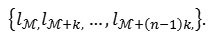
Let ℓ be the finite population having units 1 to N. Further, we consider N=nk, where n and k are positive whole numbers. Hence there will be k samples of size n. Let ℳ be random variable having range 1 to k. The systematic random sample is then selected by the following random sequence as
Let γij and denote the values of the study variable and auxiliary attribute for (i=1,2,…,k) and (j=1,2,…,n).
Note that Φij is the binary character so it can take only two possible values i.e.,
Φij =1, if the ith unit of the population possesses attribute ɸ,
Φij=0, otherwise.

denote the total number of units in the population and sample respectively, possessing an auxiliary attribute ɸ. Hence, the corresponding sample and population proportions are

Similarly,
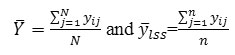
are the sample and population means of Y. For finding MSE, Let we define
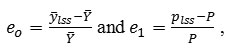
using these notations, we have

where ρp is the intra-class correlation of P, ρp is the intra-class correlation of Y and ρ is the correlation between P and Y.
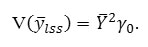
The variance of the traditional sample mean is
Following Naik and Gupta (1996), we propose the usual ratio and product estimators utilizing available auxiliary attributes under systematic random sampling scheme,
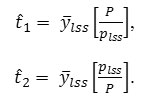
The MSEs of Ì‚t1 and Ì‚t2

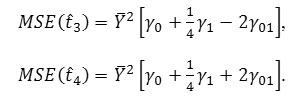
Motivated by Singh et al. (2007), we propose the exponential ratio and product estimators utilizing available auxiliary attributes under systematic random sampling scheme,

The MSEs of Ì‚t3 and are Ì‚t4
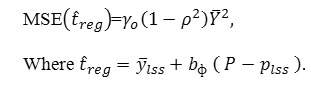
On the lines of Abd-Elfattah et al. (2010), we propose the family of estimators utilizing available auxiliary attributes under systematic random sampling scheme,

The minimum MSE of these estimators ( Ì‚t5 to Ì‚t8) is equal to the MSE of regression estimator i.e.
Solanki and Singh (2013) developed the generalized estimator, given below

Where by putting (α=0, 1, -1) we get Ì‚t0, Ì‚t3 and Ì‚t4
The Proposed Family of Estimators
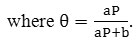
Taking motivation from Abd-Elfattah et al. (2010), we propose the following family of estimators utilizing available auxiliary attributes under systematic random sampling scheme,
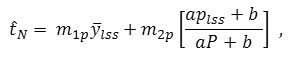
where a and b be any known population characteristics or 1.
Let we express Ì‚tN in terms of e0 and e1 as follows

Now by simplifying, we get

Let we take expectation on both sides and get the bias of Ì‚tN as
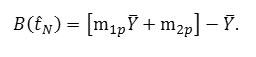
Now squaring both sides of ( Ì‚tN - á¿© ) as
The MSE of Ì‚ t N is given by

Where Partially differentiating MSE ( Ì‚ t N ), w.r.t m1p and m2p and equating to zero, we have the following equations
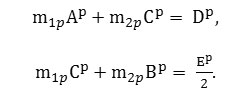
Now by solving matrix inversion method we get the optimum values of m1p and m2p i.e
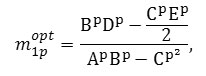
and
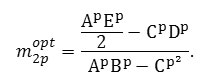
By putting
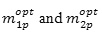
and get minimum mean square error of MSE ( Ì‚tN ) , i.e
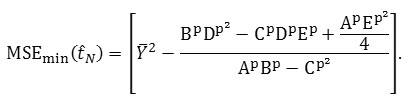
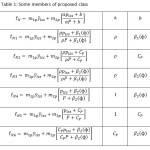 |
Table 1: Some members of proposed class.Click here to View Table |
Efficiency Comparison
In current section, we find the efficiency conditions for the proposed estimators Ì‚tN by looking at the mean square error of the existing estimators as given below

From the above mentioned conditions, we can say that proposed estimators are more efficient as compare to adapted estimators.
Numerical Illustration
The performance of proposed and existing estimators examined through two real data sets.
Population 1
Data is taken from Murthy (1967) where Y=Volume of the timber and ɸ=length >6 . Descriptives of the population are N=176, á¿©=282.61, P= 0.6022, Sy= 155.73, Sp= 0.6421, ρ= 0.51, ρp= -0.0016, py=-0.0019, Cp=1.0661, β2(Φ) = 29.110 , β1(Φ)=10.1458, n=16.
Population 2
Data is taken from Murthy (1967) where Y=Volume of the timber and ɸ= Volume >200. Descriptives of the population are N=176, á¿©=282.62, p=0.6363, Sy=155.73, Sp= 0.4824, ρ=0.7831, ρp=0.0023, py=-0.6019, Cp=0.7580, β2(Φ)=1.3214, β1(Φ)=0.3214, n=16 .
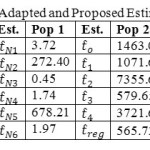 |
Table 2: MSEs of Adapted and Proposed Estimators. |
Conclusion
We have proposed a class of estimators for á¿© using available auxiliary attributes under systematic random sampling scheme and obtained its bias and minimum MSE equations. All the adapted estimators are compared with proposed estimators using MSE. With the help of these comparisons, efficiency condition has been found where proposed estimators perform much better. The theoretical conditions and numerical illustrations show that proposed estimators are much better. Hence, it is advisable to use the proposed class of estimators.
References
- Naik, V. D., and Gupta, P. C. (1996): A note on estimation of mean with known population proportion of an auxiliary character. Ind. Soc. Agr. Stat, 48(2): 151-158.
- Singh, R., Chouhan, P., Sawan, N., Smarandache, F. (2007): Ratio-product Type Exponential Estimator for Estimating Finite Population Mean Using Information on Auxiliary Attribute. Renaissance High Press, USA. pp. 18–32.
- Abd-Elfattah, A. M., El-Sherpieny, E. A., Mohamed, S. M., & Abdou, O. F. (2010): Improvement in estimating the population mean in simple random sampling using information on auxiliary attribute.Applied mathematics and computation, 215(12): 4198-4202.
- Cochran, W. G. (1977): Sampling techniques, 34rd ed. New York, NY, John Wiley and Sons.
- Shukla, N. D. (1971): Systematic sampling and product method of estimation. In Proceeding of all India Seminar on Demography and Statistics. BHU, Varanasi, India.
- Swain, A.K.P.C.(1964): The use of systematic sampling in ratio estimate. Jour. Ind. Stat.
Assoc, 2(213), 160-164. - Singh, H. P., and Solanki, R. S. (2012): An efficient class of estimators for the population mean using auxiliary information in systematic sampling. Journal of Statistical Theory and Practice, 6(2): 274-285.
- Singh, R., Malik, S., Chaudhary, M. K., Verma, H. K., & Adewara, A. A. (2012): A general family of ratio-type estimators in systematic sampling. Journal of Reliability and Statistical Studies, 5(1): 73-82.
- Koyuncu, N. (2012): Efficient estimators of population mean using auxiliary attributes.Applied Mathematics and Computation, 218(22): 10900-10905.
- Murthy, M.N. (1967): Murthy, M. N.: Sampling theory and methods. Sampling theory and methods.
- Solanki, R. S., and Singh, H. P. (2013): Improved estimation of population mean using population proportion of an auxiliary character. Chilean journal of Statistics, 4(1): 3-17.

This work is licensed under a Creative Commons Attribution 4.0 International License.