
Detection the Degradation of PS Thin Films Containing Triazole Complexes by FTIR Techniques
Raghad Haddad1* , Dina S. Ahmed2 , Wedad H. Al-Dahhan2 , Ahmed Ahmed3 , Salam Mohammed4 and Emad Yousif2
1College of Pharmacy, Private Uruk University, Baghdad, Iraq .
2Department of Chemistry, College of Science, Al-Nahrain University, Baghdad, Iraq .
3Polymer Research Unit, College of Science, Al-Mustansiriyah University, Baghdad, Iraq .
4College of Engineering and Architecture, University of Nizwa, Birkat Almouz, Nizwa, Oman .
http://dx.doi.org/10.13005/OJPS03.01.09
4-amino-5-(pyridyl)-4H-1,2,4-triazole-3-thiol (X) with Ni2+, Cu2+, Zn2+, Cd2+ and Sn2+ has been synthesized also used as PS photostabilizers. In chloroform solvent, these complexes mixed with PS to form modified PS, which involving (0.5 % wt) of complexes were prepared using casting method. At room temperature the intensity of light (6.02×10⁻⁹ Ein Dm-3 S-1) and wavelength 365 nm with utilized to irradiate polymeric films. PS films irradiation with UV light led to obvious changes in infrared spectra. The photostabilization activity of these polymeric films was investigated by observation the indices using FTIR spectroscopy.
Copy the following to cite this article:
Haddad R, Ahmed D. S, Al-Dahhan W. H, Ahmed A, Mohammed S, Yousif E. Detection the Degradation of PS Thin Films Containing Triazole Complexes by FTIR Technique. Orient J Phys Sciences 2018;1(1).
DOI:http://dx.doi.org/10.13005/OJPS03.01.09Copy the following to cite this URL:
Haddad R, Ahmed D. S, Al-Dahhan W. H, Ahmed A, Mohammed S, Yousif E. Detection the Degradation of PS Thin Films Containing Triazole Complexes by FTIR Technique. Orient J Phys Sciences 2018;3(1). Available from: https://bit.ly/3rlNsnE
Download article (pdf) Citation Manager Publish History
Introduction
Polymers are organic materials which are synthesized from monomers. Polymers can be classified into synthetic and natural. Synthetic polymers like Polyester, Polyvinyl chloride and Polystyrene [1,2]. The plastics uses in the building applications is public in the improve world because of the low cost and the easiness uses of plastic contrast to the conventional metal, wood, mortar, glass and others. Plastics utilized in other products like fishing gear, marine craft and outdoor furniture, which are usually used outdoors as well [3]. Using polymers have disadvantages one of these is that polymers degrade when they are applied in outdoor applications or high temperature conditions. While polymers are utilized in outdoor applications, the environment affected the service life negatively. This method is called weathering [4]. The control PS film becomes slightly yellow in color during irradiation. Yellow coloring of PS sample can result from the formation of many different chromophoric groups. It is mostly accepted that acetophenone end group form throughout PS UV irradiation is the most prospective, are accountable for yellowing coloration of the polymer [5]. Polystyrene is a multipurpose polymer that is applied in various applications. Common purpose of PS is hard and clear which is applied in electronics, laboratory ware and packaging [6]. One of the important PS uses in the produce of cover signal lamps of some automobiles [7]. Photodegradation is the molecule degradation caused by the photon absorption. Specially, those wavelengths found in sunlight, like visible light, ultraviolet light and infrared radiation, it involves the chemical and physical changes caused by irradiation of polymers with visible light or ultraviolet. Therefore, the chromophoric group existence in the macromolecules is a needed for photochemical reaction initiation [8]. A common photodegradation reaction is oxidation. All synthetic polymers demand stabilization the opposite influences; It became necessary to discover methods to reduce or inhibit the damage caused by the parameters of environment like air, heat and light. That is why the polymers photostability is one of the most important respects for application. The photostabilization of polymers includes the retardation or elimination of photochemical process in polymers and plastics that happen through irradiation [9]. Practice views that when the polymer includes a photostabilizer, the oxidation rate is much reduced, stabilizers do not completely inhibit the oxidation but can reduced it [10-13]. In this work the synthesizing of Zn2+, Cd2+, Sn2+, Ni2+ and Cu2+ with 4- amino-5-(pyridiyle)-4H 1,2,4 triazol -3- thiol (X) were used for photostabilization of Polystyrene and study the change in FTIR spectrum during irradiation.
Experimental
All chemicals commercially purchased and used without further purification. The FTIR spectra were listed using FTIR spectrophotometer 8300 Shimadzu in the range of frequency between (4000-400) cm-1.
Synthesis of Metal Complexes
The complexes Cu(X)2, Zn(X)2, Ni(X)2, Cd(X)2 and Sn(X)2 (Figure 1) were synthesized as previously reported [14].
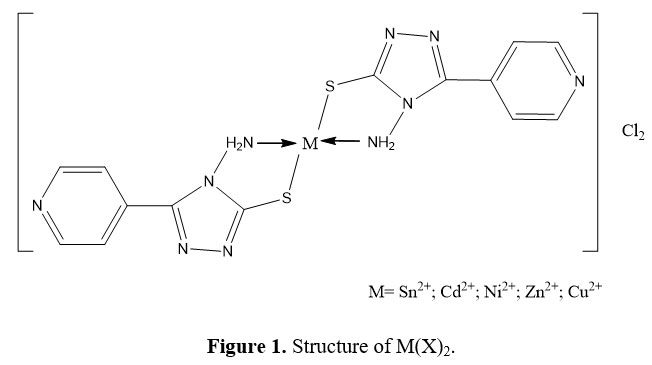 |
Figure 1: Structure of M(X)2
|
Films Preparation
In chloroform solvent, PS dissolved with metals complexes to form PS films, a micrometer type 2610 A, Germany was utilized to measure films thickness, and it is about (40 μm). By using evaporation technique the films were prepared at room temperature [15,16].
Accelerated Testing Technique
The wavelength of UV- Light that used for polymeric films irradiation in the range (250-380) nm, the light intensity at 6.2 × 10⁻⁹ Ein Dm-3 S-1. The polymeric films were fixed analogous to each other and the UV lamp. 10 cm is the distance between the source and polymeric films. The irradiated films were interchanged from time to time to enclose the light intensity occurrence on each film is the same [17].
Photodegradation Rate of Polymeric Films by Infrared Spectrophotometry
The photodegradation degree of polymeric films was monitored by FTIR spectra in the range (4000-400) cm-1. At 1720 cm-1 the carbonyl absorption is appearance. At different times of irradiation the photodegradation progress was observed by the changes in intensity of carbonyl peak; this called the "band index method", [17,21] as equation 1:
IS = As/ Ar....................(1)
Results and discussion
4-amino-5-(pyridyl)-4H-1,2,4-triazole-3-thiol (X) with Ni2+, Cu2+, Zn2+, Cd2+ and Sn2+ were applied accordingly additives for PS photostabilization. PS films irradiation with wavelength light, λ=365 nm due to obvious changes in their infrared spectra. (Figure 2) explain the photodegradation mechanism of PS in the presence of oxygen.
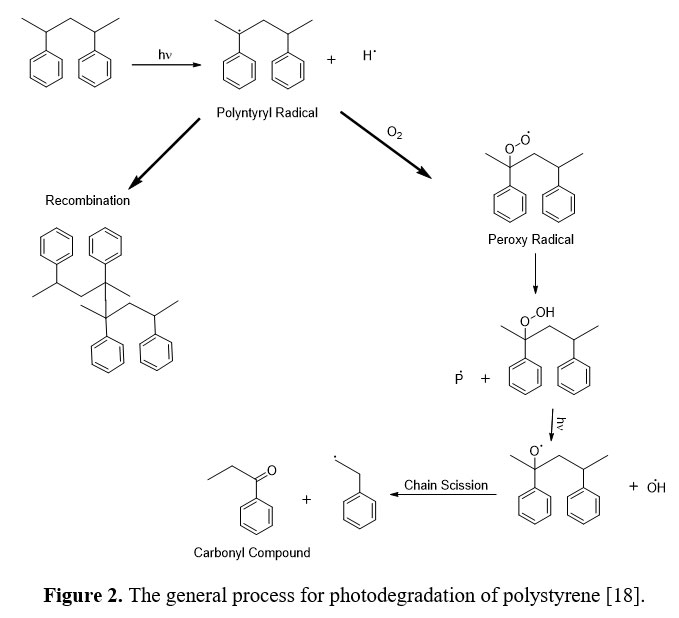 |
Figure 2: The general process for photodegradation of polystyrene [18]
|
Ultraviolet radiation has harmful influences on polystyrene that due to chemical changes into polymeric chains. Therefore, the polymeric materials could lose their mechanical properties and be discolored [23]. The photo activity of triazole additives in PS films has been tested and their efficiency in preventing the photooxidation reaction has been examined by spectroscopic methods. The spectra of IR recorded during irradiation show increasing in absorbance attributed to formation of oxidized products so the intense bands appearance in the range between (1690-1730) cm-1 refers to the carbonyl groups formation are applied to realize the degradation of polymer extension throughout irradiation. A broad band appearance in the range between (3200-3600) cm-1 due to hydroxyl group [19]. These absorptions are studied as carbonyl (ICO) and hydroxyl (IOH) indices [20,22]. So, the growth of these indices is the degradation measurement. The presence of Cu(X)2, Zn(X)2, Ni(X)2, Cd(X)2 and Sn(X)2 show lower growth rate of indices against time of irradiation with consideration to the PS without additives (blank). The results confirmed that all these additives are photostabilizer for PS films. However, from the growth rate of carbonyl and hydroxyl indices, the Cu(X)2 represents the most effective photostabilizer, followed by Zn(X)2, Ni(X)2, Cd(X)2 and Sn(X)2 are less active as shown in Figures 3 and 4.
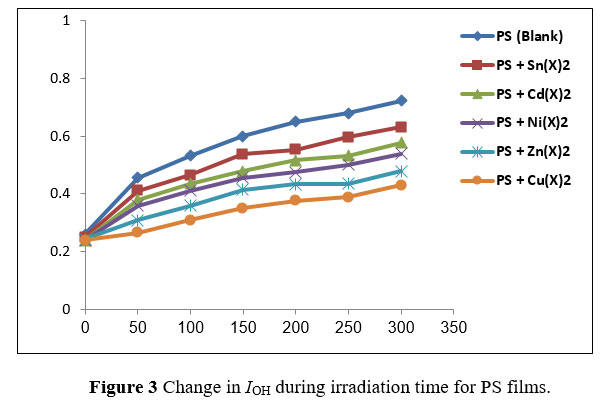 |
Figure 3: Change in IOH during irradiation time for PS films
|
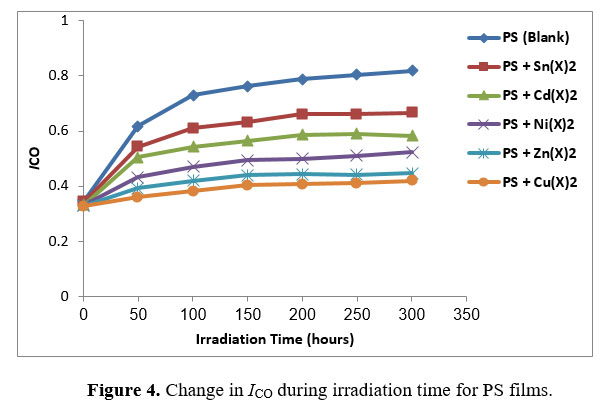 |
Figure 4: Change in ICO during irradiation time for PS films
|
The increases in both ICO and IOH indices can be used as a signal for photodegradation of PS. It must be known that indices does not beginning from zero because some photodegradation occur through PS films preparation.
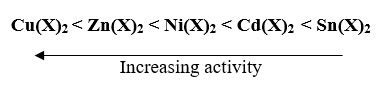
Conclusion
The PS films photostabilization which containing bis(4-amino-5-(pyridyl)-4H-1,2,4-triazole-3-thiol) have been studied. These additives act effective as photostabilizers for PS films. According to their reduction in indices, the additives take the next arrangement in activity of photostabilization.
Acknowledgement
The project was supported by Uruk, Al-Nahrain, Al-Mustansiriyah and Nizwa Universities.
References
- Hu X., He Q., Lu H., Chen H., Fabrication of gold microelectrodes on polystyrene sheets by UV-directed electroless plating and its application in electrochemical detection, J. Electroanaly Chem., 638, 21-27, (2010).
- Okamura O., Yamauchi E., Shirai M., Photo-cross-linking and de-cross-linking of modified polystyrenes having degradable linkages Reactive Functional, Polymer, 71, 480-488, (2011).
- Sampers J., Polymer Degradation Stabilization, 67, 455-463, (2002).
- Wypych G., Handbook of material weathering, 4th edn, Chemtec Publishing, Toronto, (2008).
- Yousif E., Aliwi S., Ameer A., Jaleel R., Improved photostability of PVC films in the presence of 2-thioacetic acid-5-phenyl-1,3,4-oxadiazole complexes, Turk J. Chem., 33, 399-410, (2009).
- Meenakshi P., Noorjahan E., Rajini R., Venkateswarlu U., Crose S., Mechanical and microstructure studies on the modification of CA film by blending with Polystyrene, Indian Academy of Sciences, 25, 25-29, (2002).
- Safy Eldin M., El-laithy A. Photooxidative degradation of polystyrene of cover signals lamp of some automobile, J. of applied polymer science, 55, 47-54, (1994).
- Schnabel W., Polymer Degradation: Principle and Practical Applications, Chapter 14, Hanser Int, München, (1981).
- Ahmed D.S., El-Hiti G.A., Hameed A.S., Yousif E., Ahmed A. New tetra-Schiff bases as efficient photostabilizers for poly(vinyl chloride), Molecules, 22, 1506, (2017).
- Ahmed D.S., El-Hiti G.A., Hameed A.S., Yousif E., Ahmed A. Polyphosphates as inhibitors for poly(vinylChloride) photodegradation, Molecules, 22, 1849, (2017).
- Yousif E., Salimon J., Salih N., New stabilizer for polystyrene based on 2-N-Salicylidene-5-(substituted)-1,3,4-thiadiazole compoundes, J. of Saudi Chemical Society, 16, 299-306, (2011).
- Ghazi D., El-Hiti G.A., Yousif E., Ahmed, D.S., Alotaibi, M.H. The Effect of Ultraviolet Irradiation on the Physicochemical Properties of Poly(vinyl Chloride) Films Containing Organotin(IV) Complexes as Photostabilizers, Molecules, 23, 254, (2018).
- Yousif E. and Haddad R., Photodegradation and photostabilization of polymers, especially polystyrene: review, Springer Plus, 2, 398-460, (2013).
- Haddad R., Yousif E. and Ahmed A., Synthesis and characterization of transition metal complexes of 4-Amino-5-pyridyl-4H-1,2,4-triazole-3-thiol, Springer Plus, 2, 510-516, (2013).
- Ali M., El-Hiti G., Yousif E., Photostabilizing efficiency of poly(vinyl chloride) in the presence of organotin(IV) complexes as photostabilizers, Molecules, 21, 9, (2016).
- Yousif E., Salimon J., Salih N., New stabilizer for polystyrene based on 2-Thioacetic Acid Benzothiazol complexes, J. of applied polymer Science, 125, 1922-1927, (2012).
- Yousif E., Salimon J., Salih N., Improvement of photostabilization of PVC in the presence of thioacitic acidbenzothiazole complexes, The Malaysian J. of Analytical Sciences, 15, 81-92, (2011).
- Yousif E., Salimon J., Salih N., New stabilizer for polystyrene based on 2-N-Salicylidene-5-(substituted)-1,3,4-thiadiazole compoundes, J. of Saudi Chemical Society, 16(3), 299-306, (2011).
- Rabek J. and Sanetra J., Macromolecules, Springer Berlin Heidelberg, 19, pp. 1679, (1986).
- Yousif E., El-Hiti G., Hussain Z., Altaie A., Viscoelastic, spectroscopic and microscopic study of the photo irradiation effect on the stability of PVC in the presence of sulfamethoxazole Schiff’s bases, Polymers, 7, 2190-2204, (2015).
- Shaalan N., Laftah N., El-Hiti G.A., Alotaibi M.H., Muslih R., Ahmed D.S., Yousif, E. Poly(vinyl Chloride) photostabilization in the presence of schiff bases containing a thiadiazole moiety. Molecules 23, 913, (2018).
- Ahmed D.S., El-Hiti G.A., Hashim H., Noaman R., Hameed A.S., Yousif, E. Physical and morphological properties of poly(vinyl chloride) films upon irradiation in the presence of tetra schiff bases as photostabilizers. Arab J. Phys. Chem. 5, (2018).
- Ali G.Q., El-Hiti G.A., Tomi I.H.R., Haddad R., Al-Qaisi A.J., Yousif E. Photostability and Performance of Polystyrene Films Containing 1,2,4-Triazole-3-thiol Ring System Schiff Bases. Molecules 21, 1699, (2016). doi:10.3390/molecules21121699.

This work is licensed under a Creative Commons Attribution 4.0 International License.