
Corrosion Inhibitors used in Pipelines Carrying Simulated Oil Well Water – An Overview and Inhibition of Corrosion of Mild Steel in Simulated Oil Well Water by Aqueous Extract of Chrysanthemum Indicum Flower- Case Study
K. Kavitha1,2 , H. Benita Sherine2 , Abdul Hameed Al-Hashem3 , S. Rajendran4,6*  and Caslav Lacnjevac5
1Department of Chemistry, National College, Trichy, Tamilnadu, India .
2Department of Chemistry, Periyar EVR College, Trichy, Tamilnadu, India .
3Petroleum Research Centre, Kuwait Institute for Scientific Research, Kuwait .
4Department of Chemistry, Corrosion Research Centre, St. Antony’s College of Arts and Sciences for Women Thamaraipady, Dindigul, Tamilnadu, India .
5Faculty of Agriculture, University of Belgrade, Belgrade, Serbia .
6Pondicherry University, Puducherry, India .
http://dx.doi.org/10.13005/OJPS06.01-02.07
Copy the following to cite this article:
Kavitha K, Sherine H. B, Al-Hashem A. H, Rajendran S, Lacnjevac C. Corrosion Inhibitors used in Pipelines Carrying Simulated Oil Well Water – An Overview and Inhibition of Corrosion of Mild Steel in Simulated Oil Well Water by Aqueous Extract of Chrysanthemum Indicum Flower- Case Study. Oriental Jornal of Physical Sciences 2021; 6(1,2). DOI:http://dx.doi.org/10.13005/OJPS06.01-02.07
Copy the following to cite this URL:
Kavitha K, Sherine H. B, Al-Hashem A. H, Rajendran S, Lacnjevac C. Corrosion Inhibitors used in Pipelines Carrying Simulated Oil Well Water – An Overview and Inhibition of Corrosion of Mild Steel in Simulated Oil Well Water by Aqueous Extract of Chrysanthemum Indicum Flower- Case Study. Oriental Jornal of Physical Sciences 2021; 6(1,2). Available From: https://bit.ly/3qLTb9e
Download article (pdf) Citation Manager Publish History



Introduction
Simulated Oil Well Water
Simulated oil well water (SOWW) is carried out by pipelines made of several alloys. These alloys undergo corrosion owing to presence of various aggressive ions present in SOWW. To prevent this several inhibitors have been used. Many types of research have been carried out in this regard 1-10.
Metals
Some inhibitors have been used to thwart corrosion of many metals like N80 carbon steel alloys 1, API 5LX carbon steel 2, X80 pipeline steel 3, X-65 type carbon steel 4, mild steel 5-7, metallic S90 steel 8 and carbon steel 9,10.
Medium
The inhibition efficiency of extracts in scheming corrosion of metals in various environments has been investigated. The medium includes HCl 1, oil well produced water 2, oil field waters 3, oil well formation water 4, simulated oil well water 5-7, oil fields 8, produced water in acidizing oil wells 9 and 15 % HCl 10.
Methods
Several methods have been used to estimate the inhibition efficiency of extracts 1-10. Weight loss study 1,2,5-7,9,10, electrochemical techniques 1-10, Langmuir adsorption isotherm 1, Fourier transform infrared spectroscopy 2,4,6-10, SEM 2,6,7,9,10, nuclear magnetic resonance spectroscopy 4,8, atomic force microscopy 4,6-8 and TEM 10 have been employed in these studies.
Inhibitors
Inhibitors such as Glycyrrhiza glabra 2, thiourea based imidazoline quaternary ammonium salt 3, Allium sativum (Garlic) 5, Chrysanthemum Indicum flower 6, Andrographis paniculata 7, and Aliphatic tricationic surfactants 8 have been used in these studies.
Results are abridged in Table 1.
Table 1: Summary of Results.
|
S. No. |
Metal |
Medium |
Inhibitor |
Method |
Findings |
Reference |
|
1 |
N80 carbon steel alloys |
HCl |
(E)-N-(benzo[d]thiazol-2-yl)-1-phenylmethanimine (H-BTPM), (E)-N-(6-methylbenzo[d]thiazol-2-yl)-1-phenylmethanimine (Me-BTPM), and (E)-2-(benzylideneamino) benzo[d]thiazole-6-thiol (SH-BTPM) |
gravimetric and electrochemical techniques, Langmuir adsorption isotherm |
BTPM series acted as anticorrosive property and act as potential biocides |
1 |
|
2 |
API 5LX carbon steel |
oil well generated water environment |
Glycyrrhiza glabra |
weight loss method & potentiodynamic polarization study & electrochemical impedance spectroscopy study, Fourier transform infrared spectroscopy & SEM analysis |
both abiotic & biotic systems are pretentious by unadorned pitting type of corrosion reaction & suppressed corrosion issues by forming shielding layer over carbon steel surfaces |
2 |
|
3 |
X80 pipeline steel |
Simulated oil-field waters |
thiourea base imidazoline quaternary ammonium salt |
polarization curve measurement, EIS method and scanning vibrating electrode technique |
Corrosion inhibitor is much appropriate for usage in neutral waters & it has decent corrosion inhibition effect in temperature range of 40~60 °C |
3 |
|
4 |
X-65 type carbon steel |
oil well formation water under H2S environmnet |
cationic surfactants like 1-ethyl-4H-benzo[d][1,3]thiazin-1-ium bromide (BTB) & N-ethyl-N,N-dioctyloctan-1-aminium bromide (DAB) |
Electrochemical studies such potentiodynamic polarization studies & EIS measurements. FTIR & NMR techniques and atomic force microscopy |
inhibit both cathodic & anodic type of adsorption on metal surface, inhibition efficiency obtained 93 % for compound BTB & 84% for compound DAB |
4 |
|
5 |
mild steel (MS) |
simulated oil well water (SOWW) |
Allium sativum (Garlic) |
weight loss study & electrochemical studies |
Charge transfer resistance (Rt) value upsurges, electrochemical impedance value upsurges, whereas double layer capacitance (Cdl) drops, good inhibitor for corrosion of MS in SOWW |
5 |
|
6 |
mild steel |
simulated oil well water |
Chrysanthemum indicum flower |
weight loss method and by electrochemical measurements, FTIR spectroscopy, SEM & AFM |
To study mechanistic aspects of corrosion inhibition, maximum IE obtained at 93% |
6 |
|
7 |
mild steel |
simulated oil well water |
Andrographis paniculata |
Weight loss study, potentiodynamic polarization study & electrochemical impedance spectroscopy, FTIR, SEM and AFM |
94% inhibition efficiency, controls the cathodic reaction predominantly, protective film formed on mild steel surface is confirmed by electrochemical impedance spectroscopy, potential application in petroleum industry obeys Langmuir adsorption isotherm, potential application in petroleum industry |
7 |
|
8 |
metallic S90 steel |
oil fields |
Aliphatic tricationic surfactants |
Elemental analysis FTIR spectroscopy and Nuclear magnetic resonance spectroscopy, electrochemical studies & Atomic force microscopy |
Obtained 93 % inhibition efficiency tricationic amphiphiles performed as both cathodic and anodic type inhibitors, followed Langmuir isotherm |
8 |
|
9 |
carbon steel |
generated water in acidizing oil wells |
2-(2-(3,4-bis(2-methoxyethoxy)tetrahydrofuran-2-yl)-2-(2-methoxyethoxy)ethoxy)ethyl stearate, Tween-60 |
FTIR and TGA techniques, UV-Visible spectroscopy, weight loss method, electrochemical studies & SEM |
escalation in temperature results to partial desorption of inhibitor molecules at metal surface, which make corrosion rate increase, positive sign of activation enthalpy (ΔHa) imitates endothermic nature of carbon steel dissolution process |
9 |
|
10 |
carbon steel |
15% HCl |
Bis(2-aminoethyl)amine-modified graphene oxide |
weight loss methods, electrochemical studies, FTIR, SEM and TEM |
synergistic action and IE was obtained at 96.77% |
10 |
Section B
Case Study
Inhibition of Corrosion of Mild Steel in Simulated Oil Well Water by Aqueous Extract of Chrysanthemum Indicum Flower
Experimental
Preparation of Inhibitor
12 g of shade-dried Chrysanthemum Indicum flower (CIF) was boiled with DD water. The extract was filtered and made up to 100 ml. This solution was used as a corrosion inhibitor.
Preparation of Simulated Oil Well Water (SOWW)
In 100 mL of doubly distilled water, sodium chloride (3.5 g), calcium chloride (0.305 g), and magnesium chloride (0.186 g) are added. Just before the experiment, add 0.067 g sodium sulfide and 0.4 mL of concentrated hydrochloric acid to generate hydrogen sulfide gas to form a simulated oil well water encompassing 100 ppm of H2S 11.
Preparation of Mild Steel (MS)
Mild steel specimens (0.0267 % S, 0.06 % P, 0.4 % Mn, 0.1 % C & rest iron) of dimensions 1.0 cm x 4.0 cm x 0.2 cm were polished to a mirror finish & degreased with acetone.
Weight Loss Scheme
Mild steel specimens in triplicate were engrossed in 100 ml of simulated oil well water encompassing numerous concentrations of inhibitor (aqueous extract of Chrysanthemum indicum flower) for a period of one day. Weight of specimens formerly & subsequently entanglement was indomitable using Shimadzu balance, model AY62. Corrosion products were eviscerated with Clarke’s solution 12. Variance between preliminary weight prior to deployment & final weight was castoff for the deviousness of corrosion rate by using the following formula 13.
Corrosion rate, mdd = W/AT (1)
Where, mdd is corrosion rate articulated in terms of metal loss (mg) per decimeter square area per day, W is loss in weight (mg), A is area of panels (dm2) & T is exposure time (days).
The inhibition efficiency was premeditated using relation.
Inhibition efficiency = [(CR1-CR2)/CR1] x 100 % (2)
Where CR1 = corrosion rate in nonexistence of inhibitor
CR2 = corrosion rate in the existence of inhibitor.
The surface coverage was premeditated using relation 14.
Surface coverage, θ = %IE/100 (3)
Contact Angle
Contact angle measurements on the surface were executed on a VCA Optima instrument fortified with a CCD camera for imaging. Deionized water under static conditions with a drop volume of 5 ml was engaged to conclude the contact angle. VCA Optima XC software providing instruments was castoff for fitting drop shapes to determine the contact angle of water on the surface. This measurement was reiterated three times for each sample, average values with standard deviations ±2 are testified 15.
Results and Discussion
A green corrosion of an aqueous extract of Chrysanthemum Indicum flower (CIF) has been applied to regulate corrosion of mild steel in the existence of simulated oil well water (SOWW). Findings will be expedient in petroleum technology. These inhibitors may be included in oil well water conceded by pipelines made of mild steel.
Weight Loss Method
Inhibition efficiency (IE %), corrosion rate (CR) & surface coverage (θ) values were premeditated from the weight loss method [16] for mild steel with nonexistence & existence of various concentrations of (CIF) at room temperature are abridged in Table 2. From Table 2, it is obvious that as concentrations of inhibitor upsurge, inhibition efficiency upsurges, corrosion rate drops & surface coverage upsurges. The maximum inhibition efficiency of 93 % was reached for mild steel when immersed in 10 ml of extract concentration. That is oxidation of mild steel is lessened by coverage of active molecules from inhibitor on metal surface 6.
Table 2: Corrosion Rate & Inhibition Efficiency of MS in SOWW Medium in Different Concentrations of Inhibitor (CIF).
|
The volume of inhibitor (CIF)ml |
Corrosion rate (CR) mdd |
IE |
θ |
|
0 |
14.55 |
- |
- |
|
2 |
3.64 |
75 |
0.75 |
|
4 |
3.26 |
78 |
0.78 |
|
6 |
2.76 |
81 |
0.81 |
|
8 |
1.75 |
88 |
0.88 |
|
10 |
1.02 |
93 |
0.93 |
Adsorption Isotherm
An adsorption isotherm provides a direct relationship between corrosion efficiency with a degree of surface coverage at room temperature for various concentrations of inhibitor solutions. Adsorption isotherm provides basic evidence about the nature of the interaction between mild steel surface & inhibitor molecular constituents 17. Adsorption of corrosion inhibitor molecules occurs on mild steel surface by displacement of a molecule of water adsorbed on the metal surface. Also, adsorption depends on temperature, chemical composition & concentration of inhibitor & electrochemical potential at metal-solution interface 18.
There are several isotherms proposed to account for the adsorption of corrosion inhibitor molecules on the surface of the metal. From isotherm, a linear relationship between θ and the concentration of inhibitor can be found. In this study, the changes in the θ and thereby the change in the efficiency of inhibitor is determined by using different isotherm models.
Langmuir Adsorption Isotherm
Degree of surface coverage (θ) for innumerable concentrations of inhibitor (2, 4, 6, 8, 10 ml) at room temperature was found from the weight loss method. According to Langmuir isotherm, the following equation relates the surface coverage (θ) and inhibitor concentration, C.

The plot of Langmuir adsorption isotherm, C/θ vs C shown in Figure 1. Values of adsorption parameters obtained from Langmuir adsorption isotherm including ?G0ads, R2, slope, and intercept of inhibitor on mild steel surface are listed in Table 3. The negative sign of ?G0ads makes sure extemporaneity of adsorption process & constancy of adsorbed layer on the steel surface. ?G0ads is premeditated from the equation.
?G0ads = -2.303 RT log (Kads x 55.55) (5)
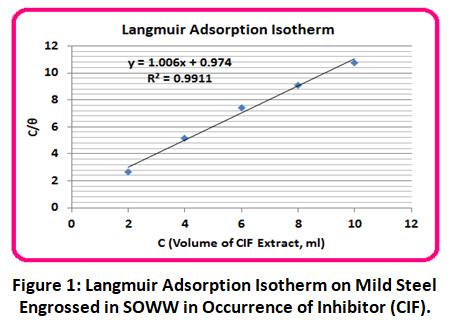 |
Figure 1: Langmuir Adsorption Isotherm on Mild Steel Engrossed in SOWW in Occurrence of Inhibitor (CIF). Click here to view Figure |
Table 3: Adsorption Factors Acquired from Langmuir Adsorption Isotherm for Corrosion Inhibitive Effect of Aqueous Extract of CIF on Corrosion of Mild Steel in SOWW.
|
R2 |
Slope |
Intercept |
Kads |
?G0ads kJ/mol |
|
0.9911 |
1.006 |
0.974 |
1.0267 |
-10.188 |
The R2 value was very high 0.9911. The negative value of Gibb’s free energy approves that the adsorption of inhibitor on metal is spontaneous. These interpretations indicate that the adsorption of inhibitor molecules on the metal surface complies with the Langmuir adsorption isotherm 19,20.
Analysis of Contact Angle Measurement
Contact angle measurement is a modest technique for the characterization of surfaces. It is useful in explaining the data such as information between a hydrophobic and hydrophilic surface of the metal and surface of the protective film formed 21. When the contact angle increases, hydrophobicity also increases. Because of this, when water repellent nature of surface upsurges & corrosion inhibition efficiency also increases. The contact angle images are shown in Figure 2. Contact angle values of polished metal, metal immersed in a corrosive environment (SOWW) & metal engrossed in inhibitor (CIF) system are given in Table 4.
It is pragmatic from Table 4, that the contact angle for polished metal is precise high (111.6°). For polished metal engrossed in SOWW, the contact angle is precise small (8.9°). For polished metal engrossed in inhibitor system, the contact angle is in between that of the above two systems (96.6°). The contact angle measurement study is expedient in explaining hydrophobicity of metal surface & corrosion inhibition efficiency upsurges of inhibitor system 22-24.
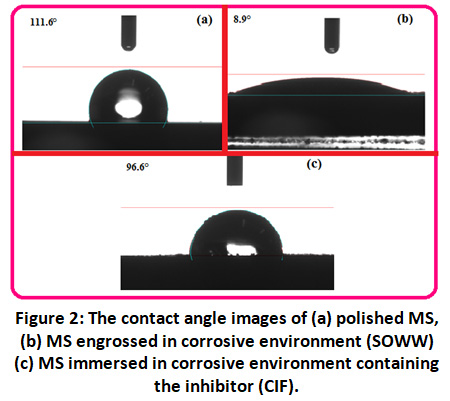 |
Figure 2: The contact angle images of (a) polished MS, (b) MS engrossed in a corrosive environment (SOWW) (c) MS immersed in a corrosive environment containing the inhibitor (CIF). Click here to view Figure |
Table 4: Contact Angle Analysis of Different Environment.
|
System |
Contact angle (°) |
|
Polished MS |
111.6 |
|
MS immersed in a corrosive environment |
8.9 |
|
MS immersed in a corrosive environment encompassing inhibitor (CIF) system |
96.6 |
Conclusions
- In this study, the anti-corrosive property of aqueous extract of CIF has been tested against the mild steel in the SOWW medium.
- Diminution in corrosion rate & escalation in inhibition efficiency of mild steel in SOWW media was observed with the upsurge in the concentration of CIF. The maximum inhibition efficiency of 93 % was accomplished for 10 ml of CIF.
- Adsorption process tracked Langmuir isotherm model. A negative value of ?G0ads achieves that the adsorption process was extemporaneous.
- Contact angle measurement studies reveal that the inhibitors form a protective layer on mild steel surfaces in a SOWW environment.
- A.A. Farag, A.M. Eid, M.M. Shaban, E.A. Mohamed, and G. Raju, Journal of Molecular Liquids, 2021, 336, 116315.
CrossRef - P. Parthipan, L. Cheng and A. Rajasekar, Journal of Molecular Liquids, 2021, 333, 115952.
CrossRef - BAI Yunlong, SHEN Guoliang, QIN Qingyu, WEI Boxin, YU Changkun, XU Jin and SUN Cheng, Journal of the Chinese Society of Corrosion and Protection, 2021, 41(1), 60-70.
- M.A. Moselhy, E.G. Zaki, S.A.E.H.A. El-Maksoud and M.A. Migahed, ACS Omega, 2021, 6(30), 19559-19568.
CrossRef - S.C. Joycee, A.S. Raja, A.S. Amalraj and S. Rajendran, International Journal of Corrosion and Scale Inhibition, 2021, 10(3), 943-960.
- K. Kavitha, H.B. Sherine and Rajendran, International Journal of Corrosion and Scale Inhibition, 2021, 10(2), 783-800.
- A.S. Prabha, K. Kavitha, H.B. Shrine and S. Rajendran, Indian Journal of Chemical Technology, 2020, 27(6), 452-460.
- M.A. El-Monem, M.M. Shaban, M.A. Migahed and M.M.H. Khalil, ACS Omega, 2020, 5(41), 26626-26639.
CrossRef - A.A. Farag and E.A. Badr, Corrosion Reviews, 2020, 38(2), 151-164.
CrossRef - K.R. Ansari, D.S. Chauhan, M.A. Quraishi and T.A. Saleh, Journal of Colloid and Interface Science, 2020, 564, 124-133.
CrossRef - R. Geethanjali and S. Subhashini, Portugaliae Electrochimica Acta, 2015, 33(2), 85-104.
CrossRef - G. Wranglen, Introduction to Corrosion and Protection of Metals, London: Chapman and Hall, 1986, 236.
- S.S. Sawant, D. Khandeparker, A. Tulaskar, K. Venkat and A. Garg, Indian Journal of Chemical Technology, 1995, 2, 322-326.
- K. Geetha and R. Udhayakumar, Indian Journal of Chemical Technology, 2021, 28, 36-46.
- V. R. Nazeera Banu and S. Rajendran, Journal of Chemical and Pharmaceutical Research, 2015, 7(10S), 146-152.
- P.N. Devi, J. Sathiyabama and S. Rajendran, International Journal of Corrosion and Scale Inhibition, 2017, 6(1), 18-31.
- E.A. Noor and A.H. Al-Moubaraki, Materials Chemistry and Physics, 2008, 110, 145-154.
CrossRef - H. Shao, J. Wang, Z. Zhang, J. Zhang and C. Cao, Materials Chemistry and Physics, 2003, 77, 305-309.
CrossRef - Atria Pradityana, Sulistijono, Sobowo, Suhariyanto, Hari Subiyanto and Liza Rusdiyana, Int. Sem. on Fund. and Appl. of Chem. Eng., AIP Conference proceedings, 2016, 1840, 100006-1-100006-4.
- Sumayah Bashir, Abhinay Thakur, Hassane Lgaz, Ill-Min Chung and Ashish Kumar, Journal of Molecular Liquids, 2019, 293, 111539.
CrossRef - Abhinay Thakur and Ashish Kumar, Journal of Bio- and Tribo-Corrosion, 2021, 7(67). 1-48.
CrossRef - C. Peter, OKafor and Yugui Zheng, Corrosion Science, 2009, 51, 850.
CrossRef - H. Dumas, B. Butffakhreddine, R. Galindo, and F. Selvan, Europhysics Letters, 1993, 22, 717-722.
CrossRef - J.M. Bennett, J. Jahannir, J.C. Podlesny, T.L. Baiter and D.T. Hobbs, Applied Optics, 1995, 43, 213-230.
CrossRef

This work is licensed under a Creative Commons Attribution 4.0 International License.