
Analytical Model for Compact Star in a Buchdahl Spacetime Consistent with Observational Data
Manuel Malaver*  and Rajan Iyer
1Department of Basic Sciences, Maritime University of the Caribbean, Venezuela .
http://dx.doi.org/10.13005/OJPS09.02.05
A method is developed to obtain solutions of Einstein field equations for anisotropic charged spheres. This procedure needs to choose a linear relationship between energy density and radial pressure and a metric function proposed for Buchdahl (1959). A new class of solution is obtained and subjected to several physical analyses for realistic models of compact stars. The new solutions in this research are physically reasonable, well-behaved in the interior of the star, which indicates that these new models satisfies important physical conditions as the measure of anisotropy and matching. The models are consistent with the upper limit on the mass of compact stars for PSR J1823-3021G, PSR J1748-2446an and PSR J1518+4904.
Copy the following to cite this article:
Malaver M, Iyer R. Analytical Model for Compact Star in a Buchdahl Spacetime Consistent with Observational Data.
DOI:http://dx.doi.org/10.13005/OJPS09.02.05Copy the following to cite this URL:
Malaver M, Iyer R. Analytical Model for Compact Star in a Buchdahl Spacetime Consistent with Observational Data. Oriental Jornal of Physical Sciences 2024; 9(2). Available here: https://bit.ly/4ebdbaF
Download article (pdf) Citation Manager Publish History



Introduction
The phenomena of supernovae stars giving birth to strange stars through gravitational collapse has motivated a number of researchers to explore the geometry of stellar inner portions 1-2. In general relativity the Einstein field equations are useful in examining the physical characteristics and gravitating behaviours of some known stellar objects such as the star remnants3-5. The essence of these models show that the field equations are useful and applied as tools to provide results with astrophysical significance6-18.
One of the groundbreaking developments in the theory of general relativity was made by Schwarzschild3 who derived the first solution to Einstein’s field equations. This solution has been crucial in understanding the behavior of massive objects and their interaction with gravity and has allowed to obtain Einstein's original cosmological solutions for a uniform distribution of fluid.
Modeling compact stellar objects has become a popular and important endeavor to explore various characteristics including their mass, charge, structure and stability19. Some reasonable physical stellar models can be proposed with various state equations as the linear equation of state20-26, quadratic equation of state 27-30, polytropic equation of state31-32 and Van der Waals equation of state33-34.
The study of anisotropy pressure in stellar objects in the presence of strong gravitational fields is a topic of fundamental importance for many researchers in astrophysics. Sokolov18 states that phase transitions are determinants in the evolution of neutron stars. The presence of an electrical field is also a cause of anisotropy19. Bowers and Liang6 indicate that the presence of anisotropy can modify the structure of compact objects. Herrera11 concludes that the pressure anisotropy influences matter stability due to the appearance of radial forces of different sign in the stellar interior causing a disturbance in the system balance. Thirukkanesh and Ragel35 state that anisotropy influences the structure and some physical parameters of compact stars such as mass and compactness. Moreover, there exist a number of research studies that have come up with anisotropic models (Takisa and Maharaj31, Thirukkanesh and Ragel32, Malaver33-34, Thirukkanesh and Ragel35, Mak and Harko36, Malaver and Iyer37).
Malaver and researches38 have discussed the effect of electromagnetic fields on compact stellar bodies in a Buchdahl space time. Malaver, Iyer, and Khan39 have determined some physical characteristic in the framework of Einstein-Gauss-Bonnet gravity for compact stellar objects with the metric potential proposed by Buchdahl. Iyer40-41 has recently published many papers as well as presentations on the importance of Rank-n tensor time quantifying gravity in quantum states with gravity and tensor time metrics. In these studies, the gradation of time tensors from rank-6 to rank-1 vectors in spacetime presents a novel approach to unifying General Relativity (GR) and Quantum Relativity (QR).
The main purpose of this study is to obtain a new variety of explicit solutions of Einstein field equations with a metric function proposed by Buchdahl42 and considering the existence of pressure anisotropy. In section 2 are shown the field equations and boundary conditions that describe the gravitational behavior of the astrophysical objects and the solutions for the Einstein field equations are given by in Section 3. In Section 4, are discussed the physical conditions that must have a charged star and the physical analysis of particular cases are given in Section 5. Finally in Section 6, we conclude that the proposed model describes a charged stable star and that the matter variables can contribute to the study of stellar structure.
Einstein Field Equations
We considered a distribution of matter with spherical symmetry whose stress tensor is locally anisotropic. The metric in a star in Schwarzschild coordinates will be described by the simple form

with h and v functions of r only, as in the case of any static and spherical symmetric distribution of matter. The Einstein-Maxwell field equations given by
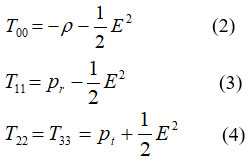
The quantities P, Pr, Pt and E refer to as energy density, radial pressure, tangential pressure and electric field, respectively. The basic field equations (2)-(4) are transformed to find the solution to the Einstein field equations with the transformations, x = cr2, Z(x) = e -2h(r) and A2 y2 (x) =e2v(r) with arbitrary constants A and c>0, suggested by Durgapal and Bannerji43 . The metric (1) can be expressed as

and Einstein field equations are written as follows
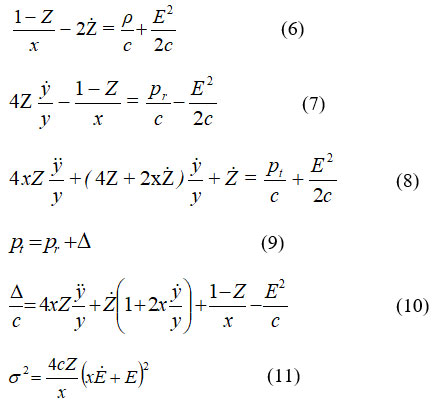
o is the charge density and dots in system of equations (6)-(11) stand for derivatives with respect to x. With the transformations of Durgapal and Bannerji43, the mass within a radius r for the realistic stellar body is given by for

Matching of the exterior and interior of the compact object at the boundary (r = R) is done by comparing the line element (1) with Reissner-Nordstrom exterior spacetime:

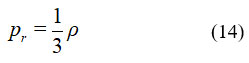
In this paper, we assume the following lineal equation of state
Materials and Methods
To be able to solve the system (6)-(11) we have taken the metric potential Z(x) of Buchdahl42 and for the electric field the proposal of Lighuda and researches44 , respectively
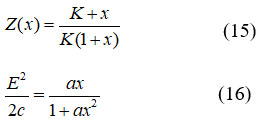
where K is a parameter related to the geometry of the star and a is a real constant. The metric potential Z(x) is continuous at the centre of the star and well behaved in the interior of the star. The electric field is finite at the center of the star and remains continuous in the interior.
Substituting (15) and (16) in (6) we obtain

we have for the radial pressure

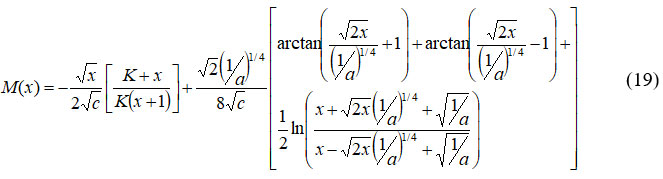
Using (17) in (12), the expression of the mass function is
With (15) and (16) in eq. (11), the charge density is

With (15), (16) and (18), the eq. (7) becomes

Integrating (21), we obtain

where for convenience
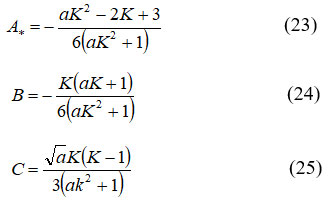
The metric functions can be written as

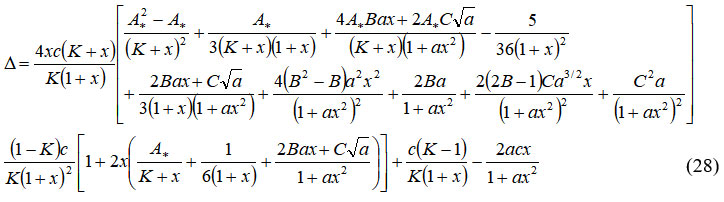
The anisotropy factor A is given by for
Physical Requirements
Any physically acceptable solution must satisfy the following conditions32,45 :
The gravitational potentials e2h and e2v are functions that take finite and positive values along the radial coordinate and are continuous throughout the stellar interior.
The energy density p decreases continuously from the centre r=0 and becomes zero at the surface r=R .
The radial pressure Pr must be finite at the centre and it must vanish at the surface of the sphere.
The radial pressure and density gradients dPr/dr<0 and dP/dr<0 for 0< r< R .
The anisotropy is zero at the center r=0, i.e. A(r=0) =0.
Any physically acceptable model must satisfy the causality condition, that is, for the radial sound speed V2sr = dPr/dP ,we should have 0< v2sr <1.
(vii) At the surface of the star the charged interior solution should be matched with the Reissner–Nordström exterior spacetime (13).
Results and Discussion
For the new solutions, the gravitational potentials e2hand e2v have finite values and are continuous throughout the stellar interior, this is in agreement with the result by Sunzu, Maharaj and Ray26. At the center e2h(0) and e2vh(0) = = A2 c21 K2A e2c . We show that in r=0 , (e2h(r))’r=0 = (e2h(r))’ =(e2v(r))’r=0 = 0 and this makes is possible to verify that the gravitational potentials should be finite at the center and avoid the singularities within the stellar interior.

Gradients dP/dr and dPr/dr acquire negative values with the radial parameter. For 0< r < R


According equations (30) and (31) the pressure and density diminish in the stellar interior and vanishes on the surface of the star. The solution for r=R must match the Reissner–Nordström exterior space–time as:

and therefore, the continuity of ev and eh across the boundary r=R is

Then for the matching conditions, we obtain:

Table 1 contains the values of a, K and masses for different stars in r=R
Table 1: Values of K, a and M(Mo) in r=R
K | a | M(Mo) |
6 | 0.0002 | 2.71 |
8 | 0.0002 | 2.87 |
10 | 0.0002 | 2.96 |
Mo = sun’s mass
The figures 1,2,3,4,5,6,7,8 and 9 represent the plots of e2h, e2v, P , Pr , dp/dr, dP/dr, M , o2 and A with the radial coordinate. For all the plots c=1.
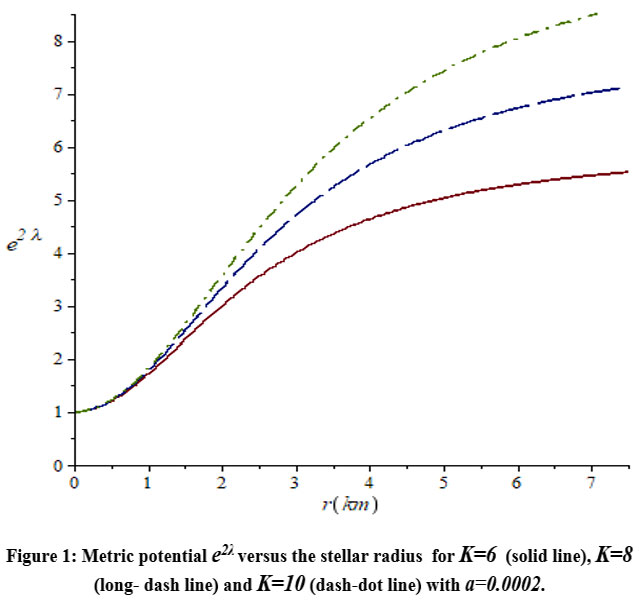 | Figure 1: Metric potential e2h versus the stellar radius for K=6 (solid line), K=8 (long- dash line) and K=10 (dash-dot line) with a=0.0002. |
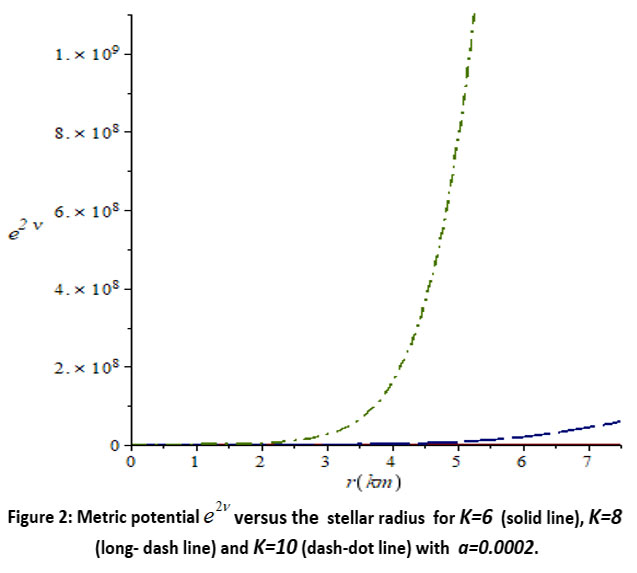 | Figure 2: Metric potential e2v versus the stellar radius for K=6 (solid line), K=8 (long- dash line) and K=10 (dash-dot line) with a=0.0002. |
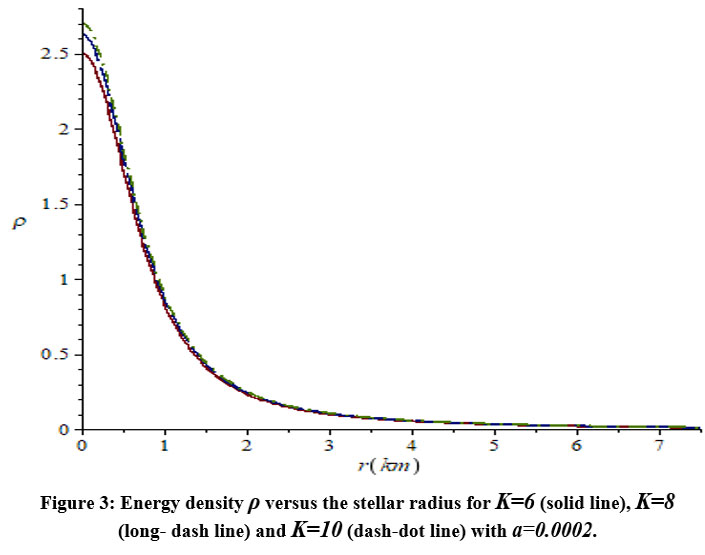 | Figure 3: Energy density p versus the stellar radius for K=6 (solid line), K=8 (long- dash line) and K=10 (dash-dot line) with a=0.0002. |
 | Figure 4: Radial pressure P versus the stellar radius for K=6 (solid line), K=8 (long- dash line) and K=10 (dash-dot line) with a=0.0002. |
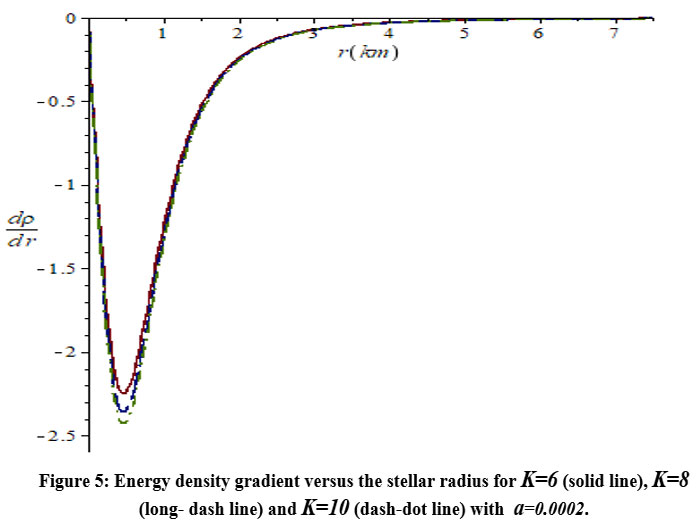 | Figure 5: Energy density gradient versus the stellar radius for K=6 (solid line), K=8 (long- dash line) and K=10 (dash-dot line) with a=0.0002. |
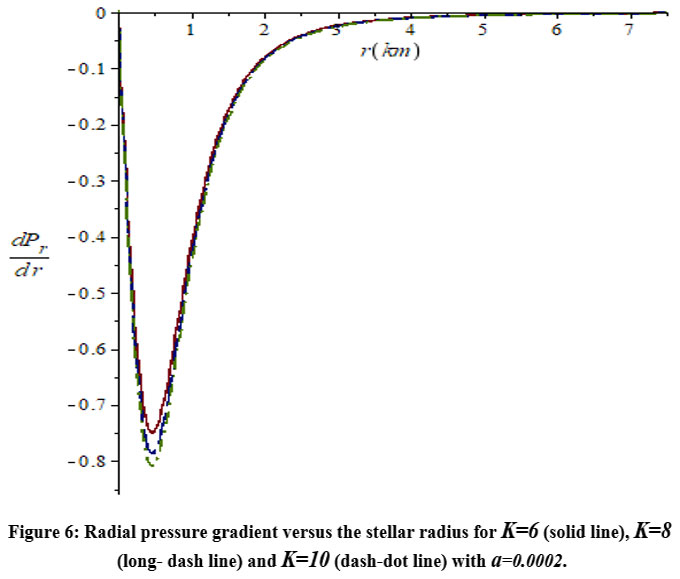 | Figure 6: Radial pressure gradient versus the stellar radius for K=6 (solid line), K=8 (long- dash line) and K=10 (dash-dot line) with a=0.0002. |
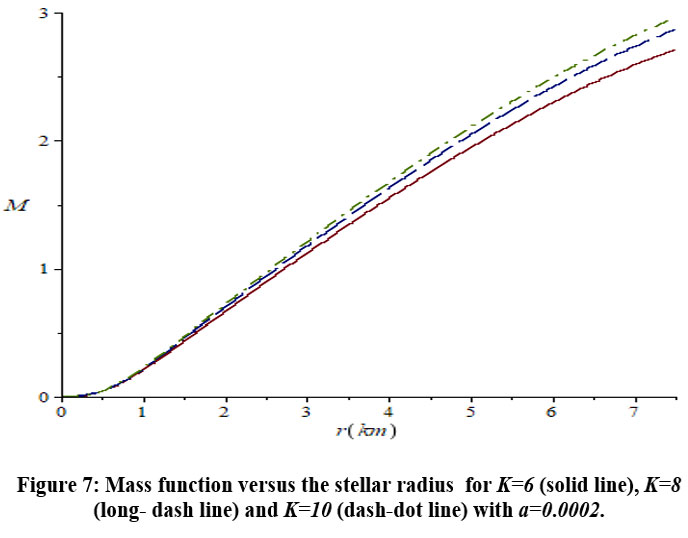 | Figure 7: Mass function versus the stellar radius for K=6 (solid line), K=8 (long- dash line) and K=10 (dash-dot line) with a=0.0002. |
 | Figure 8: Charge density O2 versus the stellar radius for K=6 (solid line), K=8 (long- dash line) and K=10 (dash-dot line) with a=0.0002. |
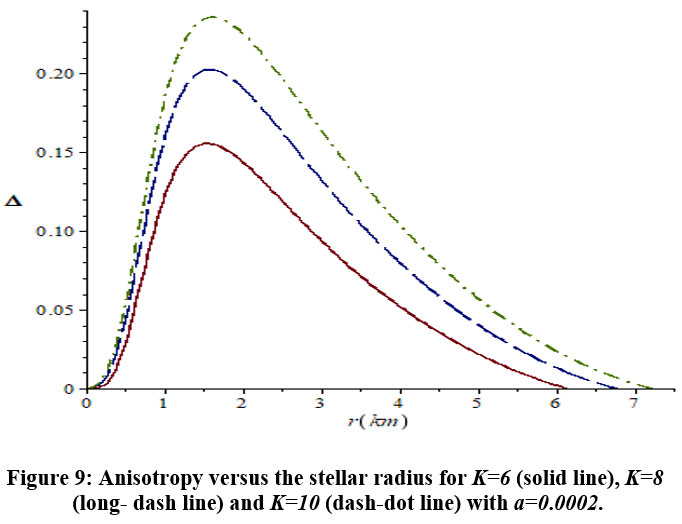 | Figure 9: Anisotropy versus the stellar radius for K=6 (solid line), K=8 (long- dash line) and K=10 (dash-dot line) with a=0.0002. |
For different values of parameter K, the gravitational potentials e2h (Figure 1) and e2v (Figure 2) are monotonically increasing function with the radial distance, continuous throughout the stellar interior and takes higher values when K is increased. The energy density from Figure 3, is observed to be maximum at the star core. It decreases as the radial distance increases for all the values of K. This indicates that the model is physically realistic as we expect the maximum value of energy at the centre as observed by Sunzu, Maharaj and Ray26. The radial pressure is also a decreasing function with radial coordinate with the maximum at the centre as a noted in Figure 4. The radial variation of energy density gradient has been shown in Figure 5, in which it is observed that dp/dr <0
We can compare the values calculated for the mass function with observational data of some astrophysical objects such as for PSR J1823-3021G, PSR J1748-2446an and PSR J1518+490446-48. The values of the stellar masses for these compact stars are tabulated in Table 2.
Table 2: The approximate values of the masses for the compact stars
Compact Star | Masses M(Mo) |
J1823-3021G | 2.65 |
J1518+4904 | 2.72 |
J1748-2446an | 2.97 |
Conclusion
This study included a choice of generalized metric function which has regained some choices made by previous researchers39. Moreover, the developed model was observed to be regular. That is, the potentials are above zero at the centre of a star showing that the model is regular. The proposed models can be compared with the pulsars PSR J1823-3021G, PSR J1748-2446an and PSR J1518+490443-44 and well behaved. Quantifying gravity in quantum states with gravity and tensor time metrics presents a novel approach to unifying General Relativity and Quantum Relativity. Astrophysical regions would demonstrate a rank2 tensor using Einstein’s Field Equations and the Schwarzschild metrics to explain the gravitational interaction in terms of spacetime curvature. Many experimental approaches such as high-energy particle collisions, gravitational wave observations, quantum entanglement experiments, astrophysical observations, and laboratory simulations have promising advances to find signatures of the quantum interior with astro exterior of these compact stars, especially pulsars50-60.
The author would like to thank Magadh University for granting the Ph.D. research work. The Department of Environmental Science, A.N. College, Patna of the Magadh University, is highly appreciated for allowing the GIS laboratory work. The author is also profoundly grateful to the National Remote Sensing Center (NRSC), Indian Space Research Organisation (ISRO), Govt. of India for their guidance during the Satellite data procurement.
Funding Sources
The author(s) received no financial support for the research, authorship, and/or publication of this article.
Conflict of Interest
The authors declares that there is no conflict of interest regarding the publication of this article.
Data Availability Statement
This statement does not apply to this article
Ethics Statement
This research did not involve human participants, animal subjects, or any material that requires ethical approval.
Informed Consent Statement
This study did not involve human participants, and therefore, informed consent was not required.
Authors’ Contribution
M.M (Manuel Malaver): Supervision and Writing – Original Draft.
R.I (Rajan Iyer): Review & Editing
References
- Kuhfitting, P.K. Some remarks on exact wormhole solutions, Adv. Stud.Theor. Phys. 2011, 5, 365- 367. DOI: https://doi.org/10.48550/arXiv.1001.0381
- Bicak, J. Einstein equations: exact solutions, Encyclopedia of Mathematical Physics. 2006, 2, 165-173.DOI: https://doi.org/10.48550/arXiv.gr-qc/0604102
- Schwarzschild K. On the gravitational field of a sphere of incompressible fluid according to Einstein’s theory. Math Phys Tech. 1916, pp: 424-434.
- Komathiraj, K., Maharaj,S.D. Classes of exact Einstein-Maxwell solutions, Gen. Rel.Grav. 2008, 39, 2079-2093.DOI: https://doi.org/10.1007/s10714-007-0510-7
- Sharma, R., Mukherjee, S., Maharaj, S.D. General solution for a class of static charged stars, Gen.Rel. Grav. 2001, 33, 999-110.DOI:10.1023/A:1010272130226.
- Bowers, R. L., Liang, E. P. T. Astrophys. J. 1974, 188, 657.
- Malaver, M., Iyer, R. Analytical Model of Compact Star with a New Version of Modified Chaplygin Equation of State, Applied Physics. 2022, Volume 5, Issue 1, pp. 18-36. DOI:10.31058/j.ap.2022.51002.
- Malaver, M.; Iyer, R. Charged Stellar Model with Generalized Chaplygin Equation of State Consistent with Observational Data. Universal Journal of Physics Research. 2023, 2(1), 43–59, DOI:10.31586/ujpr.2023.748.
- Tolman RC. Static Solutions of Einstein’s Field Equations for Spheres of Fluid Phys Rev. 1939. 55: 364-373.
- Cosenza M.; Herrera L.; Esculpi M.; Witten L. Evolution of radiating anisotropic spheres in general relativity. Phys.Rev.1982, D 25, 2527-2535.
- Herrera L. Cracking of self-gravitating compact objects. Phys. Lett. 1992, A165, 206-210.
- Herrera L.; Nuñez L. Modeling 'hydrodynamic phase transitions' in a radiating spherically symmetric distribution of matter. The Astrophysical Journal. 1989, 339, 339-353.
- Herrera L.; Ruggeri G. J.; Witten L. Adiabatic Contraction of Anisotropic Spheres in General Relativity. The Astrophysical Journal. 1979, 234, 1094-1099.
- Herrera L.; Jimenez L.; Leal L.; Ponce de Leon J.; Esculpi M.; Galina V. Anisotropic fluids and conformal motions in general relativity. J. Math. Phys. 1984, 25, 3274.
- Malaver, M. Quark Star Model with Charge Distributions. Open Science Journal of Modern Physics. 2014, 1, 6-11.DOI: https://doi.org/10.48550/arXiv.1407.1936.
- Cosenza, M., Herrera, L., Esculpi, M. and Witten, L. Some Models of Anisotropic Spheres in General Relativity J.Math.Phys. 1981, 22(1), 118.
- Gokhroo, M.K., Mehra. A.L. Anisotropic spheres with variable energy density in general relativity. Gen.Relat.Grav. 1994 , 26(1), 75-84.
- Sokolov. A.I. Phase transitions in a superfluid neutron liquid. Sov. Phys.JETP. 1980, 52, 575
- Usov, V. V. Electric fields at the quark surface of strange stars in the color-flavor locked phase. Phys. Rev. D 2004, 70, 067301.22. DOI: https://doi.org/10.1103/PhysRevD.70.067301
- Komathiraj, K., Maharaj, S.D.Analytical models for quark stars, Int.J.Mod. Phys. 2007, D16, pp.1803-1811. https://doi.org/10.1142/S0218271807011103
- Malaver, M. Analytical models for compact stars with a linear equation of state. World Scientific News, 2016, 50, 64-73. https://worldscientificnews.com/analytical-models-for-compact-stars-with-a-linear-equation-of-state/
- Malaver, M. Some New Models for Strange Quark Stars with Isotropic Pressure AASCIT Communications, 2014, 1,48-51. http://www.aascit.org/communications/paperInfo?journalId=940&paperId=465
- Thirukkanesh, S., Maharaj, S.D. Charged anisotropic matter with linear equation of state, Class. Quantum Gravity, 2008, 25, 235001.DOI: https://doi.org/10.1088/0264-9381/25/23/235001
- Maharaj, S.D., Sunzu, J.M. Ray, S. Some Simple Models for Quark Stars Eur. Phys. J. Plus. 2014,129,3. DOI: https://doi.org/10.48550/arXiv.1412.8139
- Thirukkanesh, S., Ragel, F.C. A class of exact strange quark star model, PRAMANA-Journal of physics.2013, 81(2), 275-286. DOI: 10.1007/s12043-013-0582-8
- Sunzu, J.M, Maharaj, S.D., Ray, S. Quark star model with charged anisotropic matter, Astrophysics. Space. Sci. 2014, 354, 517- 524. DOI: https://doi.org/10.1007/s10509-014-2131-4
- Feroze, T., Siddiqui, A. Charged anisotropic matter with quadratic equation of state, Gen. Rel. Grav. 2011, 43, 1025-1035. DOI: 10.1007/s10714-010-1121-2
- Feroze, T,. and Siddiqui, A. (2014). Some exact solutions of the Einstein-Maxwell equations with a quadratic equation of state, Journal of the Korean Physical Society, 2014, 65(6), 944-947.DOI: 10.393938/jkps.65.944
- Malaver, M. Strange Quark Star Model with Quadratic Equation of State, Frontiers of Mathematics and Its Applications.2014, 1(1), 9-15. DOI: 10.12966/fmia.03.02.2014
- Malaver, M.Relativistic Modeling of Quark Stars with Tolman IV Type Potential, International Journal of Modern Physics and Application. 2015, 2(1), 1-6. https://doi.org/10.48550/arXiv.1503.06678
- Takisa, P.M., Maharaj, S.D. Some charged polytropic models, Gen.Rel.Grav.2013, 45, 1951-1969.DOI: 10.1007/s10714-013-1570-5.
- Thirukkanesh, S., Ragel, F.C. Exact anisotropic sphere with polytropic equation of state, PRAMANA-Journal of physics. 2012, 78(5), 687-696. DOI: 10.1007/s12043-012-0268-7
- Malaver, M. Analytical model for charged polytropic stars with Van der Waals Modified Equation of State, American Journal of Astronomy and Astrophysics. 2013, 1(4), 41-46. DOI:1011648/j.ajaa.20130104.11
- Malaver, M. Regular model for a quark star with Van der Waals modified equation of state, World Applied Programming. 2013, 3, 309-313.
- Thirukkanesh, S., Ragel, F.C. Strange star model with Tolmann IV type potential, Astrophysics and Space Science. 2014, 352(2), 743-749. DOI: https://doi.org/10.1007/s10509-014-1960-5
- Mak, M.K., Harko, T. Quark stars admitting a one-parameter group of 54. conformal motions, Int.J.Mod.Phys. 2004, D13, 149-156. DOI: https://doi.org/10.48550/arXiv.gr-qc/0309069
- Malaver, M., Iyer,R. Modelling of Charged Dark Energy Stars in a Tolman IV Spacetime. Open Access Journal of Astronomy. 2024, 2(1), pp.1-12. DOI: 10.23880/oaja-16000114
- Malaver, M.; Iyer, R.; Kar, A.; Sadhukhan, S.; Upadhyay, S.; Gudekli, E. Buchdahl Spacetime with Compact Body Solution of Charged Fluid and Scalar Field Theory, arXiv:2204.00981.
- Malaver, M., Iyer, R., Khan, I. Study of Compact Stars with Buchdahl Potential in 5-D Einstein-Gauss-Bonnet Gravity. Physical Science International Journal. 2022,26(9-10),1-18.DOI: 10.9734/psij/2022/v26i9-10762
- Iyer R. Algorithm it Quantitative Physics Coding Quantum Astrospace Timeline, Oriental Journal of Physical Sciences. 2023, 8(2), pp.58-67. DOI: http://dx.doi.org/10.13005/OJPS08.02.04.
- Iyer R. Quantum Gravity Time Rank-N Tensor Collapsing Expanding Scalar Sense Time Space Matrix Signal/Noise Physics Wavefunction Operator. Physical Science & Biophysics J. 2024, 8(2):000271. DOI: 10.23880/psbj-16000272
- Buchdahl, H.A. General relativistic fluid spheres. Phys. Rev. 1959, 116(4), 1027
- Durgapal, M.C., Bannerji, R. New analytical stellar model in general relativity, Phys.Rev. 1983, D27, 328-331
- Lighuda, A.S., Maharaj, S.D., Sunzu, J.M., Mureithi, E.W. A model of a three-layered relativistic star. Astrophys Space Sci. 2021, 366,76.DOI:10.1007/s10509-021-03983-x
- Bibi R, Feroze T, Siddiqui A. Solution of the Einstein-Maxwell Equations with Anisotropic Negative Pressure as a Potential Model of a Dark Energy Star. Canadian Journal of Physics. 2016, 94(8):758-762.DOI: https://doi.org/10.1139/cjp-2016-0069
- Yi-Zhong Fan, Ming-Zhe Han, Jin-Liang Jiang, Dong-Sheng Shao, Shao-Peng Tang. Maximum gravitational mass inferred at about 3% precision with multimessenger data of neutron stars Phys. Rev. D 109. 2024, 043052. https://arxiv.org/abs/2309.12644v2.
- Ridolfi,A et al. Eight new millisecond pulsars from the first MeerKAT globular cluster census MNRAS 2021, 504,1407-1426.https://doi.org/10.1093/mnras/stab790
- G. H. Janssen, B. W. Stappers, M. Kramer, D. J. Nice,A. Jessner, I. Cognard, B.Purver, A&A. 2008, 490, 753-761. DOI: https://doi.org/10.1051/0004-6361:200810076
- Caldwell RR, Dave R, Steinhardt PJ Cosmological Imprint of an Energy Component with General Equation of State. Phys Rev Lett. 1998, 80(8): 1582.
- Xu L, Lu J, Wang Y. Revisiting generalized Chaplygin gas as a unified dark matter and dark energy model. Eur Phys J C, 2012 72: 1883.
DOI: https://doi.org/10.1140/epjc/s10052-012-1883-7 - Pourhassan, B. Viscous modified cosmic chaplygin gas cosmology. Int J Modern Phys D, 2013, 22(9): 1350061.DOI: https://doi.org/10.1142/S0218271813500612
- Ray PS, Ransom SM, Cheung CC, Giroletti M, Cognard I, et al. Radio detection of the fermi LAT blind search millisecond pulsar J1311-3430. Astrophysical j Journal, 2013, 763(1): L13.DOI: https://doi.org/10.1088/2041-8205/763/1/L13
- Ho WCG, Heinke CO, Chugunov A. XMM-Newton detection and spectrum of the second fastest spinning pulsar PSR J0952-0607. Astrophysical Journal. 2019 84. 882(2): 128.
- E 54. El-Nabulsi RA. Phase transitions in the early universe with negatively induced supergravity cosmological constant. Chinese Physics Letters. 2006, 23(5): 1124. 87. DOI: 10.1088/0256-307X/23/5/017
- E 55. El-Nabulsi RA (2013) Nonstandard lagrangian cosmology. Journal of Theoretical and Applied Physics 7: 58. DOI: https://doi.org/10.1186/2251-7235-7-58
- Chapline G Dark energy stars. Paper presented at: Proceedings of the 22nd Texas Symposium on Relativistic Astrophysics at Stanford, CA, 2004, Texas
- Nojiri S, Odintsov SD. Inhomogeneous equation of state of the universe: Phantom era, Future singularity and crossing the phantom barrier. Phys Rev D. 2004, 72(2): 023003. DOI:https://doi.org/10.1103/PhysRevD.72.023003
- Markoulakis E, Konstantaras A, Chatzakis J, Iyer R, Antonidakis E. Real time observation of a stationary magneton, Results in Physics. 2019, 15: 102793. DOI: https://doi.org/10.1016/j.rinp.2019.102793
- Podolsky J, Papajcik M. All solutions of Einstein-maxwell equations with a cosmological constant in 2+1 dimensions. Phys Rev D. 2022, 105(6): 6-15. DOI: https://doi.org/10.1103/PhysRevD.105.064004
- Nabulsi RAE. Maxwell brane cosmology with higher-order string curvature corrections, a nonminimally coupled scalar field, dark matter, dark energy interaction and a varying speed of light. International Journal of Modern Physics D 2009, 18(2): 289- 318. DOI: https://doi.org/10.1142/S0218271809014431

This work is licensed under a Creative Commons Attribution 4.0 International License.