
Optical Study to Doping Carbon With Tio2 That Utilizing in Thermal Concentration
Rasheed N. Abed 1 * , Nabeel K. Al-Sahib 1 and Abdul Jabar. N. Khalifa 1
1Mechanical Engineering, Engineering College, Al-Nahrain University, Baghdad, Iraq .
http://dx.doi.org/10.13005/OJPS02.02.10
The optical properties of TiO2/C in the district from (200-2000 nm) were examined by setting up the composites with wt. % concentration. The optical information evaluated and translated regarding the hypothesis of phonon-assisted direct electronic change; it is watched that the energy is influenced by doping sort of mineral composite utilized. The doping manufactured powders were examined through data analysis to validate the presence of these elements. This investigation for the influence of TiO2 was an addition on the microstructure of the carbon and electrical behavior of the composite was detected, this doped was gotten in a dry place at ambient temperature and its effect was studied from the physical properties of the energy gap. The optical measurement of the specimen was measured as a component of wavelength (λ), absorptivity that exhibit good results to absorb the solar energy for selective surfaces.
Copy the following to cite this article:
Abed R. N, Al-Sahib N. K, Khalifa A. J. N. Optical Study to Doping Carbon With Tio2 That Utilizing in Thermal Concentration. Orient J Phys Sciences 2017;2(2).
DOI:http://dx.doi.org/10.13005/OJPS02.02.10Copy the following to cite this URL:
Abed R. N, Al-Sahib N. K, Khalifa A. J. N. Optical Study to Doping Carbon With Tio2 That Utilizing in Thermal Concentration. Orient J Phys Sciences 2017;2(2). Available from: https://bit.ly/3naDH9q
Download article (pdf) Citation Manager Publish History
Introduction
As of late, TiO2 consider in the optical properties for doping inorganic material have pulled in much consideration in perspective of their applications in optical gadgets, with astonishing reflection, antireflection, impedance, and TiO2 properties. Titanium dioxide (TiO2) otherwise called titanium oxide or titanium oxide or Titania is the normally happening oxide of titanium. It is an adaptable progress metal oxide and a helpful material in different present/future applications identified with catalysis, gadgets, photonics, detecting. Titania that announced has been generally contemplated attributable to its physical and chemical properties in photo-catalytic applications for ecological remediation [1]. It is generally utilized as a part of the type of nanoparticles in suspension for the high synergist surface range and movement [2], it happens in nature in anatase, brookite and rutile frames. These stages are portrayed by high refractive index (anatase = 2.488, rutile = 2.609, brookite = 2.583), high absorption and low scattering in obvious and close infrared spectral areas, high chemical and thermal stabilities [3].
TiO2 which is uses these size-subordinate properties in the transformation of solar energy. The high surface range achieved by a small particle size is valuable to most TiO2-based gadgets as it encourages association between the gadgets and communicating media which predominantly happens on the surface and relies upon the surface zone [4].
In this paper, consequences exhibited of such an examination for the optical properties of TiO2 to doped C films, behaves as semiconductor for the selective surfaces to absorb the solar energy.
Experimental details
TiO2 Nanoparticle powder (99.9%, normal distance across of 50 nm Easchem company/Changsha/Hunan/China) was prepared, and then the Carbon has been set up from the Market. it utilize to mix it with TiO2 Nanomaterial to doping carbon in Photocatalytic exercises of the specimens were evaluated in explore, Wt % of TiO2 with Carbon was added to polyethylene glycol (PEG 400) as 1:2 to set up the colloidal. Before were the colloidal alluringly blended for (1 h) by appealing stirrer to ensure the establishment of a TiO2/C composite photocatalyst, blended as a colloidal and scattered them in PEG400 with add distilled water 3:1 to PEG400 in the lab, all this happened at ambient temperature and after this the colloidal placed it in the apparatus assembly, then it delivered by utilizing glass tube that using to spray the colloidal on the samples by spray pyrolysis to start the spray coating process. At that point, the air blower is utilizing in the spray coating to blow the air under the activity of spray process on the sample.
In the beginning of the spray procedure through the glass tube the colloidal pour from the hole in the top of the tube glass, over the capillary tube that will be showered the samples through the glass tube; The glass chamber that envelops the capillary tube. This glass chamber at cone shape close from the highest point of the valve that used to open and close the space of the capillary tube, when colloidal go down to the base of the substrate to splash through its. This glass chamber filling in as a vacuum to have a weight effect inside the glass chamber, at that point to allow air to blend with colloidal beads toward the end of a capillary tube and join with the air to shower on the samples. The side opening in the glass chamber goes air through it and meeting the beads of the colloidal toward the finish of the capillary tube, to change the air pressure over the drops to shower cone on the samples that will be under the sprinkle space, the sample size was (2.5 cm x2.5 cm x0.2 cm) that consist from glass and copper. At that point the sample put it under the atomizer then put it underneath variation heater to enabling the sample to warming before begin by spray technique, to get all the arrangement of water and PEG400 will vaporize under warming when the bead falls on the sample, in the interim when finishing the shower, the samples consistent warming until the point when all the arrangement will vaporize and the samples will be dried.
All things considered, this, when completed the test; at that point put the dried samples in the furnace at temperature 250 C for 6 h to guarantee the Foundation the crystallization of the composite and give up it in the furnace to the following day when turning off the furnace.
The optical absorbance (α) of the specimen was measured as a component of wavelength (λ) extended from 200 to 2000 nm by utilizing computerized Shimadzu 1650PC UV-VISIBLE-SPECTROPHOTOMETER full-scale absorbance.
All estimations were performed at ambient temperature. UV/VIS absorption spectroscopies were made for arranged examples prior and then afterward blend. The spectra were utilized to carry out the energy gap by plotting (αhυ)2 versus (hυ) which demonstrates a progress of a direct sort, and (αhυ)0.5 versus (hυ) which shows a change of an indirect sort. The energy gap move for the example plotted as a capacity to conjunction sort [5].
Mechanism of electrical conduction in composite
The conduction properties of directing composite have already been explained on the premise of the band hypothesis of solids. As per this hypothesis of solids, when countless or particles are united to frame a composite chain or a crystalline strong, an energy band is shaped through the connection of the constituent molecular or atomic orbitals. The band of most astounding energy that is totally filled by electrons is by and large called the valence band. The electrons related with groups are associated with substance holding and are subsequently rather restricted and are not allowed to travel through the strong. The least lying empty levels shape a band which is, for the most part, called the conduction band. There is a forbidden energy locale between the valence band and the conduction band. This energy partition is known as the vitality hole or band hole. e.g. at the point when the energy gap is extensive, the material carries on as an insulator.
Along these lines, the framework moves toward becoming directing and the viable versatility of these bearers is dictated by the comparing band width. As it were, the conduction properties of the composite are identified with their electronic properties, for example, band gap, ionization potential, electron affinity, and band width. See Figure (3) which demonstrates the valence and conduction groups (energy levels) and the band gap for the composite as an insulator [6].
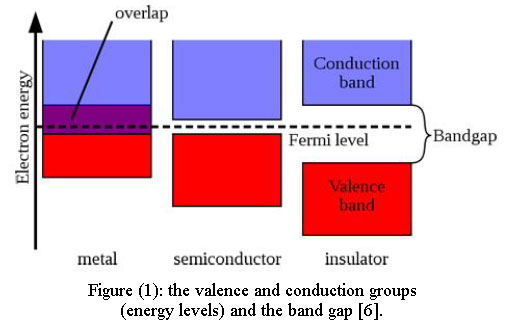 |
Figure 1: the valence and conduction groups (energy levels) and the band gap [6]
|
Results and Discussions
The connection between (αhυ)2 versus photon energy for the TiO2/C tests appear in Figures (4 to 5) for the permitted change. For doped examples appeared in Figures (4 to 5), the shift in the energy gap could be ascribed to the development of plans in the doped films. The proof of TiO2/C development is made that the response in the band to band transition because of moving the band thickness of state toward the energy gap. This perception is not like the doping in ordinary semiconductors when the band to band absorption strength does not influence the arrangement of dopant state in the energy gap.
The impact of the inorganic expansion on the estimations of phonon energies is likewise researched and the outcomes have appeared in the Table. The outcomes displayed in Figures (4 to 5) demonstrate the presence of two groups in the energy gap. The first speaks to the change from the valence band to conductance band. Which is in a decent concurrence with comes about, are gotten [7-11].
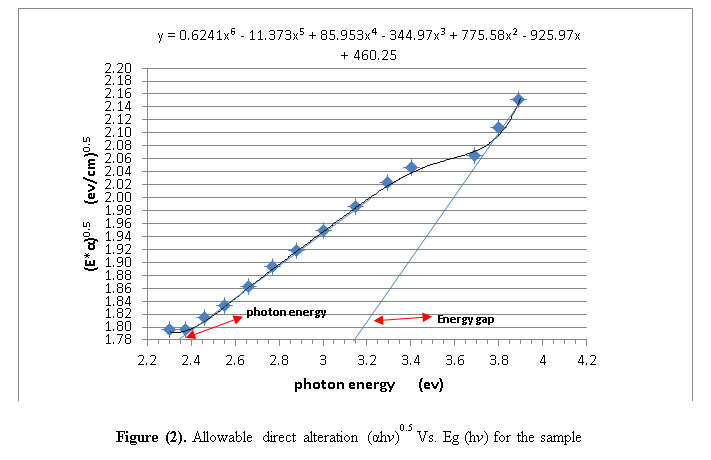 |
Figure 2: Allowable direct alteration (αhv)0.5 Vs. Eg (hv) for the sample
|
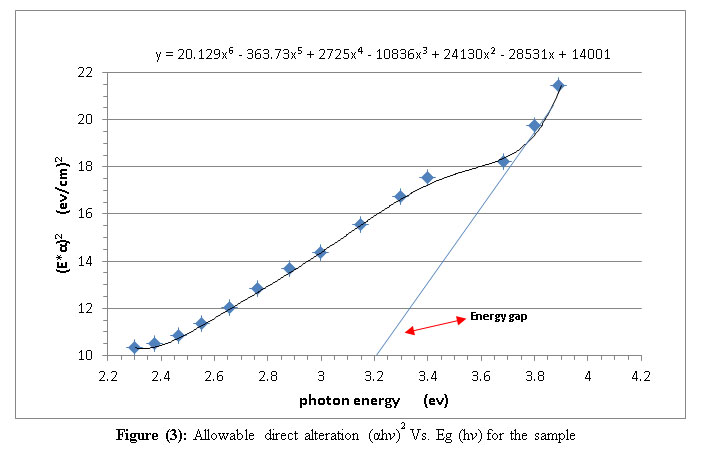 |
Figure 3: Allowable direct alteration (αhv)2 Vs. Eg (hv) for the sample
|
The Energy gaps were measured as a conduct of a conductivity estimation of TiO2/C with added substance can acquire by receiving the information of energy gap, (Table1and Figures (4 to 5)).
The table underneath demonstrates the physical information for the ligand and the arranged buildings, recommending their electrolytic nature. The absorption of information was gotten utilizing nuclear absorption method from the above hardware. The calculated values were in a good agreement with the experimental values.
Table 1: Indicate the energy band gap according to the direct allowed transition
|
Direct Band Gap For TiO2/C |
Indirect Band Gap TiO2/C |
Photon Energy for TiO2/C |
|
3.2 (ev) |
3.15 (ev) |
2.35 (ev) |
Conclusions
The optical absorption in the UV-Visible and NIR district for C doped with TiO2 edifices. The energy gaps were measured as a conduct of conductivity and it is surrendered that the energy is influenced by doping sort of metal complexes utilized. The TiO2/C is particularly retentive for short-wavelength photons NIR (the semiconductor band gap). We moreover found that the differing scale features of the nanoparticle of TiO2/C and mass carbon particles have basically enhanced the solar absorptivity contrasted and uniform nanoparticles in view of the more profitable light catching.
These two equations for a mathematical model that found from the above figures of the process makes it possible to determine the optimal conditions for the implementation of the process of calculation, with various combinations of existing factors; Besides the significance of the correlation coefficients; All this results that benefit from the manuscript to attain high absorptivity for the selective surfaces that utilizing in concentrating solar thermal, this reveal from the table above that the energy gab is a good agreement with researcher to get high absorbance
Acknowledgements
The authors acknowledge the supporting staffs of Chemical & physical in the college Sciences of Al-Nahrain University for their encouragement to help me for this work.
References
- Wang W., Gu B., Liang L., Hamilton W.A., Wesolowski D. J., Synthesis of Rutile (TiO2) Nanocrystals with Controlled Size and Shape by Low-Temperature Hydrolysis: Effects of Solvent Composition, J. Phys. Chem. B., 108, 14789-14792 (2004).
- Hussain Z., El-Hitib G., Ahmed A., Altaeed N., Yousif E, Photocatalytic Degradation of Polyhydroxybutyrate Films Using Titanium Dioxide Nanoparticles as a Photocatalyst, Russian Journal of Applied Chemistry, 89 (9), 1536-1543 (2016)..
- Zallen R., Moret M. P., The optical absorption edge of brookite TiO2; Solid State Communications, 137, 154-157 (2006).
- Chin J. C., Titanium dioxide Nanomaterials and their energy applications, Chinese Journal of Catalysis, 30, 839-851 (2010).
- Al-Taa'y W. A., Oboudi S. F., Yousif E., Effect of Nano Sb2O3 on the Dispersive Optical Constants of PMMA Films Sultan Qaboos University Journal for Science, 22(1), 56-62 (2017).
- Ali A., Fadhil D., Yousif E., Hussain Z., Abdul-Wahab S., A Comprehensive Study of Conductive Polymer Matrix Composites: A Review, Research Journal of Pharmaceutical, Biological and Chemical Sciences, 8(2), 2043- 2049 (2017).
- Yousif E., Adil H., Farina Y., Synthesis and Characterization of Some Metal Ions with 2-amino Acetate Benzothiazole", Journal of Applied Sciences Research, 6, 879-882, (2010).
- Al-Taa'y W., Mohammed S., Adil H., Khan N., Hasan A., Khalaf M., Yousif E., Optical Properties and AFM Study of New Polymers Derived From Poly(Vinyl Chloride)-2-Acetoxy Benzoic Acid Complexes, Research Journal of Pharmaceutical, Biological and Chemical Sciences, 7(4), 1079-1086 (2016).
- Ali A., Fadhil D., Yousif E., Hussain Z., Abdul-Wahab S., Zageer D., An Insight Into Measuring Conductivity Of Solutions With Ease: A Review, Research Journal of Pharmaceutical, Biological and Chemical Sciences, 8(2), 2033- 2037 (2017).
- Al-Taa’y W., Oboudi S., Yousif E., Abdul Nabi M., Yusop R., Derawi D, Fabrication and Characterization of Nickel Chloride Doped PMMA Films, Advances in Materials Science and Engineering, 2015, 1-5 (2015).
- Ali A., Fadhil D., Yousif E., Hussain Z, Al-Hussin A., Zageer D., Mohammed S, Electrical Resistivity: Concept And Measurement, Research Journal of Pharmaceutical, Biological and Chemical Sciences, 8(2), 2038- 2042 (2017).

This work is licensed under a Creative Commons Attribution 4.0 International License.