
UV-Absorbing Gallic Acid Derivatives as Functional Reinforcing Fillers in Poly(Vinyl Chloride) Films
Raghad M. Omer1* , Emaad T. Bakir1 , Ahmed Ahmed 2 , Ali Hasan 3 and Emad Yousif 3
1Department of Chemistry, Tikrit, Iraq, College of Science, Tikrit University, Tikrit, Iraq .
2Polymer Research Unit, Baghdad, Iraq, College of Science, Al-Mustansiryah University, Baghdad, Iraq .
3Department of Chemistry, Baghdad, Iraq, College of Science, AL-Nahrain University, Baghdad, Iraq .
http://dx.doi.org/10.13005/OJPS03.01.07
The poly(vinyl chloride) PVC was photostabilized by gallic acid derivatives (0.5% by weight). The photodecomposition rate constant was reduced significantly in the existence of gallic acid derivatives along with PVC (blank). R1 compound was found to be the most effective stabilizer in photostabilization of PVC. The photodecomposition rate constant for PVC films containing R1 was found to be 1×〖10〗^(-4) compared to 8×〖10〗^(-4) sec-1 for PVC films in the absence of any additives. Different mechanisms of photostability for PVC films that involve gallic acid derivatives have been proposed.
Copy the following to cite this article:
Omer R. M, Bakir E. T, Ahmed A, Hasan A, Yousif E. UV-Absorbing Gallic Acid Derivatives as Functional Reinforcing Fillers in Poly(Vinyl Chloride) Films. Orient J Phys Sciences 2018;1(1).
DOI:http://dx.doi.org/10.13005/OJPS03.01.07Copy the following to cite this URL:
Omer R. M, Bakir E. T, Ahmed A, Hasan A, Yousif E. UV-Absorbing Gallic Acid Derivatives as Functional Reinforcing Fillers in Poly(Vinyl Chloride) Films. Orient J Phys Sciences 2018;3(1). Available from: https://bit.ly/36LxAmy
Download article (pdf) Citation Manager Publish History
Introduction
Plastics have played an indispensaable role in our life and production as the most significant material of the 21st century. Plastics are closely utilized in different parts of civil life, manufacturing, and aerospace technology because of their excellent material features, including cheap, strength and lightweight [1]. There are 10,000 companies in the United State alone that are interested in manufacturing, processing and fabricating polymeric materials [2,3].
Polymers are classified into natural and artificial types. Polystyrene, Polyester and poly(vinyl chloride) are examples of synthetic polymers [4,5]. Poly(vinyl chloride) is the most extensively employed thermoplastic materials worldwide, with more than 31 million tons produced per annum [6-9]. PVC the second most widely consumed plastic, is a 21st century material [10,11], mostly utilized in several industrial applications such as toys, tubes, food packaging, medical devices, building applications, electronics and furnishings [12-14]. Photodegradation occur as a result of chemical reaction, or photochemical degradation, which could be started by the UV solar radiation energy [15]. However, long term exposure of PVC to sunlight and/or high temperature lead to its photo degradation [16]. Neat PVC is usually mixed with other additives to get a plastic with desired properties depending on the intended industrial use [17].
Photostabilization of PVC can be established through the use of various additives. The addition just a little content by weight of additives progress polymer properties, occasionally, it due to a unique combination of properties [18,19]. The most common additives are Schiff base complexes [20], heterocycles [21], plasticizers [22], metal complexes and inorganic salts [23], aromatics [24,32]. In the present study, we investigated the (kd) photodecomposition rate constant of PVC polymeric films including gallic acid derivatives on irradiation with UV light.
Experimental
Materials
From Sigma-Aldrich (Gillingham, UK) all reagents and solvents were purchased and have been utilized without further purification. K value and polymerization degree of PVC = 67, 800 respectively, it was purchased from Petkim Petrokimya (Istanbul, Turkey).
Preparation of materials
Gallic acid derivatives Fig. (1); R1, R2, R3 and R4 were synthesized based on a literature procedure [25].
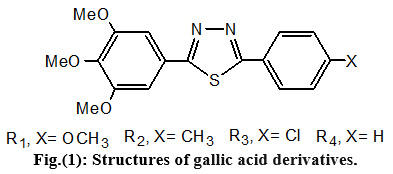 |
Figure 1: Structures of gallic acid derivatives
|
Films Preparation
Commercial PVC was re-precipitated in tetrahydrofuran (5 g/100 mL) with ethanol and dried for 24 h at 20ËšC under reduced pressure. The gallic acid derivatives (0.5% by weight) were mixed with PVC at 20ËšC based on literature procedure [25] then aluminum plate stands (Q-Panel Company, Homestead, FL, USA) were utilizing to fix PVC films [26]. 40 µm Thickness of PVC films was measured by a Digital Caliper Vernier (Kevelaer, Germany).
Accelerated Testing Technique
Irradiation (290-360 nm; λ = 313 nm) of PVC films was carried out using a standard procedure with an accelerated weather-meter QUV tester (Philips, Saarbrücken, Germany) for 250 h [27].
Photodecomposition Rate (kd) of PVC Films using UV Spectrophotometer [28]
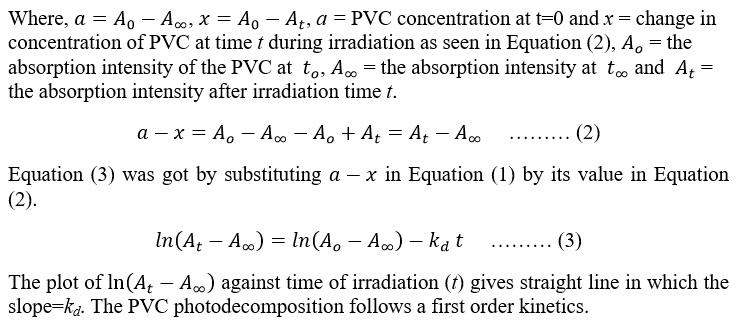
A Shimadzu UV-Vis 160A-Ultraviolet Spectrophotometer (Shimadzu Cooperation, Kyoto, Japan) was utilized to measure changes in the UV-visible spectra of PVC films during irradiation (λmax = 313 nm). kd of PVC films were calculated using Equation (1).

Results and Discussion
The effect of gallic acid derivatives (R1, R2, R3, R4) on the PVC films photodecomposition was investigated. The PVC films (40 mm thickness) containing gallic acid derivatives (0.5% by weight) were irradiated with a UV light (λmax=313 nm) for 250 h. The UV irradiation due to a clear change in PVC films and decomposition took place. lnAt-A∞ plot against time of irradiation (t) gave a straight line. The graphs showed first order kinetics in which the slope equaled kd constant for PVC films. Fig.(2) demonstrates the change in lnAt-A∞against time of irradiation (t) of PVC films in the absence any additives. Figures 3-6 show the changes in the lnAt-A∞against time of irradiation of PVC films including gallic acid derivatives (0.5% by weight) as stabilizers for PVC films on irradiation with light.
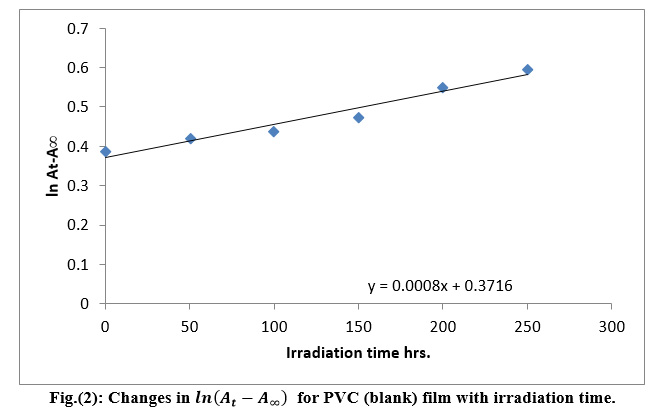 |
Figure 2: Changes in for PVC (blank) film with irradiation time
|
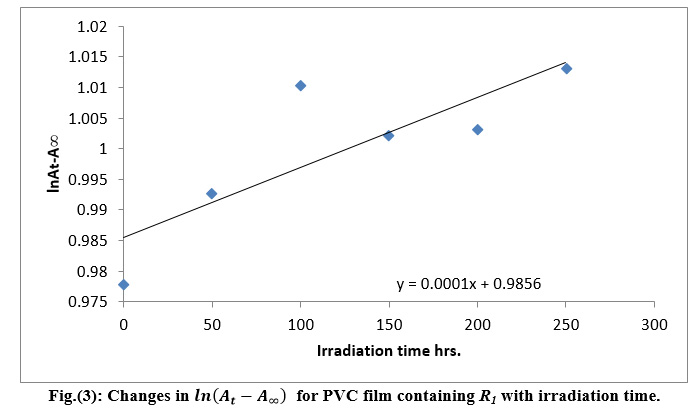 |
Figure 3: Changes in for PVC film containing R1 with irradiation time
|
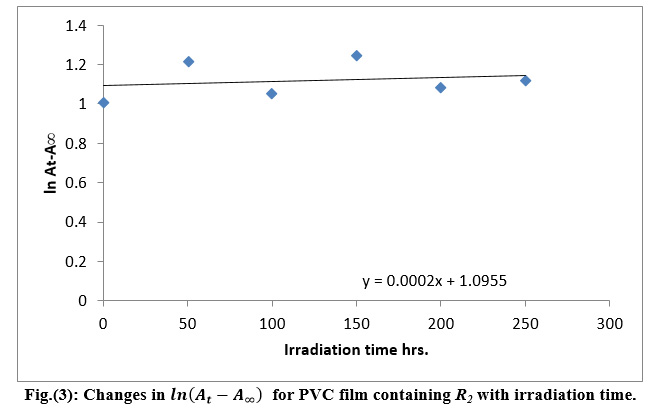 |
Figure 3a: Changes in for PVC film containing R2 with irradiation time
|
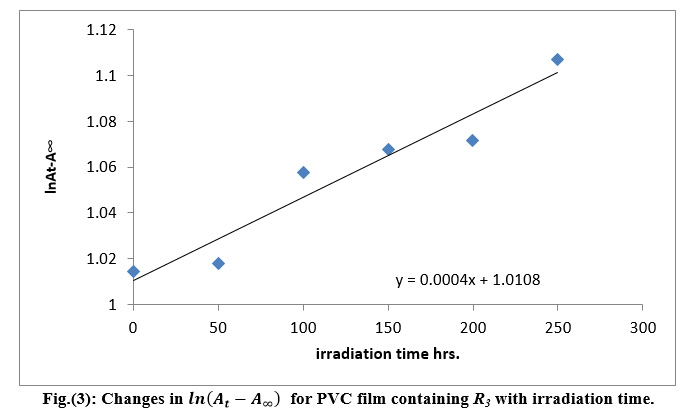 |
Figure 3b: Changes in for PVC film containing R3 with irradiation time
|
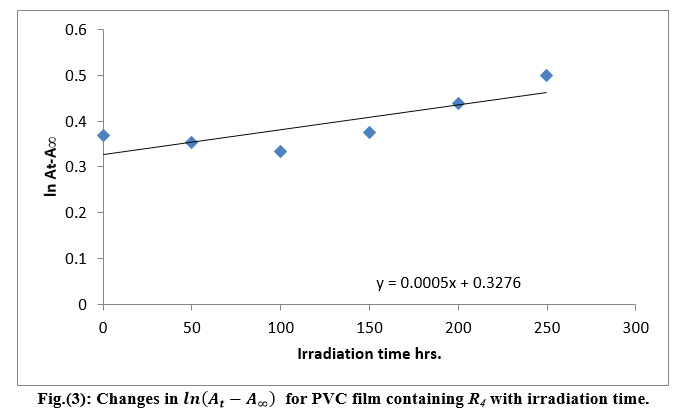 |
Figure 3c: Changes in for PVC film containing R4 with irradiation time
|
Table 1: Photodegradation rate constant (kd) values for PVC films on UV irradiation (250 h)
|
PVC film |
Kd (sec-1) |
|
PVC (blank) |
8×10⁻⁴ |
|
PVC + R4 |
5×10⁻⁴ |
|
PVC + R3 |
4×10⁻⁴ |
|
PVC + R2 |
2×10⁻⁴ |
|
PVC + R1 |
1×10⁻⁴ |
The first order photodecomposition rate constant (kd) for PVC films containing gallic acid derivatives (0.5 wt %) along with that for PVC (blank) is shown in Table (1). Table (1) and Figures (2-6) show that the rate constant (kd) values are sensitive to the presence of gallic acid derivatives and its substitution. The PVC photodecomposition rate constant was high ( sec-1) in the absence of any additives. Such rate constant has been reduced significantly ( sec-1) when gallic acid derivatives were used as additives. The photostabilization of PVC in the presence of gallic acid derivatives follow this order R1< R2< R3< R4. The R1 was the most efficient than the other derivatives in photostabilization of PVC films. Clearly, these derivatives have acted as photostabilizers for the photostabilization of PVC films. The photodecomposition rate constant was highest for PVC (blank) and lowest in the presence of R1 derivative. Such photostabilizers could play as HCl scavengers, primary stabilizers, peroxide decomposers, radical scavengers and UV absorbers [29].
Proposed Mechanisms of PVC Photostabilization
The efï¬ciency of additives as PVC photostabilizers was measured as a function of the changes in the photodecomposition rate constant value. The values were smaller in PVC films containing gallic acid derivatives along with PVC itself. Different mechanisms of photostabilization process of PVC films containing gallic acid derivatives can be proposed schemes 1 and 2.
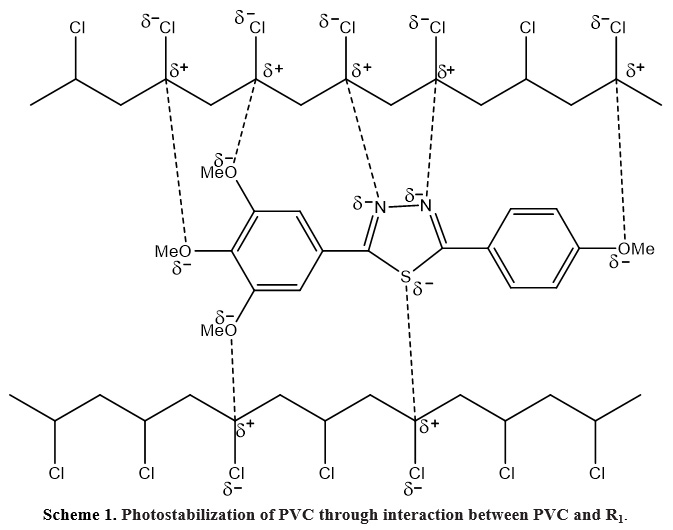 |
Scheme 1: Photostabilization of PVC through interaction between PVC and R1
|
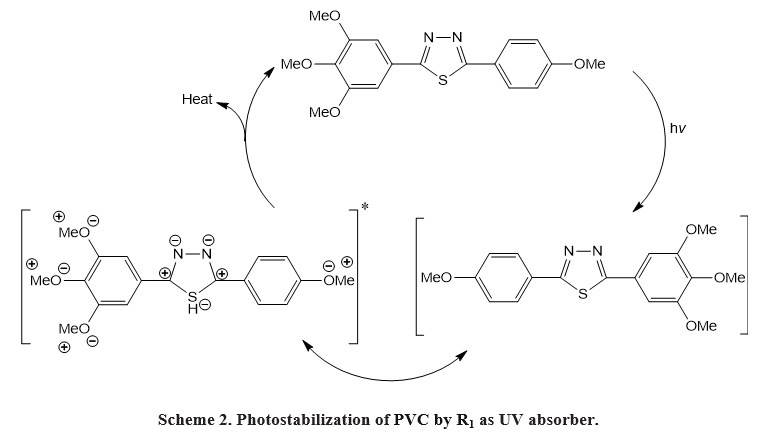 |
Scheme 2: Photostabilization of PVC by R1 as UV absorber
|
The heteroaromatic and aromatic rings can play as UV absorbers [31]. These systems have electron rich within stabilizer backbone structures can absorb the UV radiation energy directly and dissipates it to harmless heat energy, scheme 2.
References
- Ye L., Qi C., Hong J., Ma X., Life cycle assessment of polyvinyl chloride production and its recyclability in China, http://dx.doi.org/10.1016/j.jclepro.2016.10.171, (2016).
- Chemistry Explained, Foundation and Applications: Synthetic Polymers, http://www.chemistryexplained.com/Pl-Pr/Polymers-Synthetic.html, (2016).
- Ali M., El-Hiti G., Ibraheem H., Yousif E., Investigation of the Photodecomposition Rate Constant of Poly(Vinyl Chloride) Films Containing Organotin (IV) Complexes J Al-Nahrain University (science), 20(3), 18-23, (2017).
- Hu X., He Q., Lu H., Chen H., Fabrication of gold microelectrodes on polystyrene sheets by UV-directed electroless plating and its application in electrochemical detection, J. Electroanal Chem., 638, 21-27, (2010).
- Okamura O., Yamauchi E., Shirai M., Photo-cross-linking and de-cross-linking of modiï¬ed polystyrenes having degradable linkages, React. Funct. Polym.,71, 480-488, (2011).
- McCoy C., Irwin N., Hardy J., Kennedy S., Donnelly L., Cowley J., Andrews G., Pentlavalli S., Systematic optimization of poly(vinyl chloride) surface modification with an aromatic thiol, https://doi.org/10.1016/j.eurpolymj.2017.09.030, (2017).
- Guo R., Yu E., Liu J., Wei Z., Agitating transformation during vinyl chloride suspension polymerization: aggregation morphology and PVC properties, RSC Adv. 7, 24022-24029, (2017).
- Krishna R., Swamy A., Chemical Flexi Not-So-Fantastic : A review on How the Versatile Material Harms the Environment and Human Health, I. J. S. R. S. T., 2(1), 36-45, (2016).
- Huang Z., Ding A., Guo H., Lu G., Huang X., Construction of nontoxic polymeric UV-absorber with great resistance UV-photoaging, Sci. Rep. 6, doi:10.1038/srep25508, (2016).
- Ameen N., Yousif E., Ahmed A., Ahmed S., Hasan A., The Metal Complexes of 4-[(2-Hydroxy-benzylidene)-amino]-N-(5-methyl-isoxazol-3-yl)benzenesulfonamide as Photostabilizers for PVC, J. Adv. Phy. Sci., 1(1), 7-9, (2017).
- Ebnalwaled A., Thabet A., Controlling the optical constants of PVC nanocomposite ï¬lms for optoelectronic applications, Synthetic Metals, 220, 374-383, (2016).
- Azlin-Hasim S., Cruz-Romero C., Morris A., Padmanabhan C., Cummins E., Kerry P., The potential application of antimicrobial silver polyvinyl chloride nanocomposite ï¬lms to extend the shelf-Life of chicken Breast ï¬llets, Food Bioprocess Technol, 9, 1661-1673, (2016).
- Fenollar O., Balart R., Sánchez-Nácher L., García-Sanoguera D., Boronat T., Mechanical and Morphological Characterization of Novel Vinyl Plastisols with Epoxidized Linseed Oil as Natural-Based Plasticizer, DOI: 10.1063/1.3455624, (2010).
- Arrieta M., Samper M., Jiménez-López M., Aldas M., López J., Combined effect of linseed oil and gum rosin as natural additives for PVC, Industrial Crops and Products, 99, 196-204, (2017).
- Al-khateb E., Ahmed A., Alsamarrai K., Pharmaceutical Compounds as Photostabilizers, J. Al-Nahrain University (Science), 19 (3), 34-38, (2016).
- Starnes W., Structural and mechanistic aspects of the thermal degradation of poly(vinyl chloride), Prog. Polym. Sci. 27, 2133-2170, (2002).
- Mirci E., Boran S., Plasticizers and lubricants of adipic ester type with complex structure, Mater. Plast., 44, 383-392, (2007).
- Gaur M., Indolia A., Thermally stimulated dielectric properties of polyvinylidenefluoride-zinc oxide nanocomposites, J. Therm. Anal. Calorim., 103, 977-985, (2011).
- Viratyaporn W., Lehman R., Effect of nanoparticles on the thermal stability of PMMA nanocomposites prepared by in situ bulk polymerization, J. Therm. Anal. Calorim., 103, 267-273, (2011).
- Ahmed D., El-Hiti G., Hameed A., Yousif E., Ahmed A., New Tetra-Schiff Bases as Efficient Photostabilitizers for Poly(vinyl Chloride), doi:10.3390/molecules22091506, (2017).
- Balakit A., Ahmed A., El-Hiti G., Smith K., Yousif E., Synthesis of new thiophene derivatives and their use as photostabilizers for rigid poly(vinyl chloride), Int. J. Polym. Sci., doi:10.1155/2015/510390, (2015).
- Yousif E., Haddad R., El-Hiti G., Yusop R., Spectroscopic and photochemical stability of polystyrene films in the presence of metal complexes, Journal of Taibah University for Science, 11, 997–1007 (2017).
- Yousif E., El-Hiti G., Hussain Z., Altaie A., Viscoelastic, spectroscopic and microscopic study of the photo irradiation effect on the stability of PVC in the presence of sulfamethoxazole Schiff’s bases, Polymers, 7, 2190-2204, (2015).
- Tomohito K., Masahiko O., Guido G., Tadaaki M., Toshiaki Y., Antibacterial effect of thiocyanate substituted poly (vinyl chloride), J. Polym. Res., 18, 945-947, (2011).
- Tomi I., Ali G,. Jawad A., Yousif E., Synthesis and characterization of gallic acid derivatives and their utilized as organic photo-stabilizers for poly (vinyl chloride), DOI 10.1007/s10965-017-1283-7, (2017).
- Yousif E., Hasan A., El-Hiti G., Spectroscopic, Physical and Topography of Photochemical Process of PVC Films in the Presence of Schiff Base Metal Complexes, doi:10.3390/polym8060204, (2016).
- Yousif E., Hasan A., Ultra-violet spectra studies of photostabilization rate in PVC films by using some transition metal complexes, Arab. J. Phys. Chem., 1, 34-35, (2014).
- Ameen N., Ahmed S., Ahmed A., Hasan A., Yousif E., Synthesis, Characterization and Photochemical Study of PVC Films Doped by 4[(2-Hydroxy-benzylidene)-amino]-N-(5-methyl-isoxazol-3-yl)-benzenesulfonamide Complexes, J. Iraqi Industrial Research, 2(2), 26-34, (2015).
- Folarin M., Sadiku R., Thermal stabilizers for poly(vinyl chloride): A review, Int. J. Phys. Sci., 6, 4323-4330, (2011).
- Yousif E., Salih N., Salimon J., Improvement of the Photostabilization of PVC Films in the Presence of 2N-Salicylidene-5-(Substituted)-1,3,4-Thiadiazole, J. Appl. Polym. Sci., 120, 2207-2214, (2011).
- Yousif E., Bakir E., Salimon J., Salih N., Evaluation of Schiff bases of 2,5-dimercapto-1,3,4-thiadiazole as photostabilizer for poly(methyl methacrylate), J. Saudi. Chem. Soc., 16, 279-285, (2012).
- Ahmed D. S., El-Hiti G. A., Yousif E., Hameed A.S. Polyphosphates as Inhibitors for Poly(vinyl Chloride) Photodegradation, Molecules, 22, 1849, (2017).

This work is licensed under a Creative Commons Attribution 4.0 International License.