
Scientific and Applied Activities for the ChemistryDepartment, College of Science, Al-Nahrain University to Enhance Security and Safety in 2017
Emad Yousif1*  and Wedad H. Al-Dahhan1
1Department of Chemistry, College of Science, Al-Nahrain University, Baghdad, Iraq .
http://dx.doi.org/10.13005/OJPS03.02.10
Chemistry laboratories present more hazards than are typically found in other science laboratories. The Department of Chemistry at the College of Science at Al-Nahrain University aims to establish and develop the concepts of occupational safety and its embodiment through an applied reality aimed at making the work environment safe considering the development of scientific aspects and deepening the safety culture. 2017 was a year of achievements that can be summarized through major trends including the development of laboratory infrastructure, education of safety aspects, scientific support for Iraqi universities, community service in addition to the scientific research activity to teach the department on various safety topics.
Copy the following to cite this article:
Yousif E., Al-Dahhan H. W., Scientific and Applied Activities for the ChemistryDepartment, College of Science, Al-Nahrain University to Enhance Security and Safety in 2018, 3 (2), (2018).
DOI:http://dx.doi.org/10.13005/OJPS03.02.10Copy the following to cite this URL:
Yousif E., Al-Dahhan H. W., Scientific and Applied Activities for the Chemistry Department, College of Science, Al-Nahrain University to Enhance Security and Safety in 2018,3(2),(2018). Available from: https://bit.ly/374P6mb
Download article (pdf) Citation Manager Publish History
Introduction
The laboratory is a building used to carry out a scientific and practical work. The laboratory is in the process of teaching or research and contains a dedicated and separate site as an office, a hardware room and a material preparation within the competence of the laboratory, which can be chemical, physical, biological or medical.1 Laboratory work requires the application of approved safety procedures according to the nature of the laboratory, as well as rehabilitation courses for laboratory and student personnel, especially in the educational laboratories.2
Academic laboratories similar to industrial laboratories require that they conform to basic safety principles to reduce injuries and accidents.3 The development of the Department of Chemistry to promote the safety aspects included specific and important directions, including:
Development of laboratory infrastructure
The laboratory must contain sufficient space and design according to the nature of the laboratory and equip the laboratories with appropriate furniture in addition to the availability of appropriate ventilation systems, lighting, heat control devices and dust disposal devices.4
All personnel involved in the laboratory activity are responsible for safety as part of the administrative and ethical responsibility. All laboratory staff must meet the legal requirements of health, safety and the environment.5
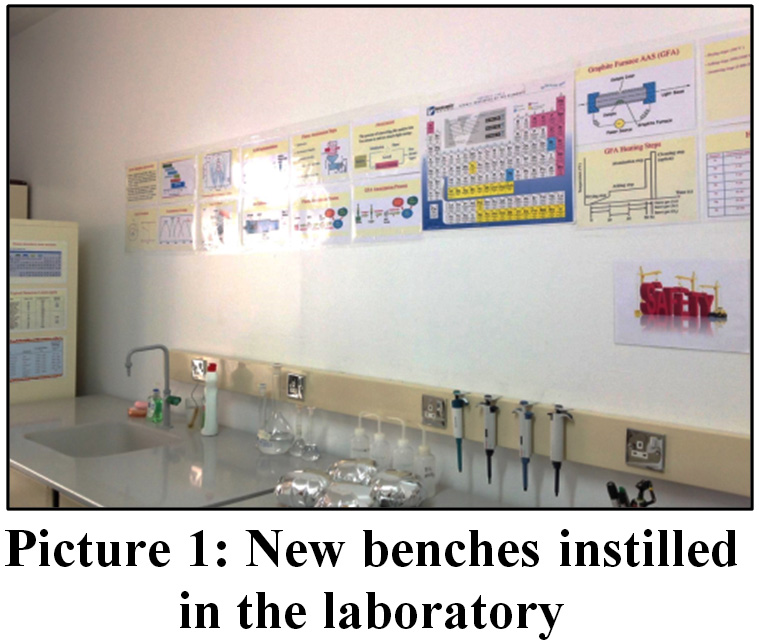
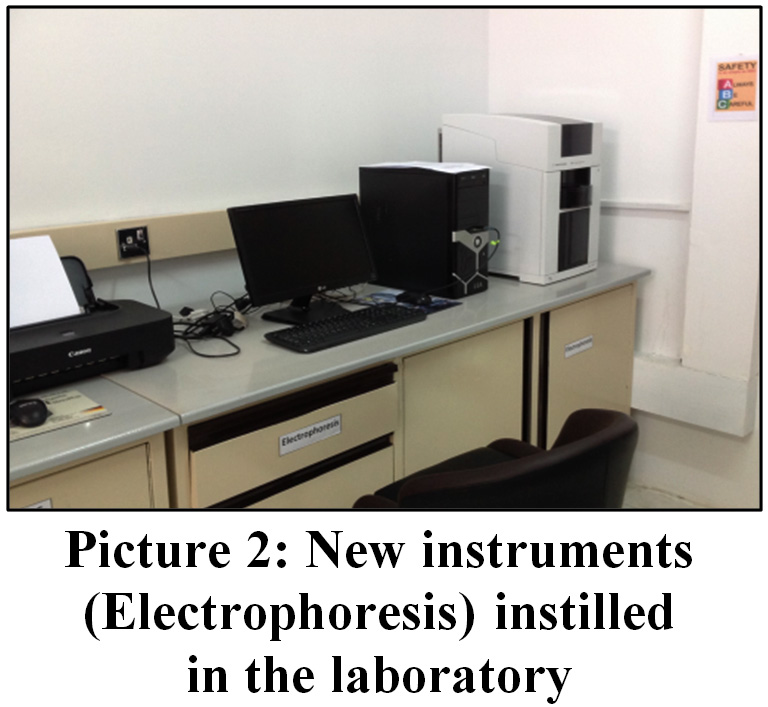
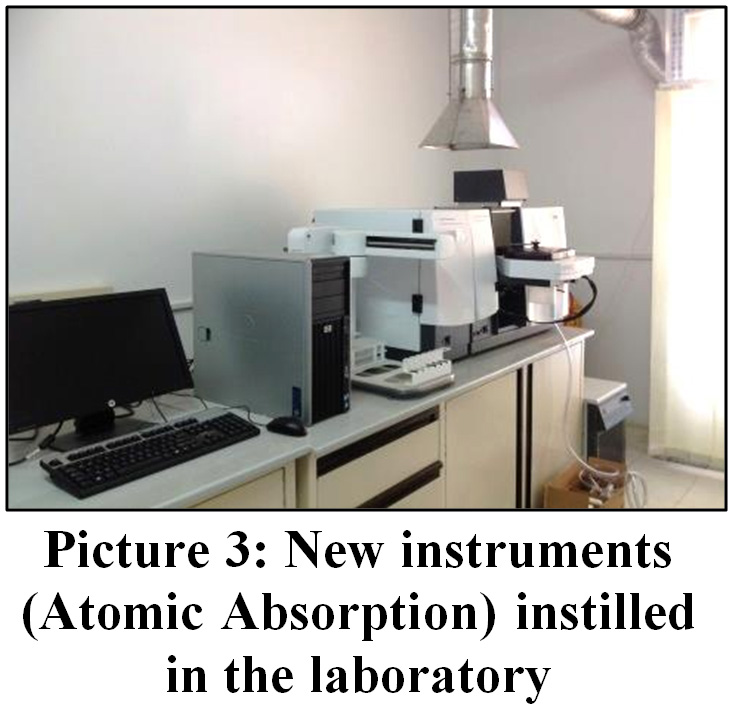
In order to upgrade the infrastructure, research laboratories have been rehabilitated in accordance with the requirements of the good laboratory and according to the basic security and safety needs. A laboratory qualification was conducted under the supervision of the trained Chemistry department staff in the American Chemical Society programs. Pictures 1, 2 and 3 shows the new benches and new instruments instilled in research laboratories.
|
|
Figure 1: New benches instilled |
|
|
Figure 2: New instruments (Electrophoresis) instilled in the laboratory |
|
|
Figure 3: New instruments (Atomic Absorption) instilled in the laboratory |
Education of safety and scientific support for Iraqi universities
Laboratory staff or students working in the laboratory must be qualified in terms of safety and receive appropriate training from the first day of work. There must be additional training takes place whenever there is an advanced laboratory work or in terms of the dealing with hazardous chemicals or use complicated devices. It is the responsibility of the institution responsible for the laboratory to improve the safety culture and documenting these programs and these exercises as part of general requirements. The most important events carried out by the Chemistry department can be summarized as follows:
-
Teaching the Occupational safety lesson for second grade students in chemistry for the eighth year with a syllabus prepared by the Chemistry department and supported by the American CRDF Foundation experts.
-
-Supporting the sectors of society by promoting a culture of safety for some of the members of the state departments within the quality sector by a workshop on occupational safety named (fires. Causes and methods of prevention and treatment).
-
Active participation in numerous researches at the Second Coordination Conference on Safety.
-
-An induction seminar for the college of science associates on Mines.
-
Establishment of a comprehensive security and safety course entitled "Safety and ethics" for teaching staff and students in Iraqi universities.
Safety and security scientific research activity
The Chemistry department has published a number of specialized researches on security and safety in international journals and educating students the basic concepts of these researches beneficiaries in practical applications. Researches published during the year 2017 are listed below:
-
Rehabilitation of gas discharge systems for chemical storage.6
-
Chemical laboratory assessment and determine the qualification requirements.7
-
Maintenance and testing of fume cupboard.
-
Precautions that must be taken in consideration when putting chemicals in the furnace.
-
Using the wrong way of putting ionic liquid sample in tube furnace.
-
Evaluating a chemical/ biological laboratory to promote safety measures.
-
Environmental problem from the combustion of sulphur in Mishraq field.
Fire systems and training
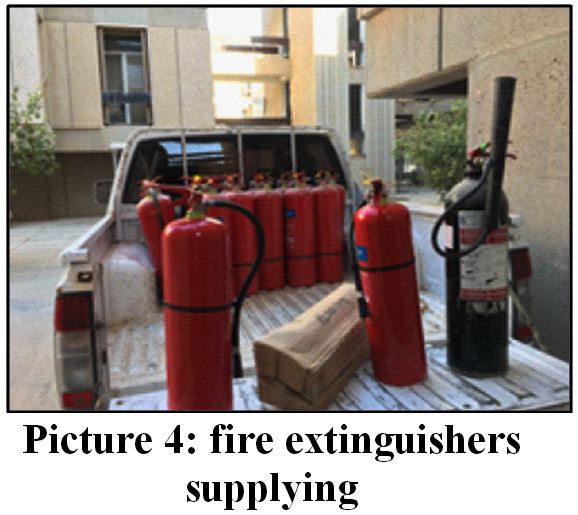
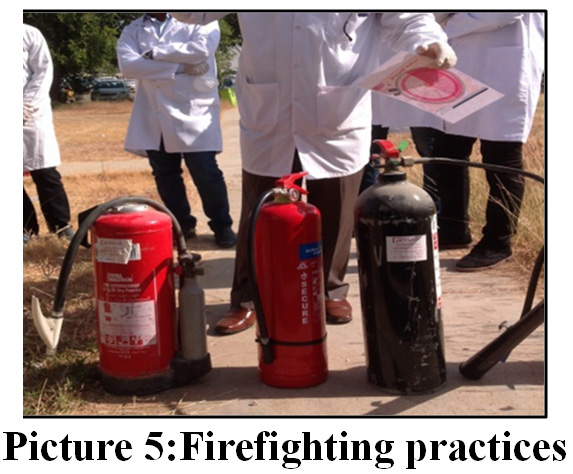
Sensors and firefighting systems are very important and need to be available in laboratories8 Fires happen when you least expect them, often during the night. They also spread very quickly, damaging property, injuring and killing people. But the real killer is smoke. If you’re asleep when a fire starts and you don’t have a smoke alarm to wake you, you are unlikely to survive. Smoke suffocates quickly – you could be dead before the flames reach you.As the Department labs do not have fire sensors and automatic firefighting systems, the department plans to create such systems when the funds are available. However, the department provided sufficient types of fire extinguishers(see picture 4) as well as the training of the members and students of the department to use them as shown in picture 5.
|
|
Figure 4: Fire extinguishers supplying |
|
|
Figure 5: Firefighting practices |
Results and Privileges
The chemistry department at Nahrain University is superior to the rest of Iraqi universities by teaching the Occupational safety lesson for second grade students in chemistry for the eighth year with a syllabus prepared by the Chemistry department and supported by the American CRDF Foundation experts and the teachers have many participations in the activities of safety such as training courses, conferences and scientific publications in international journals.
Conclusion
Illustrated by the actions of the chemistry department within various activities to strengthen the laboratory infrastructure and promote the dissemination of the culture of safety through conferences, lectures and symposiums supported by practical procedures and practices to increase expertise in procedural processes reflect the department's concern Chemical safety and security, to improve the working environment in laboratories, to ensure the safety of workers and students and to maintain the infrastructure of the educational institution.
Acknowledgments
The project was supported by Al-Nahrain University.
References
1. Laboratory Safety Guidelines, http://sydney.edu.au/whs/guidelines/others/laboratory_safety.shtml
2. Hill, Robert H, Jr. and David C. Finster, Laboratory Safety for Chemistry Students, Wiley, Hoboken, 2010. This is a comprehensive text that partitions safety considerations into three tiers, with increasingly more involved considerations being reflective of increased knowledge by students. Emphasis is on learning on a “need to know basis.
3. Prudent Practices in the Laboratory, The National Academies Press, Washington, 2015. A comprehensive study of laboratory safety issues including leadership and management considerations. (www.nap.edu/catalog.php?record_id=12654).
4. Guidelines for Recognition of Environmental Laboratories under the Environment (Protection) ACT, 1986,Central Pollution Control Board (Ministry of Environment & Forests), www.cpcb.nic.in.
5. Laboratory Safety Handbook, McMaster University Hamilton, Ontario, 2008.
6. Yousif E., Al-Dahhan W., Nema R., Ali A., AlZuhairi J., Hussein F., Rodda E., Improvement of a Chemical Storage Room Ventilation System, Journal of Progressive Research in Chemistry, 3(4), 206-210 (2017).
7. Ali A., Shaalan N., Al-Dahhan W., Hairunisa N., Yousif E., A Technical Evaluation of a Chemistry Laboratory: A Step Forward For Maintaining safety measures, Oriental Journal of Physical Sciences, 2(1), 68-71(2017).
8. The Fire Prevention Handbook, Fire Statistics UK, 2003, Office of the Deputy Prime Minister.British Crime Survey, 2002/03.

This work is licensed under a Creative Commons Attribution 4.0 International License.