
Discussion on the 6th Problem of the 29th International Mathematical Olympiad
Zhang Yue* 
1Department of Physics, Hunan Normal University, P. R. of , China .
http://dx.doi.org/10.13005/OJPS09.02.07
With respect to the 6th problem of the 29th IMO, let b = a + n for the equation of the problem, it gets an equation about a, using the mathematical theory to solve the equation about a, because a > 0, b > 0 in order to obtain a positive root a, the calculation results in k < n2, it demonstrates that k = n2. Moreover, from b = a + n , if a and b take all of the positive integers, n will also take all of the positive or negative integers. Therefore, the paper proves that there are no positive integers a > 0, b > 0 and k > 0 such that a2 + b2/ab + 1 = k is the square of an integer except the case of a = b = 1.
Copy the following to cite this article:
Yue Z. Discussion on the 6th Problem of the 29th International Mathematical Olympiad. Oriental Jornal of Physical Sciences 2024; 9(2).
DOI:http://dx.doi.org/10.13005/OJPS09.02.07Copy the following to cite this URL:
Yue Z. Discussion on the 6th Problem of the 29th International Mathematical Olympiad. Oriental Jornal of Physical Sciences 2024; 9(2).Avialable here: https://bit.ly/3Oh0kce
Download article (pdf) Citation Manager Publish History



Introduction
The 29th international mathematical Olympiad (IMO) held in Australia, although some of the attendants achived the gold medal, no one solved the 6th problem of this competition;1 the committee of the organization also did not solve this problem within 6 hours, besides, the four great experts in the number theory in Australia were also unable to solve this problem. Many people think that the 6th problem of the 29th IMO is the most difficult problem in the history of the IMO, Therefore, I think that this problem is very strange, and it is valuable for our study and investigation.2 This paper will present some discussion on the 6th problem of the 29th IMO.
Materials and Methods
The 6th problem of the 29th IMO is described as the following 1:
Let a and b be positive integers such that ab+1 divides a2 + b2
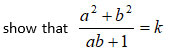
is the square of an integer.
The solution: At first, it is not difficult to find that when
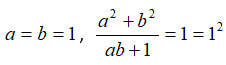
It is in concordance with the conclusion of the problem. But if a = b = 1, it is very difficult to find a group of positive integers a,b,k such that
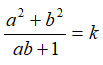
is the square of an integer. Therefore, it is reasonable to consider that there are no positive integers a,b,k, such that
is the square of an integer.
In order to conveniently discuss the equation
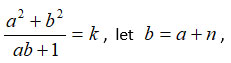
here n is an arbitrary integer, in order to make b be positive, the integer,
substituting it into
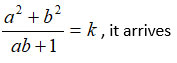

this is an equation about a, eq. (1) is equivalent of

solving eq. (2) it obtains

In consideration of eq. (2), and in general, k > 2, to get a positive root a, it is required that

therefore,

eq. (5) can be simplified as

it results in
Results and Discussion
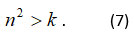
Using the algebraic equation and the theory of inequality, the paper rigorously obtains eq. (7): n2 > k. Eq.(7) demonstrates that k = n2, but the integer

n can be an arbitrary integer which belongs to (-0o, +0o), for example, if a =1000, n can take the value: ?1000+1=?999, ?1000+2=?998,…….0, 1, 2,……998, 999, 1000,……; thus, b can be 1, 2, 3, ……1000,……., it points out that n = 0, because if n = 0, from eq. (7) and
it results in that a2 = b2 < 0, eq.(7) proves that k cannot be just the square of an integer, the conclusion of this problem is impossible except the special case of a = b = 1. Therefore, that the so-called the most difficult and challenging problem in the history of IMO is in fact impossible, I think that this is the cause of that why no one over the world can solve this problem.
Conclusion
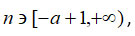
To solve the 6th problem of the 29th IMO, at first, let b = a + n, the integer n E[- a + 1, +0o]. However, if a,b E(1, + 0o), from b = a + n, n can take the value of all the positive or negative integers. Substituting
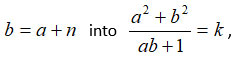
it gets a equation of a, namely eq. (1), because a > 0, in order to obtain a positive root a, it is required in eq.(3) that

this results in n2 > k, it demonstrates that corresponding to any integer n, from
.jpg)
it gets n2 > k, hence, k = n2. But n can take the value of any positive or negative integer, therefore, there are no positive integers a,b and k such that a2 + b2/ab + 1 = k is the square of an integer except the case of a = b = 1.
Acknowledgement
The author would like to thank that the international Conference on Physics & Mathematics and Awards (Meeting ID: 5291941462; Passcode: BRALNYMEET) accepted this paper as the poster of the conference.
Funding Sources
The author(s) received no financial support for the research, authorship, and/or publication of this article.
Conflict of Interest
The authors do not have any conflict of interest
Data Availability Statement
This statement does not apply to this article
Ethics Statement
This research did not involve human participants, animal subjects, or any material that requires ethical approval
Author Contributions
The sole author was responsible for the conceptualization, methodology, data collection, analysis, writing, and final approval of the manuscript
References
- Djukic D, Jankovic V, Matic I, Petrovic N. The IMO Compendium-A Collection of Problems Suggested for The International Olympiads:1959-2004. New York: Springer; 2006: 27-332.
- Lauko I G, Pinter G a P. Another step further……, On a problem of the 1988 IMO. Mathematics Magazine. 2006; 79 (1)?45-53.
CrossRef

This work is licensed under a Creative Commons Attribution 4.0 International License.