
A Vision to Promote the Forensic DNA Facility at Al-Nahrain University in Terms of Safety Measures
Ali Abd Ali 1* , Wedad Al-Dahhan 1 , Dheaa Zageer 1,2 and Emad Yousif 1
1Department of Chemistry, Baghdad, Iraq, College of Science, Al-Nahrain University, Baghdad, Iraq, Iraq .
2Forensic DNA Center for Research and Training, Baghdad, Iraq, Al-Nahrain University, Baghdad, Iraq, Iraq .
http://dx.doi.org/10.13005/OJPS02.01.03
The forensic DNA facility at Al-Nahrain University was established in 2011 with a clear message to be as a training and research center in Iraq. Iraq is still suffering from the existence of many mass graves in different provinces, and complicated criminal cases. Predominantly, the forensic DNA facility will offer a solid platform to support forensic investigations as casualties in most cases are anonymous to the government.
The forensic DNA investigation laboratories were built without any considerations to safety measures and standard laboratories ergonomics. Herein, we report a genuine safety program adopted and performed by some experts to alleviate all safety problems that were reported in the laboratories as well as qualifying those according international standards of safety. The forensic DNA facility at Al-Nahrain University now is considered as a typical example in Iraq and we aim for becoming an internationally accredited center in the Middle East in the near future. In this concern, the vision implemented is to be achieved via complying with international standards and making collaboration with the International Committee on Missing Persons (ICMP).
Copy the following to cite this article:
Ali A. A, Al-Dahhan W, Zageer D, Yousif E. A Vision to Promote the Forensic DNA Facility at Al-Nahrain University in Terms of Safety Measures. Orient J Phys Sciences 2017;2(1).
DOI:http://dx.doi.org/10.13005/OJPS02.01.03Copy the following to cite this URL:
Ali A. A, Al-Dahhan W, Zageer D, Yousif E. A Vision to Promote the Forensic DNA Facility at Al-Nahrain University in Terms of Safety Measures. Orient J Phys Sciences 2017;1(1). Available from: https://bit.ly/2LgOu4F
Download article (pdf) Citation Manager
Introduction
Offering a safe and an ergonomic place for conducting a chemical or biological activity has been one of the highly important prerequisites in any industrial or research amenity 1-4. Albeit, in some cases, there might be some inadvertency or even not adequate testing and checking for various reasons.
The Forensic DNA facility at Al-Nahrain University was established in 2011 for a genuine aim. This aim stems from the fact that Iraq at the present time urgently needs a national capacity which is capable of performing a forensic DNA investigation. Precisely speaking, the DNA analyses will assist in the identity verification for those who are found in mass graves since 2003.
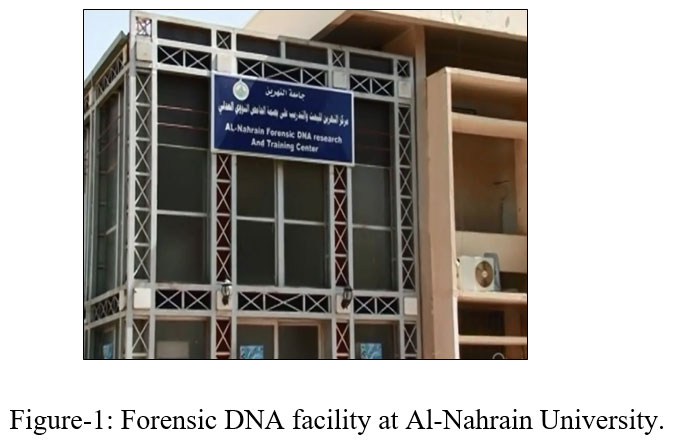 |
Figure 1: Forensic DNA facility at Al-Nahrain University.
|
This facility has very sophisticated laboratories in terms of equipment. Nevertheless, these laboratories were not build according to international standards5-10. Consequently, after two years there were many faults started to appear. In this paper, we show some of the faults in the laboratories and the vision that we employed to renovate the laboratories and make them safer, and more consistent with the international standards.
Problems and Faults in the Laboratories
Benches’ surface was not coated with a chemical-resistant material, e.g. epoxy paint. This was confirmed by performing a test via adding some strong acids and some solvents. Namely, HCl, HNO3, H2SO4, acetone, and diethyl ether as shown in Figure-2.
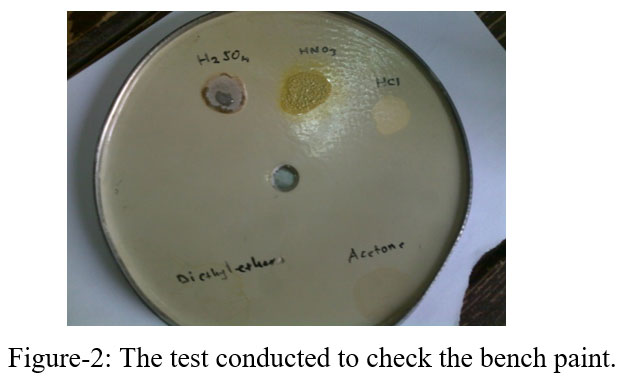 |
Figure 2: The test conducted to check the bench paint.
|
Some cracks between the bench and the metal frame were noticed (as shown in Figure-3) which we believe that if there is a chemical spill, chemical will seep into it.
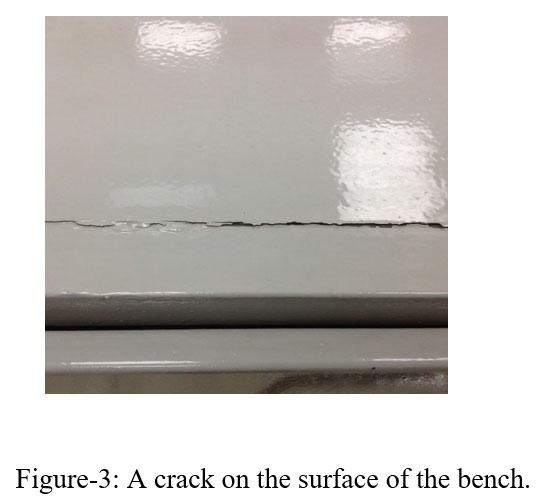 |
Figure 3: A crack on the surface of the bench.
|
Sinks were made of a metal susceptible to corrosion as shown in Figure-4.
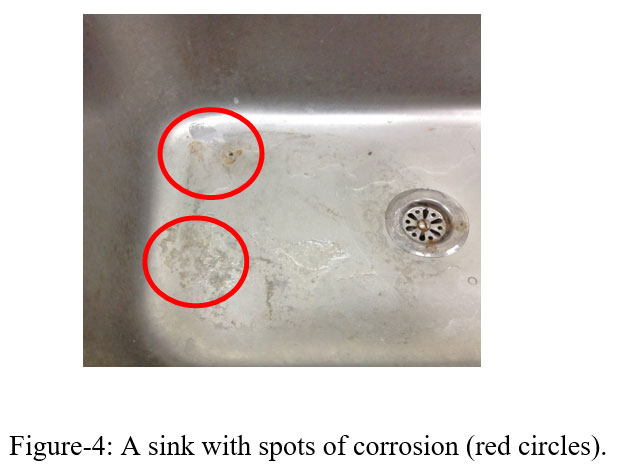 |
Figure 4: A sink with spots of corrosion (red circles).
|
Bench drawers were also corroded as we noticed a powder of iron oxide inside. This is ascribed to the fact that there was a storage for chemical substances inside them as shown in Figure-5.
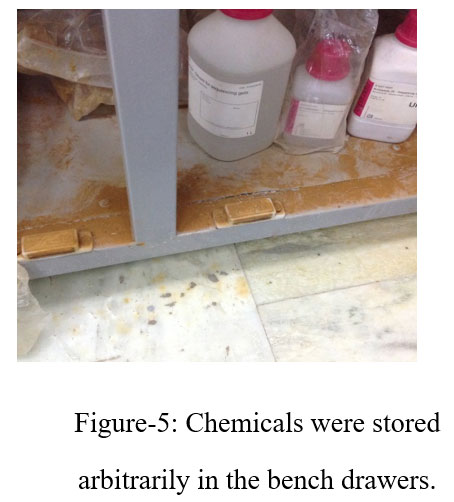 |
Figure 5: Chemicals were stored arbitrarily in the bench drawers
|
Drawers and cabinets cannot be properly closed after two years of use which means that they are not durable enough to be used in a laboratory as shown below in Figure-6.
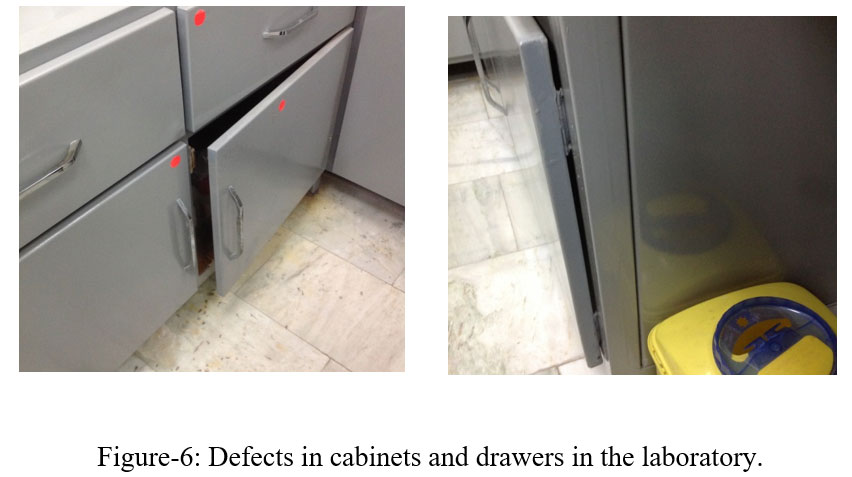 |
Figure 6: Defects in cabinets and drawers in the laboratory.
|
Fire extinguishers were placed in hidden positions and out of reach. As shown in figure-7.
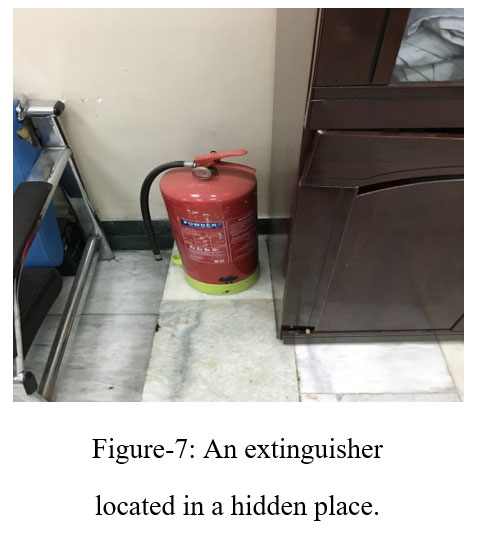 |
Figure 7: An extinguisher located in a hidden place.
|
Building pillars showed some corrosion at the base as depicted in Figure-8.
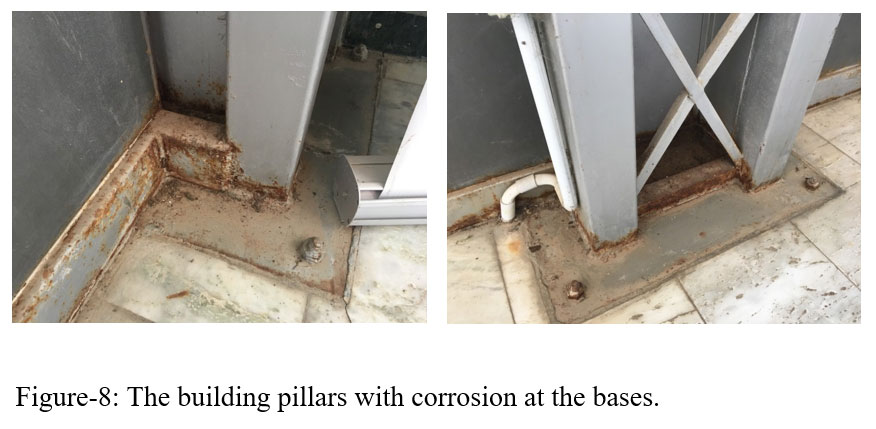 |
Figure 8: The building pillars with corrosion at the bases.
|
The renovations carried out on the laboratories
Old benches were replaced with new ones (as illustrated in Figure-9) which have the following characteristics:
Resistant to chemicals.
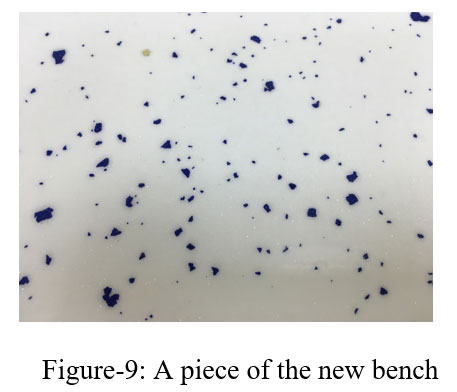 |
Figure 9: A piece of the new bench
|
The new benches have some elevated edges in order to avoid any dripping of liquid chemicals in case of spills as shown in Figure-10.
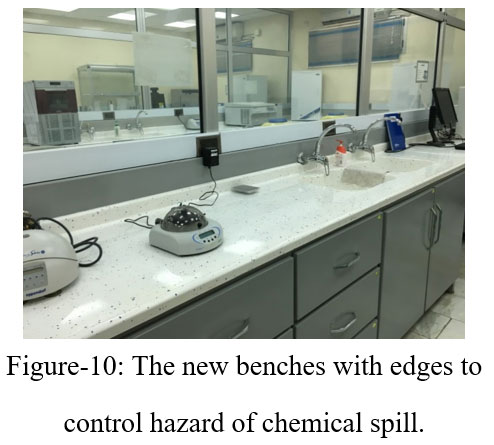 |
Figure 10: The new benches with edges to control hazard of chemical spill
|
The new benches and sinks are of the same material. That is why the sinks are also resistant to corrosives as demonstrated in Figure-11.
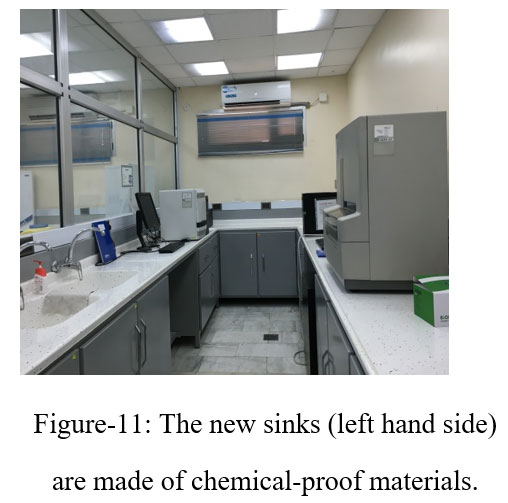 |
Figure 11: The new sinks (left hand side) are made of chemical-proof materials
|
Providing laboratories with new biological cabinets which ensures the optimum safety measures to protect personnel as shown in
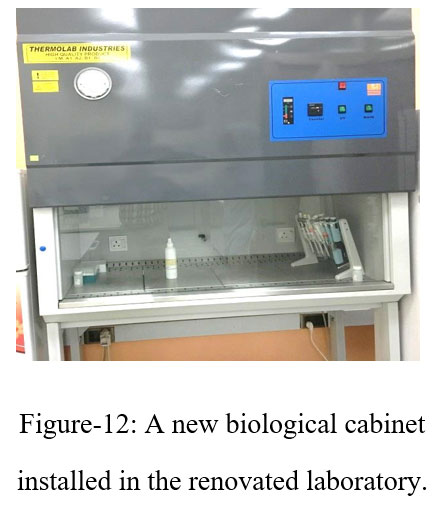 |
Figure 12: A new biological cabinet installed in the renovated laboratory
|
Installing surveillance camera inside laboratories (as depicted in Figure-13).
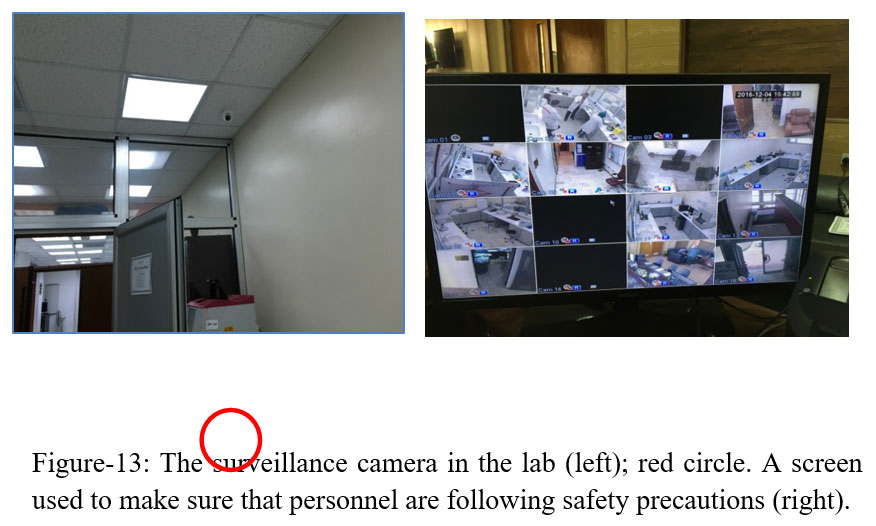 |
Figure 13: The surveillance camera in the lab (left); red circle.
|
Allocating a room used as an office to perform all necessary paper work (Figure-14).
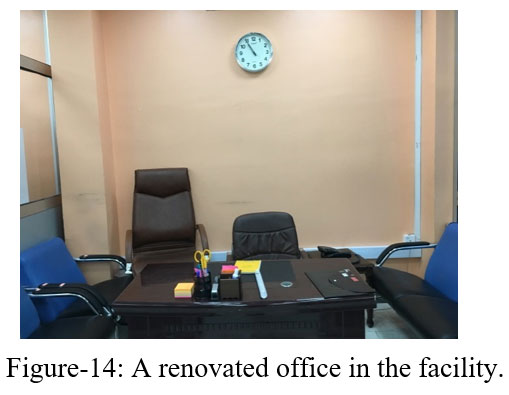 |
Figure 14: A renovated office in the facility.
|
The distribution of equipment in the laboratory is more organized than before as shown in Figure-15
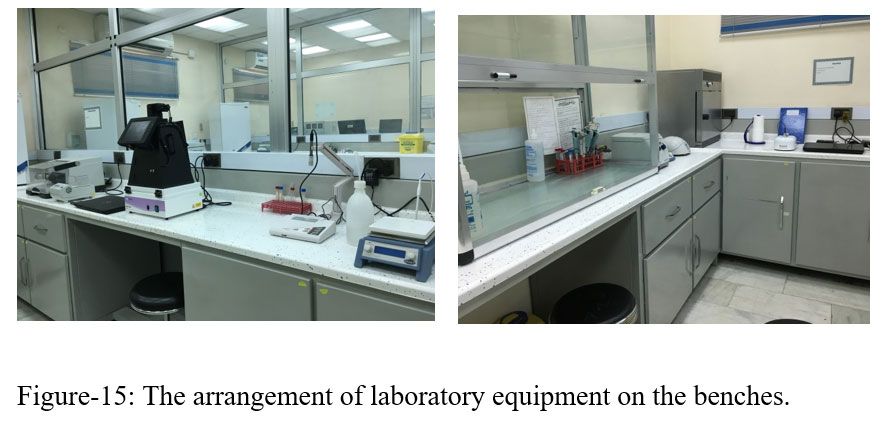 |
Figure 15: The arrangement of laboratory equipment on the benches.
|
After achieving all necessary steps to qualify the laboratories, we are completely confident that they coincide with the international laboratory standards. At the moment, the laboratory is recognized as an independent research facility and a reference for other institutions in the field of forensic investigations.
Conclusion
The safety measures have been considered strictly in the forensic DNA laboratory to establish a new competent capacity in Iraq and the Middle East. The objective evaluation of the laboratories in terms of safety has been very beneficial to propose a feasible roadmap to conduct the renovation. The Forensic DNA facility at Al-Nahrain University at the moment represents a unique center for DNA investigations in Iraq. What has been achieved so far is considered as a major step towards being a remarkable research and training institution in the future.
Acknowledgments
We would like to thank the Forensic DNA Center for Research and Training staff for their valuable assistance in accomplishing this case study.
References
- Al-Zuhairi A., Al-Dahhan W., Hussein ,. Rodda K., Yousif E., Teaching Laboratory Renovation, Oriental Journal of Physical Sciences 1, 31-35 (2016).
- Ali A., Shaalan N., Al-Dahhan W., Yousif , For a Safer Working Environment with Hydrofluoric Acid in Iraqi Industrial Plants, Open Journal of Safety Science and Technology, 6, 77-80, (2016).
- Shireen, R., Al-Dahhan, W., Al-Zuhairi, A., Hussein, F., Rodda, K. and Yousif, E., Fire and Explosion Hazards Expected in a Laboratory, Journal of Laboratory Chemical Education, 4, 35-37, (2016).
- American Chemical Society (ACS), Safety in the Academic Chemistry Laboratory (seventh edition.)ACS, Washington DC (2003).
- Clinical Laboratory Standards Institute, document GP18-A2. Laboratory Design. 2nd Edition. 2007.
- Gile T. J., Ergonomics in the laboratory. Laboratory Medicine, 32, 263-267, 2001.
- Robert J. A., Handbook of Chemical Health and Safety, American Chemical Society Handbooks, 2001.
- Al-Dahhan W., Al-Zuhairi A., Hussein F., Rodda K., Yousif E., Laboratory biological safety cabinet (BSC) explosion, Karbala International Journal of Modern, 2, 276-279, 2016.
- Al-Ibadi M., The Chemical Safety and Security in the University of Kufa: Progress and Challenges, Iraqi National Journal of Chemistry, 16 (2), 96-105, (2016).
- Al-Khalaf A, Green Chemistr y and Sustainability of Chemical Safety and Security, Iraqi National Journal of Chemistry, 16 (2), 71-81, (2016).
- kareem S., Hamzah I., Bahiya H., Improve Biosafety Level in Advance Molecular Laboratory at College of Science, Iraqi National Journal of Chemistry, 16 (2), 89-95, (2016).

This work is licensed under a Creative Commons Attribution 4.0 International License.