
Preliminary Adsorption Studies of Pb (II) with Gmelina sawdust; Zn-oxalic acid (Zn-OXA) and Cu-OXA MOFs
Kaana Asemave *  and Doosughun Igbawua
1Department. Chemistry, Benue State University, Makurdi, Nigeria .
http://dx.doi.org/10.13005/OJPS07.02.06
Copy the following to cite this article:
Asemave K, Igbawua D. Preliminary Adsorption Studies of Pb (II) with Gmelina sawdust; Zn-oxalic acid (Zn-OXA) and Cu-OXA MOFs. Oriental Jornal of Physical Sciences 2022; 7(2). DOI:http://dx.doi.org/10.13005/OJPS07.02.06
Copy the following to cite this URL:
Asemave K, Igbawua D. Preliminary Adsorption Studies of Pb (II) with Gmelina sawdust; Zn-oxalic acid (Zn-OXA) and Cu-OXA MOFs. Oriental Jornal of Physical Sciences 2022; 7(2). Available from:https://bit.ly/3Gs3bLb
Download article (pdf) Citation Manager Publish History



Introduction
Adsorption method as a means of wastewater treatment has been widely reported using different adsorbents. It has been be found to be promising because adsorption is simple, selective, efficient, cheaper, and handy to operate (Asemave & Goja, 2021). Relatedly, lignocellulosic biomass are available in large quantity and known to contain multifunctional groups which have ability to remove several pollutants (Asemave, Thaddeus, & Tarhemba, 2021). Furthermore, biosorbents are highly sustainable and environmentally friendly products (Asemave et al., 2021). Thus, rice husk ash, straw, bagasse, wood, grass, sawdust etc have been used as biosorbents for removal of Pb and other metals. Hence there have been several studies of sorption of pollutants with them. Besides sorption applications, sawdust has been used as fuel and making of products like board, packing materials etc. Recently, it has been highly considered as an inexpensive adsorbent of metal pollutants. This is so because it has substantive levels of cellulose and lignin; 45–50% and 23–30%, respectively. The presence hydroxyl, carboxylic and phenolic groups in cellulose and lignin in turn give them the capacity to bind metal ions (Albadarin et al., 2011).
On the other hand, frameworks of metal–organic (MOF) have been widely studied (Mahmoud, Fouad, & Mohamed, 2020). They consist of central metal ions bonded to organic moieties known as linkers to give one or more dimensional frameworks. MOFs have high porosity, high surface area, amenable pore sizes etc that has generated wide stake about them (Zhang et al., 2022). Good number of inorganic and organic components could be used, and this elasticity has allowed the rational design and assembly of materials with peculiar characteristics (Getachew et al., 2014). There are different methods of synthesizing MOFs; such as slow evaporation, solvothermal, hydrothermal, ultrasonic, mechano-chemical, and electrochemical methods (Mahmoud et al., 2020). More so, many biomaterials and MOFs have been demonstrated as adsorbents (Sulaiman, Ajayi, & Olakunle, 2022). However, there are little information about the comparison of MOFs and biosorbents in terms of pollutants sorption capacities. Therefore, this research compares the sorption of Pb (II) with Gmelina sawdust; Cu-OXA and Zn-OXA MOFs.
Materials and Methods
Apparatus/ Reagents/ Equipment
Wood shaving of Gmelina arborea, Muffle furnace (Ney-252 model), desiccator, mortar and pestle, Sieve (2 mm mesh size), beakers, pH meter, oven, spatula, analytical weighing balance, stop watch, Whatman Filter paper, measuring cylinder, conical flask, plastic funnel, speed adjusting multi-purpose vibrator, volumetric flask, distilled water, hydrochloric acid (JHD - AR, 36%), lead (II) nitrate (JHD - AR, 99%), stirrer, sample bottle, separating funnel, crucible, petri-dish, copper (II) nitrate (JHD - AR, 99%), zinc (II) nitrate (JHD - AR, ≥ 99%), absolute ethanol (JHD - AR, 99.7%), and oxalic acid (JHD - AR, ≥99.5%) were used.
Sample collection
Saw dust sample of Gmelina arborea were obtained from timber workshop at George Akume Way, International Market Makurdi, Benue State -Nigeria.
Carbonization of the sawdust
The obtained sawdust was properly washed with distilled water for removal of impurities and sundried for 7 days. A portion of the dried sawdust was modified through carbonisation at 400 ºC for 1 h using muffle furnace. The charred sample was removed from the furnace, cooled in the desiccator for 30 min, and pulverized. This was then sieved using 2 mm mesh size sieve to obtain uniformly fine particles. The uncarbonised sample was pulverized and sieved as well. The wt % yield after carbonisation was 16.90.
Activation of the carbonized sawdust
About 5 g carbonized materials was placed inside beaker. 5 mL concentrated hydrochloric acid (36%) was added and kept for 48 h with intermittent stirring. The beaker was then heated in fume cupboard for 5 h at 180 ºC. Thereafter, the content was repeatedly washed and decanted until a pH of 7 was obtained. The Gmelina adsorbent was filtered and dried at 105 ºC. After 3 h, it was then removed and cooled in the desiccator (Asemave et al., 2021).
Preparation of the Zn- and Cu- MOFs
The MOFs were prepared using the slow evaporation method at room temperature as similarly and previously established in (Mansab & Rafique, 2015). Oxalic acid (0.25 g) was weighed into a beaker and then dissolved with absolute ethanol (10 mL). In another beaker, 1.0 g copper nitrate or zinc nitrate (1.20 g) was dissolved in distilled water (10 mL). Contents of the two beakers were then coalesce together with continuous whirling for 30 min. Resultant solution was left standing for 5 days. In the end, the resultant product was filtered. The product was then left to dry. After drying, the weight of the dried product was taken and yield calculated. Therefore, the wt % yields are 16.80 ± 2.5 (Zn-OXA MOF) and 22.35 ± 2.9 (Cu-OXA MOF). The MOFs obtained are presented in Figure 1.
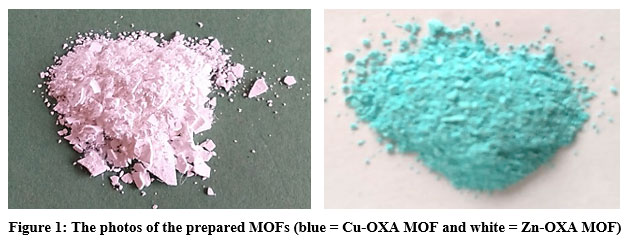 |
Figure 1: The photos of the prepared MOFs (blue = Cu-OXA MOF and white = Zn-OXA MOF). |
Preparation of the Pb(II) solution
35 mg of Pb (II) nitrate was dissolved in 250 mL beaker with small amount of distilled water. This was transferred into volumetric flask (1 dm3). Subsequently, the beaker was washed and emptied into the volumetric flask. The solution was then thoroughly shaken and made up to the mark with distilled water to from stock solution of 35 mg/L.
Adsorption studies
Batch adsorption experiment was adopted from (Ahile et al., 2019). About 20 mL of the Pb (II) nitrate solution (35 mg/L) was applied to 0.2 g of adsorbents (uncarbonized sawdust, carbonized sawdust, and the MOFs) in separate conical flasks. The mixtures were placed on the vibrator for 1 h of agitation. Then they were unmounted and left to equilibrate for 30 min before filtration. The filtrates were then transferred into sample vials for determination of residual Pb (II) ions level using AAS. Then the % removal of Pb (II) was deduced accordingly.
Results and Discussion
FTIR Results
The prepared sorbents were carefully elucidated with the help of their FTIR spectra as previously reported (Koppula, Surya, Katari, Dhami, & Nair, 2022). Therefore, the spectra of the uncarbonised and carbonized sawdusts were obtained and compared (see Figures 2 and 3, respectively). On the other hand, the FTIR spectra of oxalic acid, Zn-OXA and Cu-OXA MOFs were also analysed as given in Figures 4, 5, and 6, respectively. The FTIR absorption values (with reference to Figures 2 and 3) found at 1736.9 cm-1 and 1684.8 cm-1 implied C=O presence (Deepa & Suresha, 2014)(Bartczak et al., 2015)(Ogunleye, Adio, & Salawudeen, 2014)(Hashem, 2007). The analyses revealed principally the presence of COOH/ O-H (3809 – 3336 cm-1) , C=O (1736 -1684 cm-1), and C=C/ N-H (1591 – 1580 cm-1) functional groups present in the uncarbonised and carbonized biomaterials (Deepa & Suresha, 2014)(Bartczak et al., 2015).
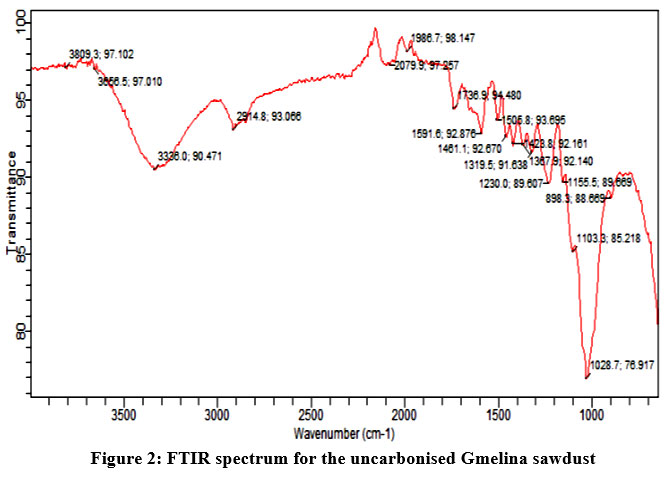 |
Figure 2: FTIR spectrum for the uncarbonised Gmelina sawdust Click here to view Figure |
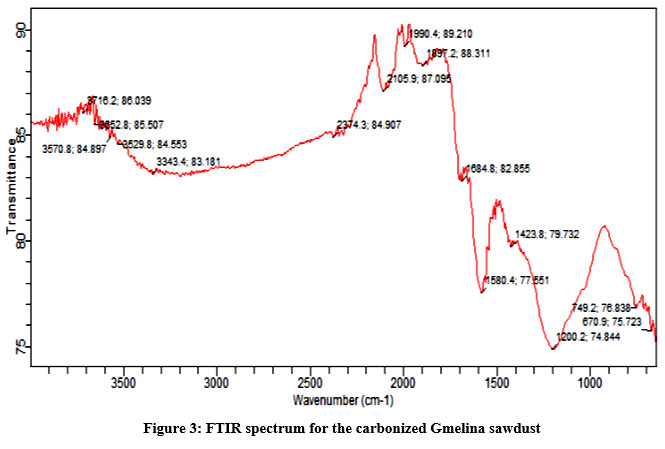 |
Figure 3: FTIR spectrum for the carbonized Gmelina sawdust Click here to view Figure |
More so, The FTIR spectrum (see Figure 4) of the free oxalic acid has a substantial absorption at 3418 cm -1 which attests for O-H presence (from COOH) functional group. It also has absorption at 1654 cm-1; coming from C=O. The intense FTIR absorption band at 3362 -3377 cm-1 in the MOFs spectra are attributed to stretching vibration of O-H. In addition, the peaks at 1606 - 1625 cm?1 indicate the presence of C=O functional group. Furthermore, the FTIR absorption values of O - H (3418 cm-1) and C= O (1654 cm-1) for free oxalic acid were decreased to 3362 -3377 cm-1 and 1606 - 1625 cm-1, respectively in the MOFs (Figures 5 and 6).
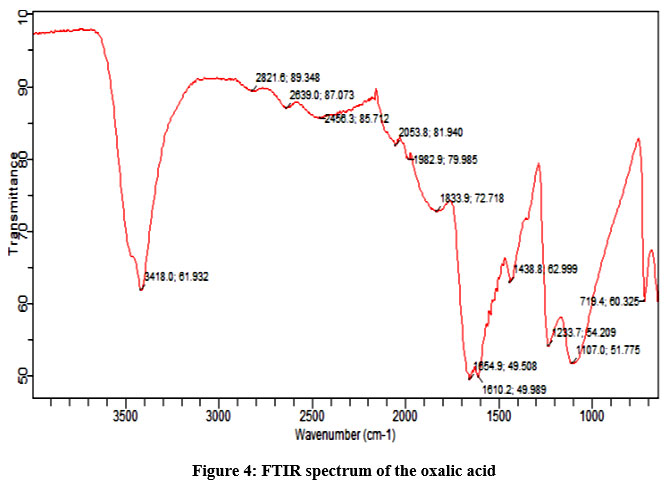 |
Figure 4: FTIR spectrum of the oxalic acid Click here to view Figure |
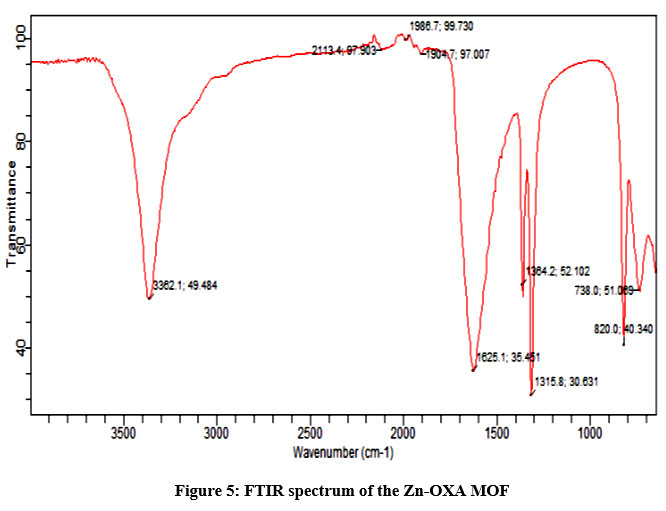 |
Figure 5: FTIR spectrum of the Zn-OXA MOF Click here to view Figure |
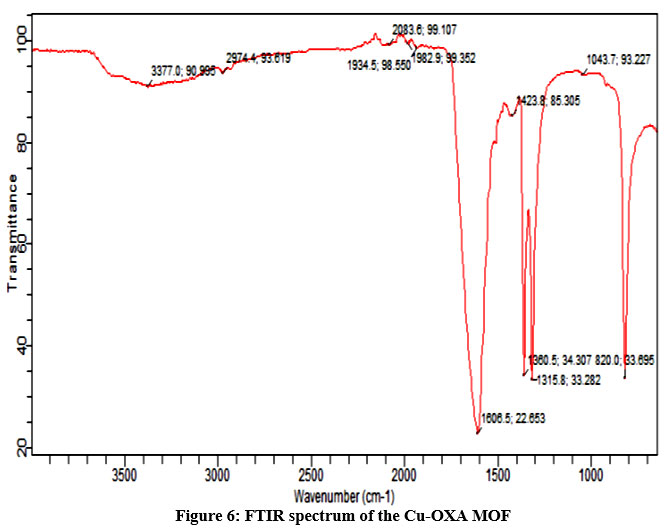 |
Figure 6: FTIR spectrum of the Cu-OXA MOF Click here to view Figure |
Adsorption Results
Prior to the adsorption studies, the MOFs were tested for their solubility in aqueous phase. Both the Zn-OXA and Cu-OXA MOFs were observed to be completely insoluble in water, hence their suitability for use as sorbents of pollutants from aqueous systems. It’s also on records that oftentimes, MOFs are insoluble in water. Therefore, the sawdust products as well as the MOFs were tested in terms of their abilities to adsorb Pb (II) as similarly demonstrated for other metals (Koppula, Jagasia, Panchangam, & Surya, 2022). The results of the Pb (II) adsorption is depicted in the Figure 7 as follows.
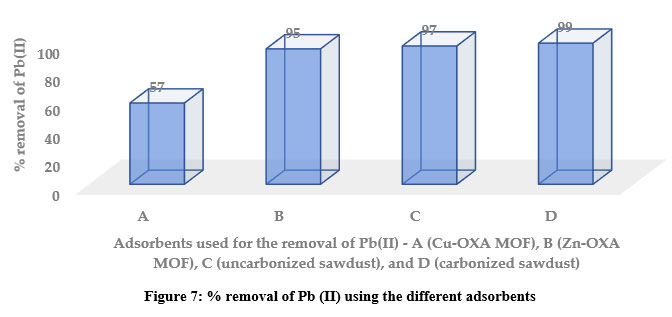 |
Figure 7: % removal of Pb (II) using the different adsorbents Click here to view Figure |
From the results in Figure 7 above it can be seen that the order of the removal of Pb (II) by these adsorbents is: Cu-OXA-MOF (57) < Zn-OXA framework (95%) < uncarbonised Gmelina sawdust (97%) < carbonized Gmelina sawdust (99%). These results are comparable to similar previous findings as described in Table 1.
Table 1: % removal of Pb (II) using the different adsorbents
Discussion
The decrement in the FTIR absorption value of O-H and C = O as seen in the Cu- and Zn- MOFs clearly implied that oxalic acid bonded to the Zn and Cu ions via O - H and C= O functional groups. Therefore, the schematic structure of the MOFs is given in Figure 8; where each of the anion (oxalate) is acting as tetradentate ligand; and the metal (M) may have additionally coordinated water molecules. Such scheme for a polymeric structure of metal oxalates has been similarly described by (D’Antonio et al., 2009).
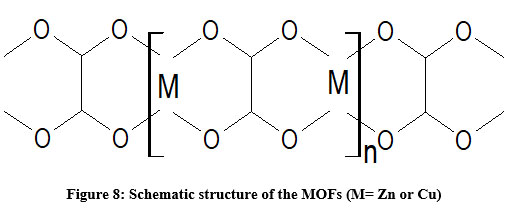 |
Figure 8: Schematic structure of the MOFs (M= Zn or Cu). Click here to view Figure |
In general, the presence of functional groups on adsorbents can facilitate metals removal (Bartczak et al., 2015). Thus, the presence of carboxyl, carbonyl, hydroxyl, and amine for the sawdust; and carboxyl, carbonyl, and hydroxyl for the MOFs is partly the reason they performed well in terms of the Pb (II) sorption. Except for A, the removal of the Pb (II) by B, C, and D is well comparable. This may be due to lower surface area of A as compared to B, C, and D. Therefore, Figure 9 represents sorption mechanism of the Pb (II) by the biomaterials and these MOFs.
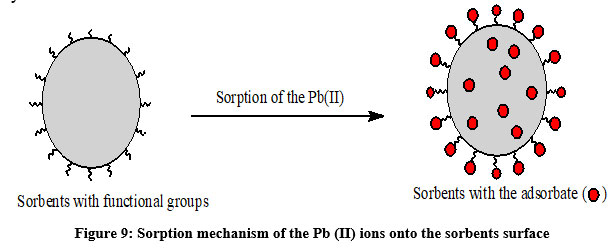 |
Figure 9: Sorption mechanism of the Pb (II) ions onto the sorbents surface. Click here to view Figure |
Our results on the levels (%) of Pb (II) removed were in complete conformity with previous similar findings. The sorption of Pb (II) ions by rice husk and husk ash was found to be 88% and 95%, respectively at condition of 60 min and 30 mg/L Pb (II) (El-Said, 2010)(Naiya et al., 2009). Meanwhile, maize leaf removed nearly 100% of Pb (II) ions from industrial wastewater within contact time of 1 h (Babarinde et al., 2006). In another development, the removal of Pb (II) by birbira (Militia ferruginea) activated carbon indicated maximum removal of 97% at 3 h, dose of 4 g, and at pH of 4 (Mengistie et al., 2008). Ogunleye et al. observed that the maximum percentage removal of Pb (II) using banana stalk-based activated carbon was 98% at equilibrium time of 120 min (Ogunleye et al., 2014). Our research work here again agrees with the report of Hashem (Hashem, 2007) who observed that the adsorption of Pb(II) by okra wastes reached 99%. More so, about 100% of Pb (II) was removed using leaves of Araucaria cookii at 50 mg/L Pb (II), 2 g/L biosorbent, pH 6, and 60 min (Deepa & Suresha, 2014).
In addition to the sorption studies, we can see that the biomaterials, sawdust (hitherto considered as waste) is highly available with scarce applications. Therefore, we can leverage on its cheap source to develop appropriate technologies that can harness this product, especially in the area of environmental remediation and reclamation. And this has greatly been the concerns in Green Chemistry for ensuring environmental benignness and waste control & minimization. Also, the synthesis of the Zn and Cu MOF was carried out in highly energy efficient manner at room temperature. Thus, the procedure is highly sustainable and in tandem to the 6th principle of Green Chemistry which advocates for ‘design for energy efficiency’(Kaana Asemave, 2016). These are other benefits of the research besides the ultimate removal of Pb (II).
Conclusions
Gmelina sawdust; Cu- and Zn- MOFs sorbents have been prepared using known and reported procedures. Thereafter, their sorption of Pb (II) was demonstrated. The sorption of Pb (II) by these adsorbents were: Cu-OXA MOF (57%); Zn-OXA MOF (95%); uncarbonised sawdust (97%); carbonized sawdust (99%). The presence of the functional groups in the sawdust sorbents (carboxyl, carbonyl, hydroxyl, amine) and the MOFs (carboxyl, carbonyl, and hydroxyl) is the reason they performed well in terms of the Pb (II) adsorption. However, the sawdust products and Zn-OXA MOF are more effective in the sorption of the Pb (II) than the Cu-OXA MOF.
Acknowledgment
The academic and technical staff of the Chemistry Department, Benue State University Makurdi, Nigeria are acknowledged for shaping this research technically.
Conflicts of Interest
The authors declare no conflict of interest.
Funding Sources
Please add: This research received no external funding.
References
- Ahile, U. J., Iorav, H. N., Asemave, K., Ahile, U. J., Dooga, L., Terungwa, D.,Torsabo, S. T. (2019). Preparation, Characterization and Application of Rice Husk Adsorbent in the Removal of Ampicillin from Aqueous Solution. International Journal of Modern Chemistry Int. J. Modern Chem, 11(1), 28–39.
- Albadarin, A. B., Mangwandi, C., Walker, G. M., Allen, S. J., & Ahmad, M. N. (2011). Biosorption Characteristics of Sawdust for the Removal of Cd(II) Ions: Mechanism and Thermodynamic Studies. https://doi.org/10.3303/CET1124217
- Asemave, K., & Goja, T. J. (2021). Elemental composition and preliminary investigation of Native Gmelina arborea Sawdust as Phosphate Sorbent. Journal of Chemical Research Advances, 2(2), 30–36.
- Asemave, K. (2016). Biobased Lipophilic Chelating Agents and their Applications in Metals Recovery. University of York, UK
- Asemave, K, Thaddeus, L., & Tarhemba, P. T. (2021). Lignocellulosic-Based Sorbents: A Review. Sustain. Chem., 2, 271–285. https://doi.org/10.3390/suschem2020016
CrossRef - Babarinde, N. A. A., Babalola, J. O., & Sanni, R. A. (2006). Biosorption of lead ions from aqueous solution by maize leaf. International Journal of Physical Sciences, 1(1), 023–026.
- Bartczak, P., Norman, M., Klapiszewski, ?., Karwanska, N., Kawalec, M., Baczynska, M., … Jesionowski, T. (2015). Removal of nickel(II) and lead(II) ions from aqueous solution using peat as a low-cost adsorbent: A kinetic and equilibrium study. Arabian Journal of Chemistry. https://doi.org/10.1016/j.arabjc.2015.07.018
CrossRef - D’Antonio, M. C., Wladimirsky, A., Palacios, D., Coggiola, L., González-Baró, A. C., Baran, E. J., & Mercaderd, R. C. (2009). Spectroscopic Investigations of Iron(II) and Iron(III) Oxalates. J. Braz. Chem. Soc., 20(3), 445–450.
CrossRef - Deepa, C. N., & Suresha, S. (2014). Biosorption of Lead (II) from aqueous solution and Industrial Effluent by using leaves of Araucaria cookii: Application of Response Surface Methodology. IOSR Journal of Environmental Science, Toxicology and Food Technology, 8(7), 67–79.
CrossRef - El-Said, A. G. (2010). Biosorption of Pb(II) Ions from Aqueous Solutions Onto Rice Husk and its Ash. Journal of American Science, 6(10), 143–150.
- Getachew, N., Chebude, Y., Diaz, I., & Sanchez, M. S. (2014). Room temperature synthesis of metal organic framework MOF-2. J Porous Matter, 21, 769–773.
CrossRef - Hashem, M. A. (2007). Adsorption of lead ions from aqueous solution by okra wastes. International Journal of Physical Sciences, 2(7), 178–184.
- Koppula, S., Jagasia, P., Panchangam, M. K., & Surya, S. B. M. (2022). Synthesis of bimetallic Metal-Organic Frameworks composite for the removal of Copper(II), Chromium(VI), and Uranium(VI) from the aqueous solution using fixed-bed column adsorption. Journal of Solid State Chemistry, 312, 123168. https://doi.org/https://doi.org/10.1016/j.jssc.2022.123168
CrossRef - Koppula, S., Surya, S. M., Katari, N. K., Dhami, P. S., & Nair, R. K. S. (2022). Mesoporous MOF composite for efficient removal of uranium, methyl orange, methylene blue, and Congo red dyes from aqueous solutions. Applied Organometallic Chemistry, 36(3), e6554. https://doi.org/https://doi.org/10.1002/aoc.6554
CrossRef - Mahmoud, N. F., Fouad, O. A., & Mohamed, G. G. (2020). Newly synthesized Cu-MOF based on Schiff base linker: structure, properties, method of synthesis and characterization. J. Bas. & Environ. Sci., 7, 221–224.
- Mansab, S., & Rafique, U. (2015). Synthesis of MOFs from Carboxylate Ligands and Its Industrial Application. International Journal of Scientific & Engineering Research, 6(3), 45–53.
- Mengistie, A. A., Rao, T. S., Rao, A. V. P., & Singanan, M. (2008). Removal Of Lead(Ii) Ions From Aqueous Solutions Using Activated Carbon From Militia Ferruginea Plant Leaves. Bull. Chem. Soc. Ethiop., 22(3), 349–360.
CrossRef - Naiya, T. K., Bhattacharya, A. K., Mandal, S., & Das, S. K. (2009). The sorption of lead(II) ions on rice husk ash. Journal of Hazardous Materials, 163, 1254–1264.
CrossRef - Ogunleye, O. O., Adio, O., & Salawudeen, T. O. (2014). Removal of Lead (II) from Aqueous Solution using Banana (Musa Paradisiaca) Stalk-Based Activated Carbon. Chemical and Process Engineering Research, 28, 45–59.
- Rivera, J., Rincón, S., Youssef, C. Ben, & Zepeda, A. (2016). Highly Efficient Adsorption of Aqueous Pb(II) with Mesoporous Metal-Organic Framework-5: An Equilibrium and Kinetic Study. Journal of Nanomaterials, 1–10. https://doi.org/10.1155/2016/8095737
CrossRef - Sulaiman, M. S., Ajayi, O. A., & Olakunle, M. S. (2022). Synthesis of metal organic frameworks (MOF-199) and it’s application for chromium (VI) adsorption from aqueous solution by experimental design approach. Special Conference Edition, 13(1), 336–342. https://doi.org/http://dx.doi.org/10.4314/bajopas.v13i1.51S
- Zhang, Q., Yang, H., Zhou, T., Chen, X., Li, W., & Pang, H. (2022). Metal–Organic Frameworks and Their Composites for Environmental Applications. Advanced Science, 9(32), 2204141. https://doi.org/https://doi.org/10.1002/advs.202204141
CrossRef - Zheng, Y., Rao, F., Zhang, M., Li, J., & Huang, W. (2021). Efficient, selective, and reusable metal–organic framework-based adsorbent for the removal of Pb(II) and Cr(VI) heavy-metal pollutants from wastewater. Cleaner Engineering and Technology, 5, 1–11. https://doi.org/10.1016/j.clet.2021.100344
CrossRef - Zhu, H., Yuan, J., Tan, X., Zhang, W., Fang, M., & Wang, X. (2019). Efficient removal of Pb2+ by Tb-MOFs: identifying the adsorption mechanism through experimental and theoretical investigations. Environ. Sci.: Nano, 6, 261–272. https://doi.org/10.1039/ c8en01066h
CrossRef

This work is licensed under a Creative Commons Attribution 4.0 International License.