
Theoretical Quantum Mass
Rakesh Kumar Pandey* 
1Synod Higher Secondary School, Mission Vengthlang, Aizawl, Mizoram India .
http://dx.doi.org/10.13005/OJPS09.01.07
In the present theoretical work, attempts have been made to find the least mass, which quantifies the discrete mass, in terms of the reduced Planck constant and cosmological constant in the Heisenberg position-momentum uncertainty relation as well as by employing the time period of oscillating universes in mass-time inequality. It has been estimated and reported that the least mass exists in the range 5.98 × 10-74 < m < 2 × 10-68 kg, which quantifies discrete masses in the universe of size < 8.64 G ly.
Copy the following to cite this article:
Pandey R. K. Theoretical Quantum Mass. Oriental Jornal of Physical Sciences 2024; 9(1).
DOI:http://dx.doi.org/10.13005/OJPS09.01.07Copy the following to cite this URL:
Pandey R. K. Theoretical Quantum Mass. Oriental Jornal of Physical Sciences 2024; 9(1). Available here: https://bit.ly/4eAJYGV
Download article (pdf) Citation Manager Publish History



Introduction
Everything is inherently discrete microscopically and is an integral multiple of a smallest value. Photon energy, electronic charge, reduced Planck constant, Bohr’s Magneton, neuron, nephron, and Plank time, etc., quantify energy, charge, angular momentum, magnetic moment, nerves, kidney, time, etc., respectively. Although the Planck length is the quantum length, three Planck volumes quantize the discrete volume.1-3 Energy less than Planck’s value is not quantifiable.4 Thus, the least quantifiable energy is E = h, which corresponds to a system of frequency 1Hz with time 1s. The mass energy equivalent relation E=mc2 yields the least quantifiable mass m = h/c2 ~ 7.37 × 10-51kg. for Planck’s energy value. However, many systems have a time period of more than one second and possess quantifiable energy with different values of least mass. A claim has been found that mass mq ~ 2 × 10-68, estimated using the modified Heisenberg uncertainty relation m = h ^/c in terms of the cosmological constant ^ = 1.1 × 10-52, light speed c in vacuum and the Planck constant h instead of the reduced Planck constant h , quantizes discrete masses.5
According to our scientific estimation, the universe is approximately 13.8 G years old with prefix G for Giga.5 The creation and annihilation of the material universe occurs 36000 times at intervals of 8.64 G years inside a giant universe of life 311.04 T years with prefix T for tera or trillion.6-9 The inner universe contains both energy and matter in half its time period; otherwise, it contains energy only. With these two time periods and an ultimate light speed a ly/year, the outer giant universe is ~311.04 T ly while the size of the inner universe is ~8.64 G ly. All estimated universe sizes after 1965 AD and until now are in the range 8.64 G ly ~ 311.04 T ly.10
However, from a survey of the literature, it is found that no work is available on the least mass obtained in terms of the reduced Planck constant and mass-time inequality using the cosmological constant and time period of universes, respectively. Thus, it becomes quite imperative to estimate the minimum mass in terms of the reduced Planck constant and cosmological constant in the Heisenberg position-momentum uncertainty relation as well as to employ the time period of oscillating universes in mass-time inequality ab initio to re-examine the claimed quantum mass. In the present theoretical approach, for the first time attempts have been made to find the least mass in terms of the reduced Planck constant using the cosmological constant and mass-time inequality by employing the time period of universes. In the course of calculating the least mass using the modified Heisenberg uncertainty relation in terms of the reduced Planck constant and cosmological constant as well as the mass-time inequality employing the time period of universes, five values of least mass have been estimated and reported excluding the claimed mass. The claimed mass is in the mass range 5.98 × 10-74 kg-7.37 × 10-51kg.
Theory and calculations
According to the Heisenberg uncertainty inequality limit, the product of the standard deviation in position  and the linear momentum p = mc of a particle of mass m moving at speed c will never be less than half the reduced Planck constant3,11 as follows:

The estimated universe size R is the reciprocal of the square root of the cosmological constant A i.e. R = 1/A.4 When, x = R, equation (1) results in the mass formula:

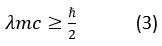
However, for h = cT in terms of time period T and light speed c, equation (3) reduces to the mass-time inequality3 as follows:

 | Table1: Comparison of least mass obtained in different methods with different variables. |
It is clear from the Table that the least mass ~5.98 ×10-74 kg may be the quantum mass. Approximately 36000 times the least mass created due to energy transformation during creation in the outer universe quantifies the masses in the inner universe.
Conclusions
Although there may be a minimum mass that quantizes every mass, no value of mass obtained in the present calculations is equal to the quantum mass claimed in reference (4) due to differences in the approaches used. In comparison, the earlier claimed masses are approximately 33439 and 9.3 times the masses obtained using the time periods of outer and inner universes, respectively while they are nearly 12.56 times the masses obtained in terms of the reduced Planck constant and cosmological constant values. The claimed mass is approximately 1.35 times the mass obtained at 13.8 billion years. However, the three masses are of the same order of magnitude with fewer differences. The mass obtained using the time period 8.64 G years is approximately 1.35 times the mass obtained with the reduced Planck constant. The mass values given in the Table make it clear that the quantum mass may lie somewhere in the mass range5.98 × 10-74 kg -7.37 × 10-51kg that quantifies discrete masses in the universe of size < 8.64 G ly. Except for energy, no mass form exists beyond the universe of size > 8.64 G ly. Due to the lack of experimental evidence and the unavailability of suitable instruments until recently, it was not possible to ascertain the correct value of the least mass. An in depth study may ensure the accuracy of the minimum mass in the future. In accordance with the charge-matter principle, wherever mass is present, there are electric charges. The present calculation also predicts the existence of an electric charge of an unknown value less than the electronic and quark charges.
Acknowledgement
The author is very thankful to the fellowmen and teachers for fruitful discussions and inspirations. He expresses very deep gratitude to his wife Archana Pandey and daughter Rashika Pandey for their encouragement and cooperation during the work.
Funding Sources
The author received no financial support for the research, authorship, and/or publication of this article.
Conflict of Interest
The author declares no conflict of interest in the article.
References
- Pandey R.K., Origin of Quantum Space-Time and Primordial Black Hole, Open Access Library Journal, 1, e688-e684, (2014). http://dx.doi.org/10.4236/oalib.1100688
- Pandey R.K., Quantum volume of discrete space and its growth rate, Journal of Physics & Astronomy, 3 (2), FP 71-FP 76, (2014).
- Pandey R.K., Fundamentals of Gravitoelectromagnetism, Lambert Academic Publishing, Saarbrücken, (2013).
- Sakurai J.J., Advanced Quantum Mechanics, Pearson, New York, US, (1967).
- Wesson P.S., Is Mass Quantized?, Modern Physics Letter, 19, 1995-2000, (2004). http://dx.doi.org/10.1142/S0217732304015270
- Zhdanov L.S., Physics for the Technician, Mir, Publishers, Moscow, (1980).
- Kaushik Ashok Ed, Shrimadbhagvad Gita, Star Publications, New Delhi, India, (1993).
- Bunker Ralph Tr, Brahma Puran, Vedic Literature Collection, Maharishi University of Management, (2020).
- Ved Vyas, Sri Vishnu Puran, Gita Press, Gorakhpur, UP, India, (2010).
- Prabhupada A.C., Tr, Srimadbhagvatam, the Bhaktivedanta Book Trust, Dai Nippon Printing Co., Ltd., Tokyo, Japan , (1974).
- Smale Alan, Astrophysics Science, NASA, US, (2017).
- Schiff L.I., Quantum Mechanics, McGraw Hill, US, (1981).

This work is licensed under a Creative Commons Attribution 4.0 International License.